
Microscope glass slides are essential laboratory consumables used in hospitals, diagnostic centers, research institutions, universities, and industrial laboratories worldwide. Although they look like simple pieces of transparent glass, their quality directly affects specimen preparation, microscopic imaging, staining performance, and diagnostic accuracy.
From blood smear analysis and histology testing to microbiology research and digital pathology scanning, a reliable microscope glass slide provides the stable, optically clear surface required for accurate observation. Poor-quality slides with inconsistent thickness, surface defects, or weak specimen adhesion can negatively affect image clarity, staining results, and laboratory efficiency.
Today, microscope glass slides are available in many specialized designs, including plain slides, frosted slides, positive charged slides, adhesion-coated slides, and low-autofluorescence slides. Different laboratories choose different slide types depending on their testing methods, specimen requirements, and workflow conditions.
For laboratories, distributors, and medical equipment suppliers purchasing microscope glass slides in bulk, understanding the differences between slide types, glass materials, dimensions, and manufacturing quality is essential. Choosing the right slide can improve testing consistency, reduce specimen loss, and support reliable laboratory operations.
This complete guide explains what microscope glass slides are, the different types available, their materials and sizes, common applications, and how to choose the right slides for your laboratory or business.
Table of Contents
- 1 Why Are Microscope Glass Slides Important?
- 2 Types of Microscope Glass Slides
- 3 What Materials Are Microscope Glass Slides Made Of?
- 4 Standard Microscope Glass Slide Sizes and Specifications
- 5 How Are Microscope Glass Slides Manufactured?
- 6 Common Applications of Microscope Glass Slides
- 7 Microscope Glass Slide vs Coverslip
- 8 How to Choose the Right Microscope Glass Slide
- 9 How to Buy Microscope Glass Slides in Bulk
- 10 Best Practices for Handling and Storing Microscope Glass Slides
- 11 Common Mistakes When Using Microscope Glass Slides
- 12 Why Manufacturing Quality Matters for Microscope Glass Slides
- 13 FAQs
- 13.1 What is the standard size of a microscope glass slide?
- 13.2 Are microscope glass slides reusable?
- 13.3 What is the difference between plain and frosted microscope slides?
- 13.4 Why are positive charged slides used in pathology?
- 13.5 Which material is best for microscope glass slides?
- 13.6 Can microscope glass slides be sterilized?
- 13.7 Are microscope glass slides sterile?
- 13.8 Can microscope glass slides be customized?
- 13.9 What edge finish is recommended for microscope slides?
- 13.10 How should microscope glass slides be stored?
- 14 Summary
Why Are Microscope Glass Slides Important?
A microscope can only provide accurate results when the specimen is properly prepared and mounted on a high-quality surface. This is the primary function of a microscope glass slide.
Unlike ordinary glass products, laboratory microscope slides are manufactured with strict requirements for optical performance, surface cleanliness, thickness consistency, and edge safety. The glass surface must remain flat and transparent so light can pass through the specimen evenly without distortion.
Even small imperfections, such as scratches, bubbles, uneven thickness, or contamination, may affect microscopic observation, especially under high magnification.
High-quality microscope glass slides provide several important advantages:
- Excellent optical clarity for accurate microscopic observation
- Uniform thickness for stable focusing and imaging
- Chemical resistance against common laboratory stains and reagents
- Heat resistance during fixation and staining procedures
- Smooth edges to improve laboratory safety
- Reliable specimen adhesion when using charged or coated surfaces
For pathology laboratories, specimen retention is especially important. Tissue sections often undergo multiple staining, washing, and chemical treatment steps. Without proper adhesion, samples may detach from ordinary slides, resulting in repeat testing, wasted materials, and potential delays in diagnosis.
This is why professional laboratories consider microscope slides as precision laboratory consumables rather than simple glass products.
Types of Microscope Glass Slides
Although all microscope slides serve the same basic purpose, different laboratory applications require different slide designs. Selecting the correct type helps improve specimen preparation, staining performance, and workflow efficiency.
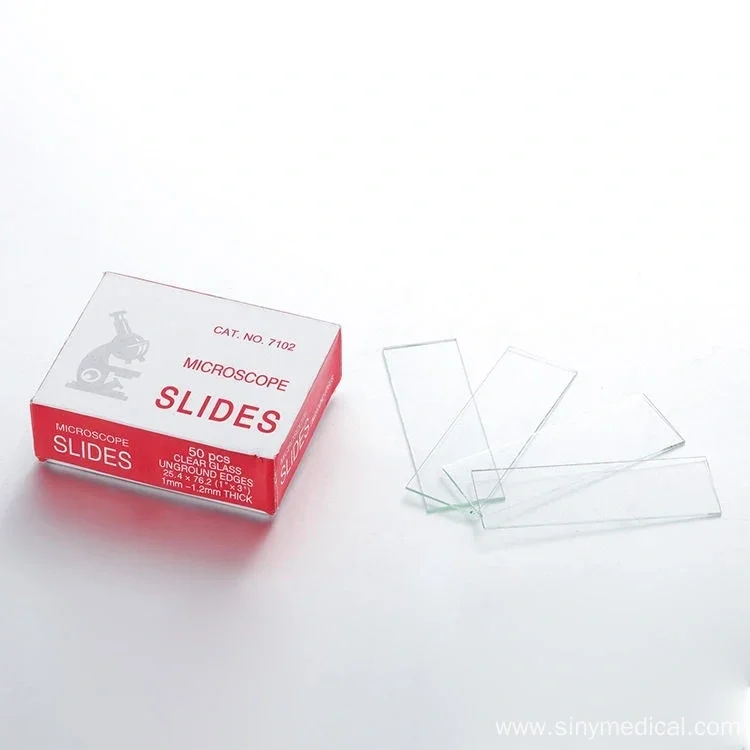
Standard Plain Microscope Slides (7101 & 7102)
Standard plain microscope slides are the most commonly used type in laboratories. They feature a smooth transparent surface without special coatings and are suitable for general microscopic examination.
Common options include:
7101 Microscope Slides
7101 slides usually feature ground edges, which help reduce the risk of cuts and minimize edge chipping during handling.
They are commonly selected for:
- Clinical laboratories
- Routine diagnostic testing
- Blood smear preparation
- Educational applications
- General microscopy
7102 Microscope Slides
7102 slides typically feature cut edges, providing a more economical option for laboratories with high-volume routine testing requirements.
They are widely used in:
- Teaching laboratories
- Basic research
- Routine sample observation
- General laboratory applications
Because of their versatility and cost efficiency, standard plain slides remain one of the most widely used microscope slide options worldwide.
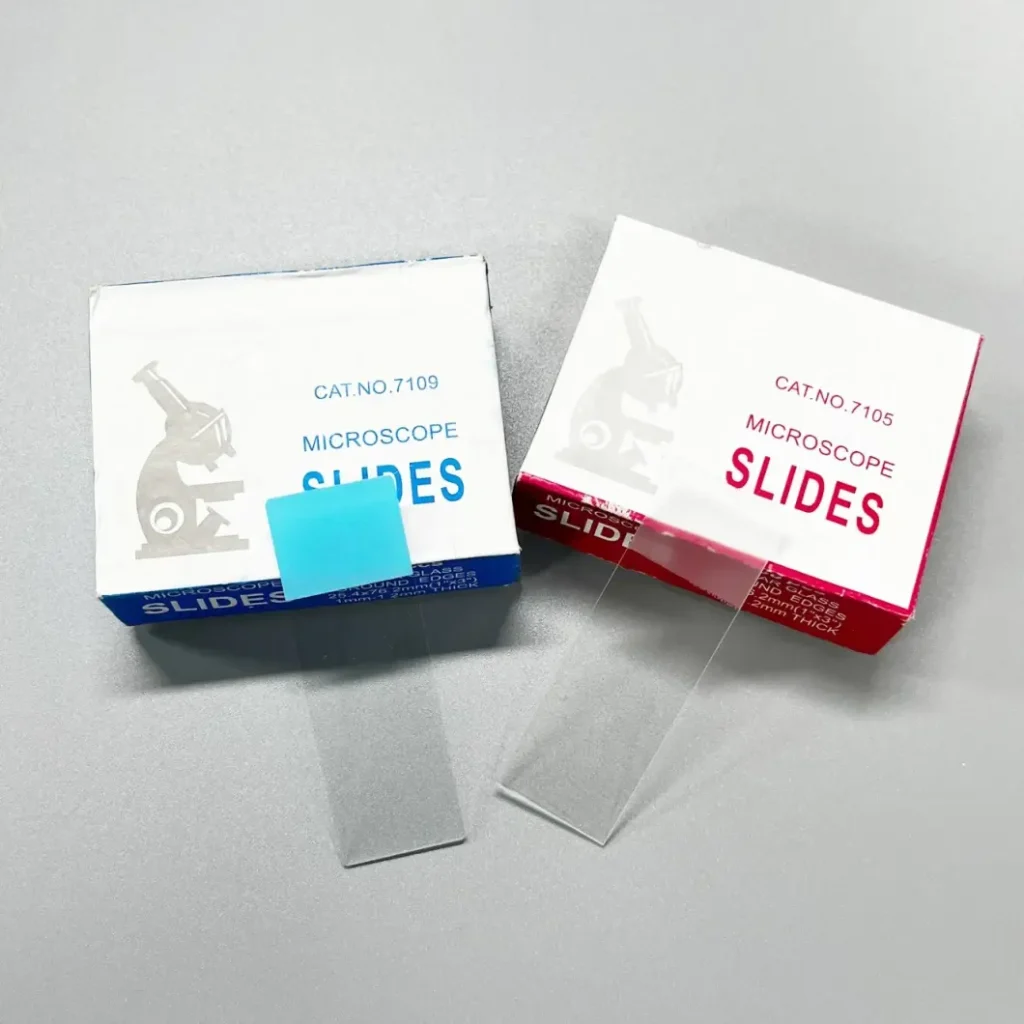
Frosted Microscope Slides (7105 & 7107)
Frosted microscope slides include a special writing area on one or both ends of the slide. This surface allows laboratory technicians to mark sample information directly onto the glass using laboratory markers or pencils.
Compared with external labels, frosted areas provide better resistance against:
- Moisture
- Solvents
- Laboratory stains
- Repeated handling
Common types include:
7105 Frosted Slides
7105 slides feature:
- Single frosted end
- Ground edges
- Convenient sample identification area
7107 Frosted Slides
7107 slides feature:
- Double frosted ends
- Ground edges
- Larger labeling area
Frosted slides are commonly used in:
- Clinical diagnostics
- Histology laboratories
- Pathology departments
- High-volume sample processing
They help reduce labeling errors and improve sample management efficiency.
Positive Charged Microscope Slides
Positive charged microscope slides are specially treated with a permanent positive surface charge. This surface improves the attachment of negatively charged biological specimens, especially tissue sections.
These slides are widely used for:
- Histology
- Pathology
- Immunohistochemistry (IHC)
- Molecular pathology
- In situ hybridization
- Automated staining systems
During complex laboratory procedures, tissue sections may experience repeated exposure to water, stains, and chemical solutions. Positive charged slides help maintain strong specimen attachment throughout these processes.
For this reason, they are often selected as professional histology slides and pathology slides in diagnostic laboratories.
Adhesion-Coated Microscope Slides
Adhesion-coated slides use specialized surface treatments to improve specimen retention. Common coatings include:
- Poly-L-lysine
- Silane coatings
- Other adhesion-enhancing treatments
These slides are suitable for delicate specimens that require additional support during laboratory processing.
Typical applications include:
- Frozen tissue sections
- Cytology samples
- Advanced staining procedures
- Research applications
Compared with untreated slides, adhesion-coated slides help reduce specimen loss during demanding laboratory workflows.
Concave (Well) Microscope Slides (7103 & 7104)
Concave microscope slides contain one or more shallow wells designed to hold liquid samples.
Common types include:
7103 Concave Slides
Features:
- Single concave well
- Ground edges
- Suitable for wet mount preparation
7104 Concave Slides
Features:
- Double concave wells
- Ground edges
- Suitable for multiple liquid specimens
These slides are commonly used for:
- Live microorganism observation
- Parasite examination
- Wet mount testing
- Crystal analysis
- Small-volume liquid samples
The recessed area helps prevent liquid spreading and keeps specimens concentrated during observation.
Color Frosted Microscope Slides
Color frosted microscope slides combine labeling convenience with visual organization.
Different colors can help laboratories identify:
- Departments
- Testing categories
- Research projects
- Sample priority levels
- Educational classifications
Although the colored area does not affect optical performance, it improves workflow organization in laboratories that process large numbers of samples every day.
What Materials Are Microscope Glass Slides Made Of?
The material used to manufacture microscope glass slides directly affects optical performance, durability, chemical resistance, and application suitability.
Different laboratories may choose different glass materials depending on their testing requirements.
Soda Lime Glass
Soda lime glass is the most commonly used material for microscope slides.
It provides a good balance between performance and cost, offering:
- Good optical transparency
- Stable dimensions
- Reliable surface quality
- Compatibility with common staining procedures
Because of its affordability and versatility, soda lime glass is widely used in:
- Hospitals
- Diagnostic laboratories
- Educational institutions
- Routine research applications
For general laboratory microscopy, soda lime glass remains the preferred choice for many users.
Super White Glass (Water White Glass)
Super white glass is a premium type of soda lime glass manufactured with extremely low iron content.
Compared with standard glass, it provides:
- Higher light transmission
- Better color accuracy
- Reduced green tint
- Lower optical interference
Super white glass is particularly suitable for:
- Digital pathology scanning
- Fluorescence microscopy
- High-resolution imaging
- Advanced research applications
When image quality and color accuracy are critical, many laboratories prefer super white microscope slides.
Borosilicate Glass
Borosilicate glass provides better thermal and chemical resistance compared with standard soda lime glass.
Its advantages include:
- Lower thermal expansion
- Higher heat resistance
- Improved chemical stability
It is often used in:
- Advanced research laboratories
- Specialized microscopy
- High-temperature procedures
- Chemical analysis applications
Quartz Glas
Quartz microscope slides are designed for highly specialized optical applications.
They offer:
- Excellent UV light transmission
- Extremely high chemical resistance
- Superior thermal stability
- Very low autofluorescence
Because of their higher cost, quartz slides are mainly used in advanced scientific research where maximum optical performance is required.
Standard Microscope Glass Slide Sizes and Specifications
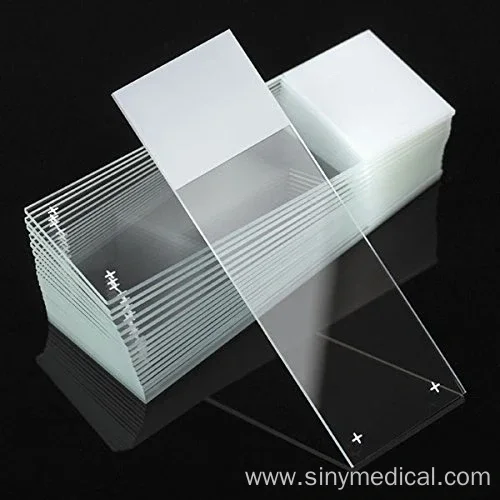
Most laboratories use standardized microscope glass slides that are compatible with conventional microscopes, automated staining systems, and digital scanning equipment.
Although different manufacturers may offer customized dimensions, the most common laboratory microscope slide size remains approximately 75 mm × 25 mm or 76 mm × 26 mm.
Common specifications include:
| Specification | Standard Range |
|---|---|
| Length | 75–76 mm |
| Width | 25–26 mm |
| Thickness | Approximately 1.0–1.2 mm |
| Surface Type | Plain, frosted, charged, or coated |
| Edge Finish | Cut edges, ground edges, or polished edges |
| Corner Style | 90-degree corners or clipped corners |
The consistency of these specifications is important because modern laboratories increasingly rely on automated equipment. Slides with uneven thickness, inaccurate dimensions, or poor edge finishing may cause problems such as:
- Incorrect microscope focusing
- Automated loading failures
- Scanner compatibility issues
- Increased breakage during handling
For high-volume laboratories, selecting microscope slides with strict dimensional control helps maintain stable workflow efficiency.
How Are Microscope Glass Slides Manufactured?
The quality of a microscope glass slide depends heavily on the manufacturing process. Professional manufacturers use controlled production procedures to ensure consistent optical performance, surface cleanliness, and mechanical strength.
Although manufacturing methods vary between suppliers, the general production process includes several key steps.
1. Glass Cutting
Large sheets of laboratory-grade glass are precisely cut into standard microscope slide dimensions.
During this stage, manufacturers control:
- Slide length and width accuracy
- Thickness consistency
- Cutting precision
Accurate cutting ensures compatibility with microscopes and automated laboratory equipment.
2. Edge Grinding and Polishing
After cutting, slide edges are processed according to the required specification.
Different edge finishes provide different benefits:
Ground edges
- Smoother and safer to handle
- Reduce the risk of cuts
- Lower the chance of edge chipping
Cut edges
- More economical
- Suitable for routine applications
Polished edges
- Provide premium surface quality
- Suitable for demanding laboratory environments
3. Cleaning and Surface Treatment
After mechanical processing, slides undergo intensive cleaning to remove:
- Glass particles
- Dust
- Oil residues
- Manufacturing contaminants
For specialized products, additional surface treatments may be applied, such as:
- Positive charging
- Adhesion coating
- Frosting
- Color coating
These treatments improve specimen attachment and laboratory usability.
4. Quality Inspection
Before packaging, microscope slides undergo quality checks to verify:
- Optical clarity
- Surface defects
- Thickness uniformity
- Edge quality
- Dimensional accuracy
High-quality inspection helps ensure that each slide performs consistently in clinical and research environments.
5. Packaging and Sterile Protection
Proper packaging protects slides from:
- Dust contamination
- Moisture exposure
- Breakage during transportation
Professional suppliers usually provide different packaging options depending on customer requirements, including:
- Laboratory boxes
- Plastic storage containers
- OEM customized packaging
For distributors and international buyers, reliable packaging is especially important because microscope glass slides are fragile products that require careful handling during shipping.
Common Applications of Microscope Glass Slides
Microscope glass slides are used in a wide range of industries, from medical diagnostics to scientific research. Different applications often require different slide designs and surface treatments.
Clinical Diagnostics
Clinical laboratories use microscope slides for routine diagnostic testing, including:
- Blood smear examination
- Urine sediment analysis
- Cytology testing
- Microbiological examination
High optical clarity and consistent surface quality help laboratory professionals obtain accurate microscopic images.
Histology and Pathology
Histology and pathology laboratories require reliable slide adhesion because tissue samples often undergo multiple processing steps.
Positive charged slides and adhesion-coated slides are commonly used for:
- Tissue section preparation
- Immunohistochemistry (IHC)
- Special staining procedures
- Digital pathology scanning
Strong specimen attachment helps prevent tissue loss during staining and improves diagnostic reliability.
Microbiology
Microbiology laboratories use microscope slides to examine:
- Bacteria
- Fungi
- Parasites
- Other microorganisms
A clean, transparent slide surface allows technicians to observe fine structures more clearly.
Research Laboratories
Universities, biotechnology companies, and pharmaceutical research centers use specialized microscope slides for:
- Cell culture studies
- Fluorescence microscopy
- Molecular biology research
- Experimental analysis
Applications involving advanced imaging often require premium materials such as super white glass, borosilicate glass, or quartz glass.
Education and Training
Educational institutions typically use standard plain microscope slides because they are:
- Affordable
- Easy to handle
- Suitable for repeated demonstrations
They are widely used in schools, universities, and training laboratories.
Veterinary and Food Testing Laboratories
Veterinary clinics and food safety laboratories also depend on microscope slides for:
- Parasite identification
- Microbial testing
- Quality control analysis
These applications require the same basic requirements as medical laboratories:
- Optical clarity
- Consistent dimensions
- Reliable surface quality

Microscope Glass Slide vs Coverslip
Microscope glass slides and coverslips are often used together, but they serve different functions.
| Feature | Microscope Glass Slide | Coverslip |
|---|---|---|
| Main Function | Supports the specimen | Covers and protects the specimen |
| Thickness | Approx. 1.0–1.2 mm | Approx. 0.13–0.17 mm |
| Standard Size | Usually 75 × 25 mm | Smaller sizes such as 18 × 18 mm or 22 × 22 mm |
| Material | Soda lime, super white, borosilicate, quartz | Thin optical glass |
| Application | Specimen mounting | Specimen protection and image improvement |
A microscope slide provides the foundation for specimen preparation, while a coverslip creates a protective optical layer above the sample.
Using a coverslip helps:
- Reduce evaporation of liquid samples
- Flatten specimens
- Improve image quality
- Protect microscope objectives from contamination
Choosing the correct combination of microscope glass slide and coverslip is important for achieving clear and accurate microscopic images.
How to Choose the Right Microscope Glass Slide
Selecting the correct microscope glass slide depends on the specimen type, testing method, and laboratory workflow.
For Routine Laboratory Testing
Standard plain slides are suitable for:
- General microscopy
- Educational use
- Routine sample observation
For laboratories prioritizing cost efficiency, standard 7101 and 7102 slides provide reliable performance.
For Histology and Pathology
Choose:
- Positive charged slides
- Adhesion-coated slides
These products improve tissue attachment and reduce specimen loss during complex staining procedures.
For Sample Identification and High-Volume Testing
Choose:
- Frosted microscope slides
- Color frosted slides
They provide convenient labeling areas and improve sample organization.
For Fluorescence and Digital Pathology
Choose:
- Super white glass slides
- Low-autofluorescence slides
- Borosilicate slides
These materials help reduce background interference and improve image accuracy.
For Automated Laboratory Systems
When using automated staining or scanning equipment, consider:
- Strict dimensional tolerance
- Uniform thickness
- Smooth edges
- Reliable packaging
Consistent manufacturing quality helps prevent equipment errors and improves laboratory efficiency.
How to Buy Microscope Glass Slides in Bulk
For hospitals, distributors, and laboratory suppliers, purchasing microscope glass slides in bulk requires more than comparing prices.
Important factors include:
Product Quality
Evaluate:
- Optical clarity
- Surface cleanliness
- Thickness consistency
- Edge quality
Manufacturing Capability
A reliable supplier should have:
- Stable production capacity
- Strict quality control systems
- Consistent batch performance
- Experience with international orders
Customization Options
Many distributors require customized solutions, such as:
- OEM packaging
- Private labeling
- Customized printing
- Special slide coatings
Certifications and Compliance
Medical laboratories and distributors should consider whether suppliers provide appropriate quality documentation, such as:
- ISO quality management systems
- Product compliance documents
- Export documentation
Supply Reliability
For large-volume buyers, a stable supply chain is essential.
A professional microscope slide manufacturer should provide:
- Consistent delivery schedules
- Reliable packaging
- Technical support
- Long-term cooperation capability
Choosing the right supplier helps laboratories maintain product consistency while reducing purchasing risks.
Best Practices for Handling and Storing Microscope Glass Slides
Proper storage helps maintain slide quality before use.
Recommended practices include:
- Store slides in a clean and dry environment.
- Keep slides inside original packaging until required.
- Avoid touching the optical surface directly.
- Use powder-free gloves for sensitive applications.
- Remove damaged slides immediately.
- Protect slides from humidity, dust, and sudden temperature changes.
Proper handling reduces contamination risks and helps maintain reliable laboratory performance.
Common Mistakes When Using Microscope Glass Slides
Even when laboratories use high-quality microscope glass slides, improper handling or incorrect product selection can still affect testing results. Avoiding common mistakes helps improve laboratory efficiency, reduce specimen loss, and maintain consistent microscopic observations.
Choosing the Wrong Slide Type
One of the most common mistakes is using a standard microscope slide for applications that require specialized surface treatment.
For example:
- Routine slides may not provide enough adhesion for histology samples.
- Untreated slides may cause tissue sections to detach during staining.
- Standard glass may not provide optimal imaging performance for fluorescence applications.
Selecting the correct slide type based on the specimen and testing method is essential for reliable results.
Touching the Optical Surface
Fingerprints, dust, and skin oils can affect specimen preparation and microscopic imaging.
When handling microscope slides:
- Hold slides by the edges whenever possible.
- Avoid touching the center observation area.
- Use gloves when preparing sensitive samples.
Keeping the surface clean helps prevent image distortion and contamination.
Using Damaged or Low-Quality Slides
Small scratches, chips, cracks, or uneven surfaces may influence microscope performance.
Poor-quality slides can cause:
- Reduced image clarity
- Uneven focusing
- Specimen preparation problems
- Increased risk of breakage
For clinical and research applications, consistent slide quality is especially important because even minor defects may affect analytical accuracy.
Incorrect Sample Labeling
Laboratories process large numbers of specimens every day. Poor labeling practices can create serious workflow problems.
Common issues include:
- Labels falling off during staining
- Incorrect sample identification
- Writing areas that are not resistant to solvents
Frosted microscope slides provide a practical solution by allowing permanent identification directly on the glass surface.
Improper Storage Conditions
Microscope glass slides should be stored in suitable conditions before use.
Exposure to:
- High humidity
- Dust
- Excessive temperature changes
- Chemical contamination
may affect slide cleanliness and usability.
Proper storage helps maintain optical quality and prevents slides from sticking together.
Why Manufacturing Quality Matters for Microscope Glass Slides
Although microscope glass slides from different suppliers may appear similar, manufacturing quality can vary significantly.
A reliable microscope slide manufacturer focuses on every production stage, from raw glass selection to final packaging.
Important quality factors include:
Optical Performance
High-quality slides should provide:
- Excellent transparency
- Minimal surface defects
- Consistent light transmission
- Reliable imaging performance
This is particularly important for pathology, fluorescence microscopy, and digital scanning applications.
Dimensional Accuracy
Precise dimensions ensure compatibility with:
- Microscopes
- Automated staining systems
- Slide scanners
- Laboratory storage systems
Consistent thickness and size reduce workflow interruptions.
Edge Safety and Durability
Professional microscope slides may use:
- Ground edges
- Polished edges
- Clipped corners
These designs improve handling safety and reduce breakage during laboratory operations.
Surface Cleanliness
Manufacturing processes should minimize:
- Dust particles
- Glass residue
- Oil contamination
- Surface imperfections
Clean slide surfaces support more reliable specimen preparation.
Packaging Reliability
Because microscope glass slides are fragile products, packaging quality directly affects delivery performance.
Professional packaging helps prevent:
- Breakage during transportation
- Moisture exposure
- Surface contamination
For international distributors and laboratories, stable packaging is an important part of product quality.
FAQs
What is the standard size of a microscope glass slide?
The most common microscope glass slide size is 75 mm × 25 mm (approximately 3 × 1 inches). Some manufacturers also provide 76 mm × 26 mm sizes depending on regional requirements and laboratory equipment compatibility.
The standard thickness is usually around 1.0–1.2 mm, allowing consistent focusing under most microscopes.
Are microscope glass slides reusable?
Some microscope slides can be reused after proper cleaning and sterilization. However, many medical and diagnostic laboratories prefer single-use slides to reduce contamination risks and maintain consistent testing conditions.
For clinical applications, disposable microscope glass slides are generally recommended.
What is the difference between plain and frosted microscope slides?
Plain microscope slides have a completely transparent surface and are mainly used for general microscopy.
Frosted microscope slides include a special marking area that allows laboratory staff to write sample information directly on the slide.
The main differences are:
| Feature | Plain Slides | Frosted Slides |
|---|---|---|
| Surface | Fully transparent | Transparent with frosted labeling area |
| Main Use | General microscopy | Sample identification and clinical testing |
| Labeling | Requires external labels | Direct writing on glass |
| Common Applications | Education, routine testing | Hospitals, pathology laboratories |
Why are positive charged slides used in pathology?
Positive charged microscope slides improve specimen attachment by creating a surface that attracts negatively charged tissue sections and cells.
They are commonly used in:
- Histology
- Immunohistochemistry
- Molecular pathology
- Special staining procedures
Their strong adhesion helps prevent tissue loss during repeated washing and staining steps.
Which material is best for microscope glass slides?
The best material depends on the application.
- Soda lime glass: Suitable for routine laboratory use and general microscopy.
- Super white glass: Recommended for high-resolution imaging and digital pathology.
- Borosilicate glass: Suitable for applications requiring higher thermal and chemical resistance.
- Quartz glass: Used for advanced research requiring UV transmission and extremely low autofluorescence.
There is no single material that is best for every application. Laboratories should choose based on their specific testing requirements.
Can microscope glass slides be sterilized?
Yes, microscope glass slides can generally be sterilized using appropriate laboratory methods.
However, laboratories should consider:
- Slide coating type
- Intended application
- Manufacturer recommendations
Some specialized coated slides may require specific handling procedures to maintain surface performance.
Are microscope glass slides sterile?
Standard microscope glass slides are usually supplied as clean laboratory consumables rather than sterile medical devices.
If sterile slides are required for a specific application, buyers should confirm sterilization requirements with the manufacturer before purchase.
Can microscope glass slides be customized?
Yes. Many manufacturers provide customized microscope glass slides for distributors, laboratories, and OEM customers.
Customization options may include:
- Logo printing
- Customized packaging
- Frosted area design
- Special coatings
- Product labeling
OEM customization is especially valuable for medical distributors developing their own laboratory product lines.
What edge finish is recommended for microscope slides?
The best edge finish depends on the application.
Ground edges:
- Safer handling
- Reduced cutting risk
- Suitable for clinical laboratories
Cut edges:
- Lower cost
- Suitable for education and routine applications
Polished edges:
- Premium finish
- Suitable for advanced laboratory environments
How should microscope glass slides be stored?
Microscope slides should be stored in a clean, dry environment away from dust, moisture, and direct sunlight.
Recommended storage practices include:
- Keep slides inside original packaging.
- Avoid excessive humidity.
- Prevent exposure to chemicals.
- Handle slides with clean gloves when necessary.
Proper storage helps maintain slide quality until use.
Summary
Microscope glass slides are essential laboratory consumables that support accurate specimen preparation, microscopic observation, and diagnostic workflows. Although they appear simple, factors such as glass material, surface treatment, dimensions, and manufacturing quality have a direct impact on laboratory performance.
From standard plain slides used for routine microscopy to positive charged slides designed for advanced pathology applications, choosing the correct microscope glass slide helps laboratories improve efficiency, reduce specimen loss, and achieve more reliable results.
For hospitals, laboratories, distributors, and research organizations, working with an experienced microscope slide manufacturer is equally important. A dependable supplier can provide consistent quality, stable production capacity, customized packaging, and professional technical support.
At Siny Medical, we manufacture a wide range of microscope glass slides for global healthcare and laboratory markets, including:
- Plain microscope slides (7101 / 7102)
- Frosted microscope slides (7105 / 7107)
- Concave microscope slides (7103 / 7104)
- Positive charged microscope slides
- Customized OEM microscope slide solutions
With strict quality management systems, advanced manufacturing processes, and experience serving international customers, Siny Medical helps laboratories and distributors obtain reliable microscope glass slides with consistent performance.
If you are looking for a trusted microscope glass slide supplier or need customized OEM solutions for your laboratory business, contact Siny Medical to discuss your requirements.