| Specification | Details |
|---|---|
| Product Name | Hospital disposable plastic 1.5ml Centrifuge Tube |
| Product Category | Microcentrifuge Tube |
| Nominal Capacity | 1.5ml |
| Material | Polypropylene (PP) |
| Graduation | Graduated |
| Cap Design | Attached Lid |
| Intended Use | Disposable Laboratory Sample Handling |
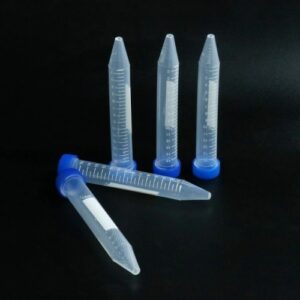
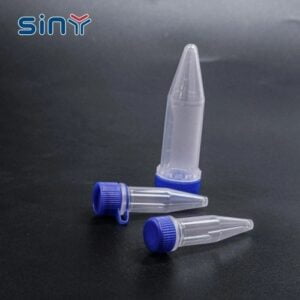
The Hospital Disposable Plastic 1.5ml Centrifuge Tube is a polypropylene (PP) microcentrifuge tube designed for handling small-volume samples in hospital and laboratory environments. Its 1.5ml nominal capacity provides a practical format for sample preparation, liquid transfer, mixing, and compatible centrifugation procedures.
The tube features graduation markings and an attached lid, allowing laboratory personnel to handle small liquid quantities and keep the closure connected to the tube during use. Its compact design also supports workflows that involve multiple samples or limited bench space.
Unlike larger centrifuge tubes, this 1.5ml format focuses on small-volume laboratory procedures. It is suitable for workflows where users need a compact sample container rather than a 10ml, 15ml, or 50ml tube.
Siny Medical supplies 1.5ml plastic centrifuge tubes for hospitals, diagnostic laboratories, research facilities, and medical consumables distributors.
The tube has a nominal capacity of 1.5ml, making it suitable for small-volume laboratory samples.
This size helps laboratory personnel prepare and process limited quantities of liquid without using larger containers.
However, nominal capacity does not necessarily represent the maximum recommended fill volume during centrifugation. Users should follow the selected product’s operating instructions.
The tube is made from polypropylene, a lightweight plastic commonly used in laboratory consumables.
PP provides useful resistance to many routine laboratory reagents and handling conditions. Nevertheless, chemical compatibility depends on the reagent, concentration, temperature, and exposure time.
Before using aggressive solvents or specialized chemicals, laboratories should verify the tube’s compatibility.
The tube includes graduation markings that help users estimate liquid volume during sample preparation.
These markings can support routine pipetting and sample handling.
However, graduated microcentrifuge tubes are not substitutes for calibrated volumetric measuring instruments when precise liquid measurement is required.
An attached lid keeps the closure connected to the tube body during opening and closing.
This arrangement can help reduce the chance of misplacing the lid during repeated pipetting or sample preparation.
The lid also helps contain the sample during routine handling when properly closed.
However, the attached closure does not automatically establish leakproof or aerosol-tight performance.
The small tube body fits workflows involving limited sample quantities.
For example, hospital laboratories may use compatible 1.5ml tubes for preparing small aliquots, handling liquid samples, or collecting separated material.
Before centrifugation, users must confirm compatibility with their rotor and operating conditions.
A 1.5ml microcentrifuge tube supports various small-volume sample-handling procedures.
Hospital laboratories often prepare small liquid samples before analysis.
A compact centrifuge tube can provide a convenient container for compatible sample preparation steps, including mixing and transferring liquids.
However, clinical specimen handling must follow the laboratory’s validated procedures and the requirements of the intended assay.
Aliquoting involves dividing a sample into smaller portions for testing or processing.
A 1.5ml tube may be useful when laboratory personnel need to transfer a small quantity of a compatible sample into a separate container.
Appropriate labeling and contamination-control procedures remain essential.
Compatible 1.5ml tubes can be used for centrifugation procedures involving small liquid volumes.
During centrifugation, suspended particles may sediment toward the bottom of the tube.
Laboratory personnel can then separate the supernatant or recover the pellet according to their procedures.
However, users must verify the selected tube’s maximum relative centrifugal force (RCF) before use.
Laboratories may use 1.5ml tubes to prepare small reagent mixtures, buffers, or other compatible solutions.
The attached lid supports convenient access during repeated pipetting steps.
Nevertheless, the tube material must be compatible with the reagents and processing conditions.
Research laboratories and diagnostic facilities commonly use small-volume tubes during specimen preparation.
A 1.5ml format may support selected protein, nucleic acid, or other biological sample preparation workflows.
However, sensitive assays may require verified purity characteristics, such as DNase-free or RNase-free status. These properties should not be assumed from the tube’s material or capacity.
The main advantage of a 1.5ml centrifuge tube is its compact format for procedures that do not require larger sample containers.
When a procedure involves a relatively small amount of liquid, a 1.5ml tube provides an appropriately sized container.
This can help users organize samples without unnecessarily large tubes.
However, the correct choice depends on the required sample volume and processing steps.
The attached lid allows laboratory personnel to open the tube and access its contents without managing a separate closure.
This may be helpful during reagent addition, sample mixing, or repeated liquid transfers.
The 1.5ml format is commonly used with laboratory microcentrifuges and compatible tube racks.
However, nominal capacity alone does not guarantee that a tube will fit every rotor or rack.
Users should confirm the tube dimensions and equipment compatibility before use.
| Feature | 0.5ml Microcentrifuge Tube | 1.5ml Microcentrifuge Tube | 15ml Centrifuge Tube |
|---|---|---|---|
| Nominal Capacity | 0.5ml | 1.5ml | 15ml |
| Typical Selection Reason | Very small samples | Small-volume sample processing | Larger-volume sample preparation |
| General Format | Microcentrifuge tube | Microcentrifuge tube | Laboratory centrifuge tube |
| Equipment Consideration | Verify rotor compatibility | Verify rotor compatibility | Verify rotor or adapter compatibility |
These are general laboratory format comparisons, not a claim that all listed sizes belong to the same product model.
Hospitals and laboratory distributors should consider the tube’s physical design, sample compatibility, and intended operating conditions.
Choose a 1.5ml tube when its nominal capacity suits the intended procedure.
Consider the sample volume, any reagents to be added, and the space needed for mixing.
Do not exceed the recommended working volume for the selected application.
Before centrifugation, confirm that the tube fits the intended microcentrifuge rotor or adapter.
Also check that the lid does not interfere with the equipment.
Correct positioning helps reduce the risk of tube damage during operation.
Relative centrifugal force describes the force applied to a sample during centrifugation.
The maximum permitted RCF depends on the tube’s construction and operating conditions.
Therefore, users should follow the selected model’s documented limits rather than assume a universal rating for 1.5ml PP tubes.
Polypropylene is suitable for many routine laboratory reagents, but not every chemical.
Laboratories should consider reagent concentration, exposure time, and temperature before use.
Specialized procedures may require additional compatibility verification.
Some hospital laboratory procedures require sterile consumables or tubes with specific purity characteristics.
Buyers should confirm these properties from the product labeling and documentation.
An attached lid or disposable PP construction does not, by itself, establish sterile status.
Temperature requirements vary between laboratory workflows.
Some procedures involve refrigeration or freezing, while others involve heating.
Users should not assume that every 1.5ml centrifuge tube is suitable for autoclaving, boiling, or PCR thermal cycling.
Check the tube body and lid for visible damage.
Ensure that the lid closes correctly and that the tube is suitable for the intended procedure.
When centrifuging samples, balance the rotor correctly and follow the equipment manufacturer’s instructions.
After use, dispose of the tube according to the sample contents and applicable laboratory waste procedures.
It is used for handling and processing small liquid samples in laboratory workflows. Applications may include sample preparation, aliquoting, reagent mixing, and compatible centrifugation.
The tube is made from polypropylene (PP), a plastic commonly used in laboratory consumables.
Yes. The listed 1.5ml configuration includes graduation markings for approximate volume reference during sample handling.
Yes. The listed 1.5ml configuration features an attached lid that remains connected to the tube body during use.
The original page contains conflicting sterilization information. Buyers should verify the sterile status and sterilization method of the selected product configuration before use.
Only if the selected model is rated for the intended RCF. Users must confirm the tube’s operating limits and rotor compatibility.
A 1.5ml tube may be used for compatible sample preparation steps, but PCR thermal cycling requires a tube specifically validated for the intended temperature program and instrument.
Hospitals should verify material, nominal capacity, lid design, graduation markings, centrifuge compatibility, maximum RCF, sterile status, packaging, and any required sample purity specifications.
Siny Medical supplies laboratory consumables for hospitals, diagnostic laboratories, research facilities, and medical distributors. Our Hospital Disposable Plastic 1.5ml Centrifuge Tube provides a compact polypropylene format with graduation markings and an attached lid for small-volume sample handling. Contact Siny Medical to discuss product specifications, purchasing requirements, and quotation details.
Copyright © 2026 | Ningbo Siny Medical Technology Co., Ltd