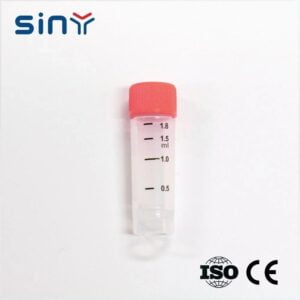
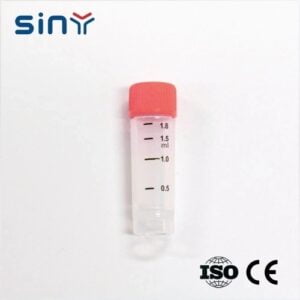
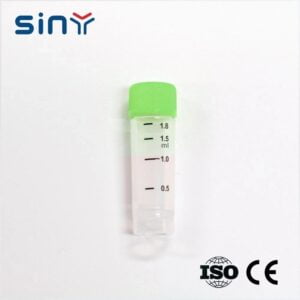
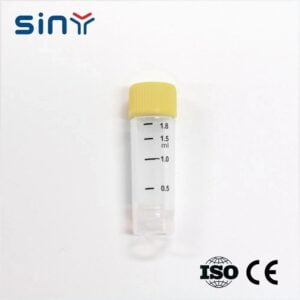
| Specification | Details |
|---|---|
| Product Name | Cryogenic Cryotube Cryovial Tubes External Thread |
| Product Type | External Thread Cryogenic Vial |
| Material | Polypropylene (PP) |
| Capacity | 1.8ml / 5ml |
| Cap Type | External Screw Cap |
| Graduation | Yes |
| Sterility | Non-Sterile |
| Temperature Range | -196°C to 121°C |
| OEM/ODM | Available |
Siny Medical offers Cryogenic Cryotube Cryovial Tubes External Thread for biological sample preservation and laboratory cryogenic storage. Made from polypropylene (PP), these cryovials feature an external screw cap design that supports convenient sample handling and secure closure.
Our external thread cryogenic vials are available in 1.8ml and 5ml capacities. Both sizes include graduation markings, making them practical for preparing and organizing biological samples. In addition, available silicone sealing ring configurations support different laboratory storage requirements.
The tubes have a listed temperature range of -196°C to 121°C. Their polypropylene construction and threaded closure make them suitable for compatible ultra-low-temperature storage applications, including appropriately validated liquid nitrogen vapor-phase workflows.
The external thread is an important feature of this product. By positioning the threads outside the tube opening, the design helps reduce accidental contact between the sample and threaded surfaces during routine handling.
Siny Medical supplies cryogenic storage consumables to research institutions, biotechnology laboratories, biobanks, hospitals, and international medical distributors. Our products support practical sample preservation and laboratory inventory management.
The external screw cap is the main structural feature of this cryogenic vial.
Unlike internal-thread containers, external-thread cryovials have threads positioned outside the tube opening. The cap engages with the exterior threaded section.
This arrangement helps reduce direct contact between biological samples and the threads during opening and closing.
As a result, it offers a practical advantage during sample preparation, transfer, and retrieval.
The external screw cap also provides a convenient closure mechanism for routine laboratory use. Technicians can handle samples while following established contamination-control procedures.
For laboratories processing multiple specimens, a suitable closure design is an important part of an organized workflow.
Siny Medical offers cryovial configurations with silicone sealing rings.
The sealing ring supports the connection between the cap and vial body. It helps maintain the intended closure performance during compatible handling and storage.
Our 1.8ml configuration includes a sealing ring. Meanwhile, the 5ml range includes versions with and without sealing rings.
These options give laboratories greater flexibility when selecting cryogenic storage containers.
The appropriate configuration depends on the sample, storage method, and containment requirements.
Our cryogenic tubes are made from polypropylene, a widely used material in laboratory consumables.
PP offers lightweight construction and useful resistance to many common laboratory reagents.
It also supports practical handling during sample preparation and storage.
Suitable polypropylene formulations can perform under ultra-low-temperature conditions. The complete vial assembly, including its cap and sealing components, determines its compatibility with the intended storage system.
For laboratories managing large sample collections, polypropylene cryovials provide a convenient storage container format.
Siny Medical supplies external-thread cryogenic tubes in 1.8ml and 5ml capacities.
The 1.8ml format is useful for smaller biological sample aliquots. Laboratories can use this size to organize specimens into individual portions for future research.
The 5ml format provides additional space for larger preparations.
Both capacities include graduation markings for convenient volume observation.
These options help laboratories choose suitable storage containers according to their sample quantities and workflow requirements.
Our cryogenic tubes have a listed temperature range of -196°C to 121°C.
They are designed for cryogenic sample storage applications, including compatible ultra-low-temperature freezer and liquid nitrogen vapor-phase workflows.
These storage methods are widely used in biological research and sample preservation.
The selected vial should match the intended storage equipment and procedure. Direct liquid-phase nitrogen immersion requires specific product validation and is not established by the temperature rating alone.
Both available capacities feature graduation markings.
These markings help technicians estimate liquid volumes during sample preparation.
For example, laboratory personnel can use them as a visual reference when preparing aliquots or transferring compatible specimens.
Graduations also support organized sample handling when multiple tubes are processed.
For precise volume measurement, calibrated laboratory instruments remain the appropriate choice.
The listed external-thread cryovials are supplied non-sterile.
They are suitable for laboratory procedures that do not require sterile containers.
For applications involving aseptic sample preparation, laboratories should select appropriately specified sterile consumables.
This distinction helps purchasing teams match the product to their actual laboratory requirements.
Cryogenic tubes are widely used to preserve biological specimens under controlled low-temperature conditions.
Our external-thread cryovials provide containers for compatible biological preparations during freezing, storage, and retrieval.
The external screw cap helps reduce contact between the sample and threaded surfaces during handling.
In addition, the available capacities support different specimen volumes.
These features make the tubes useful for research laboratories that regularly prepare and organize biological samples.
Cell preservation is an important application of cryogenic storage containers.
Researchers prepare cell suspensions and transfer them into suitable cryovials before freezing.
The 1.8ml format can support smaller aliquots, while the 5ml format provides additional capacity.
A suitable cryovial forms part of the complete cryopreservation system.
The preservation protocol also determines the required cryoprotectant, freezing rate, storage conditions, and thawing procedure.
Microbiology laboratories maintain collections of compatible microbial preparations for future research.
Cryogenic tubes help organize these materials within suitable storage systems.
The external-thread design provides a practical closure arrangement during sample handling.
Meanwhile, graduation markings offer an approximate volume reference.
These characteristics support routine sample preparation and laboratory organization.
Biobanks often manage large collections of biological specimens.
Reliable sample organization helps laboratory personnel locate materials and maintain accurate records.
Cryogenic vials provide individual containers for prepared specimens.
External screw caps support routine handling, while compatible labels and storage racks help organize sample inventories.
The available 1.8ml and 5ml capacities also allow biobanks to accommodate different sample quantities.
Biotechnology laboratories regularly prepare and store biological materials for experimental work.
These may include cell-based research samples, compatible biological preparations, and laboratory specimens.
Our external-thread cryogenic tubes provide a practical container format for selected preservation procedures.
Their polypropylene construction, graduated bodies, and screw cap design support routine sample handling.
Research projects may require samples to remain available for future analysis.
Cryogenic storage helps laboratories preserve suitable materials under controlled conditions.
A well-organized storage system combines appropriate containers, labeling, temperature monitoring, and inventory records.
Siny Medical external-thread cryovials support these workflows by providing convenient containers for compatible specimen storage.
Cryogenic vials are available with different threaded closure designs.
The two common configurations are external-thread and internal-thread cryovials.
Understanding their differences helps laboratories select suitable containers for sample handling.
An external-thread cryovial has threads located outside the tube opening.
The screw cap engages with the exterior threaded section.
This design helps reduce accidental contact between the sample and threaded surfaces during normal handling.
It is particularly useful when laboratories prioritize convenient sample access and organized handling procedures.
However, effective contamination control still depends on appropriate laboratory techniques.
An internal-thread cryovial has threads positioned inside the tube opening.
The cap engages with the internal threaded section.
Some internal-thread designs use additional sealing components to support closure performance.
Both thread arrangements can be suitable for cryogenic storage when the complete vial design meets the intended application requirements.
| Feature | External Thread Cryovial | Internal Thread Cryovial |
|---|---|---|
| Thread Position | Outside the tube opening | Inside the tube opening |
| Cap Engagement | External threaded section | Internal threaded section |
| Sample Contact With Threads | Reduced during normal handling | Depends on closure design and handling |
| Sealing Performance | Depends on complete closure | Depends on complete closure |
| Typical Selection Focus | Convenient sample handling | Closure configuration and workflow |
| Cryogenic Storage | Requires suitable validated conditions | Requires suitable validated conditions |
The right design depends on the laboratory workflow.
External-thread cryovials offer a practical option when reducing sample contact with threaded surfaces is important.
Internal-thread cryovials provide an alternative closure arrangement for compatible storage procedures.
For applications requiring specific containment performance, the complete cap and sealing design should guide product selection.
Siny Medical’s external-thread cryogenic tube range focuses on convenient handling, graduated sample containers, and available sealing ring configurations.
Start with the required sample volume.
Siny Medical offers 1.8ml and 5ml external-thread cryovials.
The smaller size is useful for individual aliquots. The larger size provides additional space for compatible biological preparations.
Laboratories should also consider the recommended working volume during freezing.
The external-thread design helps reduce sample contact with the threaded area.
This can be useful during routine preparation and retrieval.
When comparing cryovials, buyers should consider cap handling, compatibility with their procedures, and the complete closure design.
Siny Medical offers configurations with silicone sealing rings.
The 5ml range also includes a version without a sealing ring.
These options support different purchasing requirements.
Buyers should select a configuration that matches their storage and containment needs.
Cryogenic vials may be used in ultra-low-temperature freezers or suitable liquid nitrogen storage systems.
The listed temperature range is -196°C to 121°C.
For liquid nitrogen applications, buyers should distinguish vapor-phase storage from direct liquid-phase immersion.
The selected configuration must be suitable for the intended method.
Graduation markings help technicians estimate sample volumes.
Both available capacities include these markings.
They are useful during sample preparation, aliquoting, and routine handling.
Precise measurements should still be performed with calibrated equipment.
Our listed external-thread cryovials are non-sterile.
They provide a practical option for laboratory procedures that do not require sterile containers.
For aseptic workflows, buyers should select products with verified sterile status.
Packaging quantity is important for laboratories and distributors.
Siny Medical lists 500 pieces per bag for the 1.8ml configuration.
The 5ml configurations are listed at 200 pieces per bag.
These quantities help purchasing teams organize stock levels and procurement schedules.
Laboratory buyers need clear product information and consistent supply arrangements.
Important considerations include capacity, sealing configuration, packaging, and intended storage conditions.
Siny Medical supports international laboratory consumables procurement and OEM/ODM discussions.
Our product range helps distributors and laboratories select practical solutions for different sample storage requirements.
They are used to store compatible biological specimens under low-temperature conditions. Common applications include cell preservation, microbiology research, and biobanking.
External threads are positioned outside the tube opening. This helps reduce contact between the sample and threaded surfaces during routine handling.
Our external-thread cryogenic vials are available in 1.8ml and 5ml capacities.
Yes. The 1.8ml configuration includes a sealing ring. The 5ml range includes versions with and without sealing rings.
The listed products are supplied non-sterile.
They have a listed temperature range of -196°C to 121°C and are intended for compatible cryogenic storage applications. Direct liquid-phase immersion requires specific validation.
Yes. Both the 1.8ml and 5ml configurations include graduation markings.
The 1.8ml configuration is packaged at 500 pieces per bag. The 5ml configurations are packaged at 200 pieces per bag.
Siny Medical supplies laboratory consumables for research institutions, biotechnology laboratories, hospitals, biobanks, and medical distributors worldwide. Our Cryogenic Cryotube Cryovial Tubes External Thread range combines polypropylene construction, external screw caps, graduated bodies, and sealing ring options for compatible biological sample storage. Contact Siny Medical to discuss available configurations, OEM/ODM requirements, bulk purchasing, and quotation details.
Copyright © 2026 | Ningbo Siny Medical Technology Co., Ltd