| Specification | Details |
|---|---|
| Product Name | Cryovial Tube Cryo Tube for Labs |
| Product Type | Cryogenic Storage Tube |
| Material | Polypropylene (PP) |
| Capacity | 1.8ml / 5ml |
| Temperature Range | -196°C to 121°C |
| Sterility | Non-Sterile |
| Graduation | Yes |
| OEM/ODM | Available |
Siny Medical supplies Cryovial Tube Cryo Tube for Labs for biological sample preparation, freezing, and laboratory storage. Made from polypropylene (PP), these tubes offer a practical solution for research laboratories, biotechnology facilities, hospitals, and biobanks.
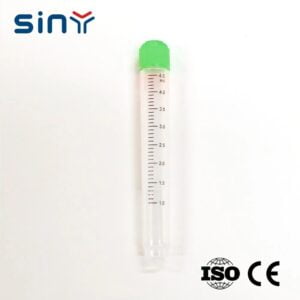
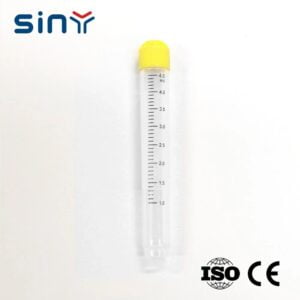
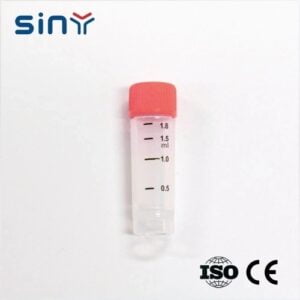
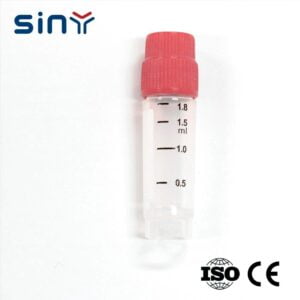
Our cryovial tubes for labs are available in 1.8ml and 5ml capacities. Both sizes feature graduation markings for convenient volume observation. In addition, available silicone sealing ring configurations support different sample storage requirements.
The tubes have a listed temperature range of -196°C to 121°C. Their lightweight construction and convenient screw cap design make them useful for compatible ultra-low-temperature storage procedures.
Cryogenic tubes play an important role in modern laboratories. They help researchers prepare individual sample aliquots, organize biological specimens, and manage stored materials efficiently.
As a laboratory consumables supplier, Siny Medical provides practical cryogenic storage products for distributors and institutional buyers. Our available capacity and sealing options help customers select suitable containers for their laboratory workflows.
Our cryovial tubes are made from polypropylene, a widely used material in laboratory consumables.
PP combines lightweight construction with useful resistance to many common laboratory chemicals. As a result, it offers practical handling advantages during sample preparation and storage.
In addition, suitable polypropylene formulations can perform under ultra-low-temperature conditions. This makes PP a common material for cryogenic sample containers.
The lightweight design also supports convenient handling when laboratories process large numbers of specimens.
Siny Medical offers two practical capacities: 1.8ml and 5ml.
The 1.8ml format is suitable for smaller sample aliquots. For example, researchers can divide one biological preparation into individual portions for future experiments.
Meanwhile, the 5ml format provides additional space for larger sample quantities. It is useful when laboratories need to store more material in a single container.
Both capacities support efficient sample organization. Therefore, buyers can choose a suitable size according to their storage procedures and specimen volumes.
Our cryogenic tubes have a listed temperature range of -196°C to 121°C.
They support compatible low-temperature sample preservation workflows, including suitable ultra-low-temperature freezer and liquid nitrogen vapor-phase storage applications.
These storage environments are commonly used in biological research, cell preservation, and laboratory sample banking.
The polypropylene construction provides a practical container format for selected freezing procedures.
For direct liquid nitrogen immersion, laboratories must use a container specifically validated for that method.
Both available capacities feature graduation markings.
These markings provide a convenient visual reference during sample preparation and transfer. For example, technicians can estimate liquid volumes before placing tubes into storage.
Graduated bodies also support consistent sample handling when laboratories prepare multiple aliquots.
For precise liquid measurements, calibrated pipettes remain the appropriate choice.
Cryogenic tubes use threaded caps to support routine sample handling and storage.
The screw cap allows laboratory personnel to open and close containers during preparation and retrieval.
In addition, a suitable closure helps maintain organized workflows when technicians process multiple specimens.
Different cryovial designs may use internal or external threads. The appropriate configuration depends on the selected product and laboratory requirements.
Our cryogenic tube range includes configurations with silicone sealing rings.
The sealing ring supports the connection between the cap and tube body. As a result, it contributes to the intended closure performance during compatible storage procedures.
The 1.8ml configuration includes a sealing ring. Meanwhile, the 5ml range offers versions with and without sealing rings.
These options allow laboratories to select a suitable configuration for their sample handling needs.
The listed cryogenic tubes are supplied non-sterile.
They provide a practical storage solution for laboratory procedures that do not require sterile containers.
For aseptic workflows, laboratories should select products with verified sterile status.
Biological sample preparation is one of the main applications of cryovial tubes.
Research laboratories use these containers to organize specimens before freezing and preservation. The available capacities allow technicians to prepare individual aliquots according to sample volume.
For example, a laboratory may divide one preparation into several tubes for separate experiments.
This approach helps researchers organize specimens and reduces unnecessary handling of larger stored samples.
Cell culture laboratories often preserve prepared cell suspensions for future research.
Cryogenic tubes provide containers for compatible samples during freezing and storage.
The 1.8ml format supports smaller aliquots, while the 5ml format accommodates larger preparations.
In addition, organized sample storage helps researchers manage cell collections across different projects.
Successful cell preservation also requires suitable cryoprotectants, freezing conditions, and thawing procedures.
Microbiology laboratories maintain collections of compatible microbial preparations.
Cryovial tubes help technicians organize these materials within suitable storage systems.
For example, samples can be arranged according to strain identification, experiment, or preparation date.
Graduation markings also provide a useful reference during liquid sample preparation.
As a result, cryogenic tubes support efficient specimen handling and laboratory organization.
Biobanks often manage large collections of biological specimens.
Cryogenic tubes provide individual containers for prepared samples. In addition, suitable labels and inventory records help laboratories identify and retrieve stored materials.
The 1.8ml and 5ml capacities accommodate different sample quantities.
Therefore, laboratories can organize collections according to their research and storage requirements.
Biotechnology laboratories use cryogenic containers for various research activities.
These may include cell-based experiments, biological sample preparation, and storage of compatible laboratory specimens.
Our PP cryovials provide lightweight containers for selected preservation procedures.
Their graduation markings and screw cap design also support convenient handling during routine laboratory operations.
Some research projects require biological materials to remain available for future analysis.
Cryogenic storage supports the preservation of suitable specimens under controlled conditions.
An effective sample archive combines appropriate containers, clear identification, temperature monitoring, and inventory records.
Cryovial tubes support this process by providing convenient containers for organized sample collections.
Choosing the right cryovial helps laboratories manage samples efficiently.
Capacity, closure design, and storage conditions are important factors in product selection.
The 1.8ml format is suitable for smaller biological sample quantities.
Researchers can use this capacity to prepare individual aliquots for future experiments. It also supports organized sample distribution across different research projects.
The listed 1.8ml configuration includes graduation markings and a sealing ring.
For laboratories handling small-volume specimens, this format provides a convenient storage option.
The 5ml format provides additional capacity for larger biological preparations.
It is useful when laboratories need to store greater sample quantities in a single container.
Siny Medical offers 5ml configurations with and without sealing rings. Both options include graduation markings.
As a result, buyers can choose a suitable configuration according to their sample storage requirements.
| Feature | 1.8ml Cryovial | 5ml Cryovial |
|---|---|---|
| Capacity | 1.8ml | 5ml |
| Material | Polypropylene (PP) | Polypropylene (PP) |
| Graduation | Yes | Yes |
| Sealing Ring | Included | With or without |
| Typical Application | Smaller aliquots | Larger preparations |
| Packaging | 500 pcs/bag | 200 pcs/bag |
Both capacities support compatible low-temperature laboratory storage procedures.
The ideal choice depends on sample volume, storage equipment, and laboratory workflow.
Cryogenic tubes and standard laboratory tubes serve different purposes.
Standard laboratory tubes are commonly used for mixing, holding, or processing specimens during routine procedures.
In contrast, cryovial tubes are intended for selected low-temperature preservation applications.
Their material and closure design support compatible freezing and cryogenic storage workflows.
Therefore, laboratories should select containers according to their intended storage conditions.
Efficient sample organization becomes increasingly important as laboratory collections grow.
Researchers often manage specimens from different experiments, preparation dates, and storage locations.
Suitable cryogenic storage systems use identification labels, racks, and inventory records.
In addition, choosing appropriate vial capacities helps laboratories plan storage space more efficiently.
Start by identifying how the cryogenic tubes will be used.
Common applications include biological sample storage, cell preservation, microbiology research, and biobanking.
Each procedure may require different sample volumes and storage conditions.
Therefore, understanding the intended application helps buyers select suitable laboratory consumables.
Siny Medical offers 1.8ml and 5ml cryogenic tubes.
Smaller tubes are useful for individual aliquots. Meanwhile, larger tubes provide additional capacity for compatible biological preparations.
The selected size should match the sample volume and freezing procedure.
Laboratories should also allow appropriate headspace when required by the preservation protocol.
Cryogenic tubes are commonly used in ultra-low-temperature freezers and suitable liquid nitrogen vapor-phase systems.
Our listed temperature range is -196°C to 121°C.
Buyers should choose a vial configuration that matches their storage equipment and operating conditions.
Direct immersion in liquid nitrogen requires specific product validation.
The cap and sealing design influence sample containment during handling and storage.
Siny Medical offers configurations with silicone sealing rings. The 5ml range also includes a version without a sealing ring.
These options help laboratories select a suitable closure configuration.
Polypropylene offers useful resistance to many common laboratory solutions.
It is widely used for biological sample containers and cryogenic consumables.
For specialized reagents, laboratories should confirm compatibility with the intended contents.
The listed cryovial tubes are non-sterile.
They provide a practical option for procedures that do not require sterile containers.
For sensitive aseptic applications, buyers should select products with verified sterile status.
Packaging quantities help laboratories estimate purchasing requirements.
Siny Medical lists 500 pieces per bag for the 1.8ml format and 200 pieces per bag for the 5ml format.
These quantities support stock planning for research institutions and medical distributors.
In addition, purchasing teams can estimate future consumption according to sample processing volumes.
Laboratory procurement involves more than selecting a tube capacity.
Buyers may also consider packaging, product consistency, supply volume, and customization requirements.
Siny Medical offers OEM/ODM services for laboratory consumables.
We support distributors and institutional buyers with practical product supply options.
Cryovial tubes are used to store compatible biological samples under low-temperature conditions. Common applications include cell preservation, microbiology research, and biological sample banking.
Our listed cryogenic tubes are made from polypropylene (PP).
Siny Medical offers 1.8ml and 5ml cryovial tube configurations.
The tubes have a listed temperature range of -196°C to 121°C. They support compatible cryogenic storage workflows. Direct liquid-phase immersion requires specific validation.
Yes. Both available capacities include graduation markings for approximate sample volume observation.
No. The listed configurations are supplied non-sterile.
The 1.8ml configuration includes a sealing ring. Meanwhile, the 5ml range offers versions with and without sealing rings.
The 1.8ml tubes are listed at 500 pieces per bag, while the 5ml tubes are listed at 200 pieces per bag.
Siny Medical supplies laboratory consumables to research institutions, biotechnology facilities, hospitals, biobanks, and international distributors. Our Cryovial Tube Cryo Tube for Labs range offers polypropylene construction, 1.8ml and 5ml capacities, graduation markings, and practical sealing options for biological sample preservation. Contact Siny Medical to discuss available configurations, OEM/ODM requirements, bulk purchasing, and quotation details.
Copyright © 2026 | Ningbo Siny Medical Technology Co., Ltd