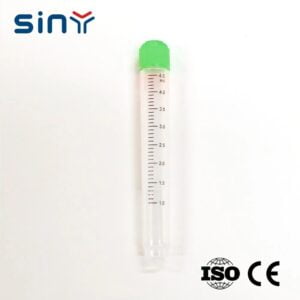
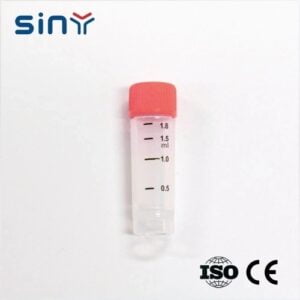
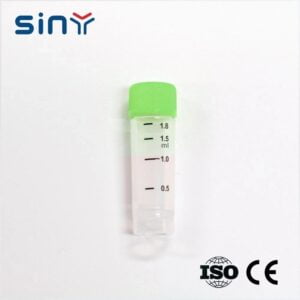
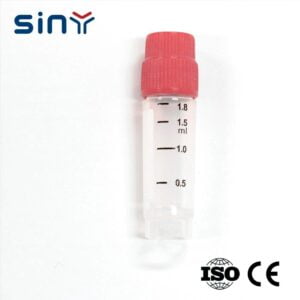
| Product Name | Cryovials Tube |
| Material | PP |
| OEM/ODM | Yes |
| Certificate | CE, ISO |
| Usage | Test Tube |
| Sterile | No-Sterilized |
| Sample | Free |
| Temperature Range | ‘-196~121ºC |
| Service | In the groups we serve: distributors, import traders, government procurement, buying agents, and medical chain stores, we provide one-stop procurement for you to simplify your procurement process. |
The Liquid Nitrogen Cryogenic Storage Vial from Siny Medical is a laboratory container designed for preserving biological samples at ultra-low temperatures. It supports compatible cryogenic storage workflows in research laboratories, biotechnology facilities, hospitals, and biobanks.
Liquid nitrogen cryogenic storage vials help laboratories organize and preserve biological materials that require controlled freezing conditions. These may include cell suspensions, tissue preparations, microbial samples, and other research specimens.
Cryogenic storage is an important part of modern laboratory operations. It allows researchers to maintain sample collections for future experiments, analysis, and long-term research projects. However, successful preservation depends on more than the storage container. The freezing procedure, storage temperature, and sample characteristics also affect the results.
Siny Medical supplies cryogenic laboratory consumables for different sample storage requirements. Our cryovial range includes conventional storage tubes and specialized configurations for laboratory sample management.
When choosing a cryogenic vial, laboratories should consider the storage environment, closure design, sample volume, and handling procedure. In particular, liquid nitrogen vapor-phase storage and direct liquid-phase immersion require different levels of container validation.
Cryogenic vials are designed to hold compatible biological samples under low-temperature storage conditions.
They are commonly used in ultra-low-temperature freezers and suitable liquid nitrogen storage systems.
For example, liquid nitrogen vapor-phase storage provides a cold environment above the liquid nitrogen reservoir. This method is widely used in biological sample preservation.
However, temperatures vary according to the storage system and sample position.
Therefore, laboratories should verify that the selected vial is suitable for the intended storage conditions.
Polypropylene is widely used in laboratory cryogenic containers.
It offers lightweight construction and useful resistance to many common laboratory reagents. Suitable PP formulations can also perform under ultra-low-temperature conditions.
However, the performance of a cryovial depends on its complete construction.
The cap, threads, sealing components, and vial body must work together under the intended storage conditions.
As a result, users should evaluate the assembled container rather than the plastic material alone.
Closure design is an important consideration in cryogenic storage.
A properly selected closure helps maintain the container’s intended containment performance during handling and storage.
Cryogenic vials commonly use threaded caps. Some designs also incorporate sealing rings to support the cap-to-vial interface.
However, a screw cap or sealing ring does not automatically guarantee leakproof performance.
Laboratories should verify the selected configuration when the procedure requires specific containment properties.
Cryogenic storage often involves large numbers of samples.
Therefore, clear identification is essential for laboratory efficiency and traceability.
Cryovials can be used with compatible labels, storage racks, and inventory systems.
For example, laboratories may record sample identification numbers, preparation dates, and storage locations.
However, labels must remain readable under the intended storage conditions.
Specialized barcode systems may also be useful for facilities that manage large sample collections.
Cryogenic vials support the storage of various biological preparations when the selected container and freezing protocol are appropriate.
These may include cells, microbial preparations, tissue-derived specimens, and research materials.
However, different samples have different preservation requirements.
For example, living cells may require suitable cryoprotectants and controlled freezing procedures.
Therefore, the storage vial should be selected as part of the complete preservation workflow.
Cryogenic sample storage involves preparation, freezing, retrieval, and thawing.
An appropriate vial helps laboratories organize these steps.
However, safe handling remains essential. Users should inspect containers before use and follow validated storage procedures.
In addition, personnel should wear suitable protective equipment when handling cryogenic materials.
Cell cryopreservation is a common application of cryogenic storage containers.
Researchers use suitable freezing procedures to preserve cell preparations for future experiments.
The storage vial holds the prepared sample during the preservation process.
However, cell viability depends on several factors. These include the cryoprotectant, cooling rate, storage conditions, and thawing method.
Therefore, laboratories should follow validated protocols for the specific cell type.
Biobanks maintain collections of biological materials for research and other approved purposes.
Cryogenic vials help organize these samples within controlled storage systems.
Proper identification allows personnel to locate specimens and maintain sample records.
In addition, suitable storage containers help support consistent handling procedures.
However, the vial must match the specimen and storage environment.
Microbiology laboratories may preserve compatible microbial preparations at low temperatures.
These samples can support future research, analysis, and laboratory investigations.
Cryogenic vials provide containers for selected microbial storage procedures.
However, microorganisms differ in their preservation requirements.
Therefore, laboratories should follow appropriate biosafety and validated freezing protocols.
Research laboratories may store tissue-derived preparations and other biological specimens.
Cryogenic storage can support selected preservation methods when the sample and storage conditions are suitable.
However, not every specimen can be frozen using the same procedure.
Sample preparation, cooling rate, and storage temperature can influence preservation quality.
For this reason, researchers should select the appropriate protocol before freezing.
Biotechnology laboratories frequently work with biological materials that require controlled storage.
These may include experimental preparations, cell-based research samples, and compatible biological reagents.
Cryogenic vials provide a practical container format for selected storage workflows.
However, users should verify chemical compatibility, containment requirements, and storage conditions.
Research projects often require samples to remain identifiable over extended periods.
A reliable storage system combines appropriate containers, labeling, inventory records, and temperature monitoring.
Cryogenic vials form one part of this system.
For example, laboratories may organize samples by project, specimen type, or storage location.
However, sample traceability also depends on accurate records and consistent handling procedures.
Liquid nitrogen systems can operate with samples positioned in the vapor phase or directly immersed in the liquid.
Understanding this distinction is essential for selecting cryogenic containers.
Vapor-phase storage keeps samples in the cold gaseous region above the liquid nitrogen reservoir.
The actual temperature depends on the equipment and sample position.
Suitable cryogenic vials can support vapor-phase storage when their specifications match the system.
One important advantage is that the container generally avoids direct contact with liquid nitrogen.
However, vapor-phase storage still requires appropriate containment and safety procedures.
Liquid-phase storage places containers in direct contact with liquid nitrogen.
At atmospheric pressure, liquid nitrogen boils at approximately -196°C.
Direct immersion creates additional risks if liquid nitrogen enters a vial.
During warming, trapped liquid nitrogen can expand rapidly into gas. This may produce dangerous internal pressure.
Therefore, direct immersion requires containers specifically validated for that application.
A general low-temperature rating does not establish immersion compatibility.
The correct storage method depends on the biological sample, storage equipment, and validated procedure.
Vapor-phase storage is commonly selected when laboratories want to avoid direct liquid nitrogen contact.
However, users must still verify that the chosen cryovial is compatible with the intended temperature and storage system.
For direct immersion, product-specific validation is essential.
| Feature | Vapor-Phase Storage | Liquid-Phase Storage |
|---|---|---|
| Sample Position | Above the liquid nitrogen reservoir | Directly immersed in liquid nitrogen |
| Temperature | Depends on equipment and position | Approximately -196°C |
| Direct Liquid Contact | Generally avoided | Present |
| Main Containment Concern | Low-temperature closure performance | Liquid ingress and pressure buildup |
| Container Requirement | Verified vapor-phase compatibility | Specific immersion validation |
| Safety Considerations | Cryogenic handling procedures | Additional pressure-related precautions |
Regardless of the storage method, laboratories should follow their equipment manufacturer’s instructions and institutional safety procedures.
First, determine where the samples will be stored.
Common options include ultra-low-temperature freezers and liquid nitrogen systems.
For liquid nitrogen applications, identify whether the system uses vapor-phase or liquid-phase storage.
Then, select a vial that meets the required conditions.
The correct capacity depends on the sample volume and freezing procedure.
Smaller vials may be suitable for limited sample quantities. Larger containers may be useful for compatible preparations requiring additional volume.
However, nominal capacity does not always represent the recommended filling volume.
Liquids may expand during freezing. Therefore, users should follow the validated filling procedure and allow suitable headspace when necessary.
The closure should suit the intended storage method.
For example, some applications may require specific containment performance during freezing and retrieval.
However, the presence of a sealing ring alone does not prove that a vial is leakproof.
Buyers should review the complete closure design and relevant validation information.
Polypropylene is commonly used in cryogenic laboratory consumables.
However, material compatibility depends on the sample, chemicals, and storage conditions.
Therefore, laboratories should verify compatibility when storing specialized reagents or chemical preparations.
Some biological workflows require sterile storage containers.
Other procedures may use non-sterile vials when the validated method permits them.
However, cryogenic compatibility does not automatically establish sterility.
Similarly, sterility does not prove that a product is RNase-free, DNase-free, or endotoxin-free.
Each characteristic should be evaluated separately.
Clear labeling helps laboratories maintain accurate sample records.
Labels should remain readable during storage, handling, and retrieval.
For larger collections, barcode-based inventory systems may improve organization.
However, users should choose identification methods compatible with the storage conditions.
Cryogenic materials require careful handling.
Before freezing, inspect the vial and closure for visible damage.
During retrieval, use appropriate protective equipment and follow the laboratory’s validated procedure.
In addition, personnel should consider pressure-related hazards when handling containers that may have been exposed to liquid nitrogen.
Never assume that a frozen vial can be safely opened or warmed without appropriate precautions.
Laboratory purchasing teams should evaluate product consistency, available configurations, and packaging requirements.
They should also consider the intended storage system and any required product documentation.
For distributors, compatibility with customers’ laboratory workflows is especially important.
Siny Medical supports laboratory consumables procurement for research institutions, biotechnology companies, and medical supply businesses.
It is a laboratory container designed for compatible biological sample preservation under ultra-low-temperature conditions, including suitable liquid nitrogen storage systems.
They are used in selected workflows involving cell preservation, biological sample banking, microbiology research, and long-term specimen storage.
Suitable cryogenic vials may be used in validated liquid nitrogen storage systems. However, vapor-phase compatibility does not automatically establish direct liquid-phase immersion compatibility.
Polypropylene is widely used because suitable formulations provide practical properties for low-temperature laboratory containers.
Sterility depends on the selected product. Laboratories should verify sterile status when their procedure requires a sterile container.
Internal-thread and external-thread vials have different cap and thread arrangements. Their containment performance depends on the complete product design rather than thread position alone.
Use identification methods suitable for the intended storage temperature. Labels should remain readable during storage and retrieval.
Important factors include capacity, material, closure design, storage compatibility, sterility requirements, labeling options, packaging, and product documentation.
Siny Medical supplies laboratory consumables for research institutions, hospitals, biotechnology laboratories, biobanks, and medical distributors. Our Liquid Nitrogen Cryogenic Storage Vial product range supports compatible ultra-low-temperature sample preservation and laboratory inventory management. Contact Siny Medical to discuss available cryovial configurations, bulk purchasing requirements, and quotation details.
Copyright © 2026 | Ningbo Siny Medical Technology Co., Ltd