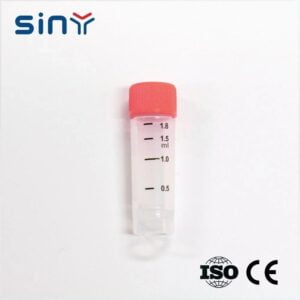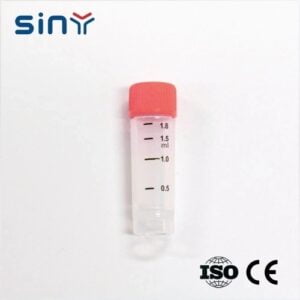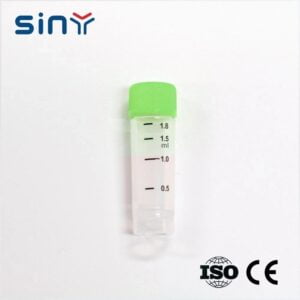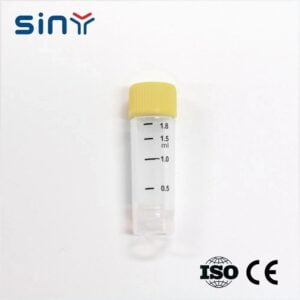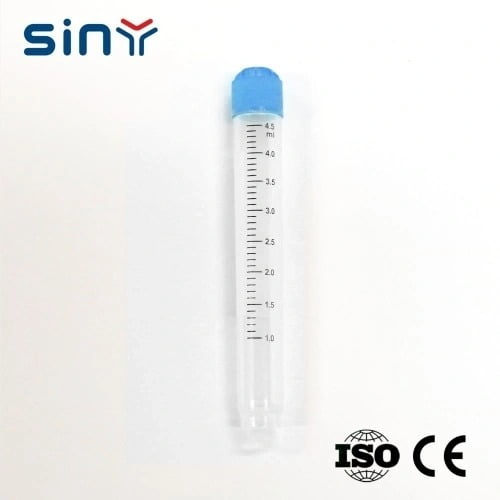
| Specification | Details |
|---|---|
| Product Name | 5ml Liquid Nitrogen Cryogenic Tube |
| Product Type | Cryogenic Vial / Cryotube |
| Material | Polypropylene (PP) |
| Capacity | 5ml |
| Temperature Range | -196°C to 121°C |
| Sterility | Non-Sterile |
| Sealing Ring | With / Without Sealing Ring |
| Graduation | Yes |
| Packaging | 200 PCS/Bag |
The 5ml Liquid Nitrogen Cryogenic Tube from Siny Medical is a polypropylene (PP) storage vial for biological samples. It supports compatible ultra-low-temperature storage in research laboratories, biotechnology facilities, and biobanks. With a 5ml nominal capacity, this cryovial provides additional space for larger sample aliquots.
5ml liquid nitrogen cryogenic tubes help laboratories organize, freeze, and store compatible biological materials. Common applications include cell suspension preservation, sample banking, and research specimen storage.
Siny Medical offers two configurations: with a sealing ring and without a sealing ring. Both versions feature graduation markings. The listed packaging quantity is 200 pieces per bag, and the product is supplied non-sterile.
The specified temperature range is -196°C to 121°C. However, temperature resistance alone does not establish compatibility with every storage or heating method. In particular, vapor-phase storage and direct immersion in liquid nitrogen have different safety requirements.
Therefore, laboratories should verify the complete vial assembly before use. Proper freezing, storage, retrieval, and thawing procedures are also essential.
Siny Medical supplies laboratory consumables to hospitals, research institutions, biotechnology companies, and medical distributors worldwide.
The 5ml capacity is a key feature of this cryogenic vial.
Compared with smaller cryotubes, this format provides additional space for compatible biological preparations. It may be useful when laboratories need to preserve larger sample aliquots.
For example, researchers may use suitable 5ml containers for cell suspensions or other prepared specimens.
However, nominal capacity does not always equal the recommended filling volume. Some liquids expand during freezing. Therefore, laboratories should follow validated filling procedures and allow suitable headspace when required.
The vial is made from polypropylene, a material widely used in laboratory consumables.
PP is lightweight and offers useful chemical resistance. In addition, suitable polypropylene formulations can perform under ultra-low-temperature conditions.
However, the complete vial assembly determines cryogenic suitability. The cap, threads, and sealing components must also tolerate the intended storage conditions.
For this reason, users should evaluate the assembled container rather than the tube material alone.
The listed operating temperature range is -196°C to 121°C.
The lower value corresponds approximately to the boiling temperature of liquid nitrogen at atmospheric pressure. This makes low-temperature performance an important consideration for the product.
However, a -196°C rating does not automatically permit direct immersion in liquid nitrogen.
Liquid nitrogen may enter an unsuitable vial during immersion. If trapped liquid later warms, rapid expansion can create dangerous internal pressure.
Therefore, laboratories should use vapor-phase storage only when the selected configuration is suitable for that environment. Direct liquid-phase immersion requires separate product-specific validation.
Siny Medical offers 5ml cryovials with and without sealing rings.
A sealing ring provides an additional component at the cap-to-vial interface. Its purpose is to support the closure design.
However, a sealing ring does not automatically guarantee leakproof performance or suitability for liquid nitrogen immersion.
The correct configuration depends on the sample, storage method, and containment requirements.
Before use, laboratory personnel should inspect the closure and follow the applicable handling instructions.
Both listed 5ml configurations include graduation markings.
These markings help technicians estimate liquid volume during sample preparation. They also provide a convenient reference when organizing aliquots.
However, graduations should not replace calibrated pipettes when accurate measurement is necessary.
The current product is identified as non-sterile.
Non-sterile cryogenic vials may be appropriate for laboratory procedures that do not require sterile containers.
However, sensitive cell culture or aseptic preparation workflows may require sterile consumables.
Therefore, buyers should verify the sterile requirements of their procedures before selecting a storage vial.
Cell cryopreservation allows laboratories to preserve suitable cell preparations at low temperatures.
A 5ml cryogenic vial may accommodate larger aliquots when the filling volume and storage procedure are appropriate.
However, successful preservation depends on several factors. These include the freezing rate, cryoprotectant, cell concentration, storage conditions, and thawing method.
The vial provides a container for the sample. It does not determine cell viability on its own.
Therefore, laboratories should follow validated cryopreservation protocols for each cell type.
Biobanks store biological materials for research and other approved purposes.
Cryogenic vials help organize compatible samples within these collections.
The 5ml capacity can be useful when a project requires larger aliquots. In addition, clear sample identification helps laboratory personnel manage storage inventories.
However, proper storage conditions remain essential for sample quality.
Laboratories should also maintain reliable labeling and tracking procedures.
Research laboratories may prepare tissue-derived materials and other specimens for low-temperature preservation.
Suitable cryovials can support these workflows when their specifications match the sample and storage method.
However, different biological materials require different preservation procedures.
Therefore, researchers should choose the freezing and storage method according to the specimen and intended analysis.
Microbiology laboratories often maintain collections of research materials.
These may include microbial preparations, biological reagents, and other compatible specimens.
Cryogenic tubes provide practical containers for selected storage procedures.
However, laboratories must follow appropriate biosafety and contamination-control requirements.
The container must also meet the sample’s containment needs.
Many research projects require long-term sample organization.
Cryogenic vials help laboratories arrange compatible materials for future testing.
Graduation markings provide an approximate volume reference during preparation. Meanwhile, suitable labeling systems help identify stored samples.
However, long-term sample quality depends on stable storage conditions and careful handling.
Liquid nitrogen storage systems may use vapor-phase or liquid-phase conditions.
Although both involve very low temperatures, they present different risks.
In vapor-phase storage, samples remain in the cold gaseous region above the liquid nitrogen reservoir.
The temperature varies according to the storage system, sample position, and operating conditions.
Suitable cryogenic vials may be used in these systems when their performance has been verified.
One advantage is that the container generally avoids direct immersion in liquid nitrogen.
However, vapor-phase storage still requires appropriate equipment, containment, and safety procedures.
Liquid-phase storage involves direct contact with liquid nitrogen.
At atmospheric pressure, liquid nitrogen has a temperature of approximately -196°C.
However, direct immersion creates additional containment risks.
If liquid nitrogen enters a vial, it may become trapped. During warming, the liquid rapidly expands into gas. This can create pressure and cause the container to rupture.
Therefore, direct immersion requires containers specifically validated for liquid-phase storage.
A general low-temperature rating is not sufficient evidence.
The correct method depends on the sample, storage equipment, and validated laboratory procedure.
For this Siny Medical product, vapor-phase applications are the appropriate focus unless additional documentation confirms direct liquid-phase compatibility.
Laboratories should also consider sample traceability, retrieval procedures, and personnel safety.
| Feature | Vapor-Phase Storage | Liquid-Phase Storage |
|---|---|---|
| Sample Position | Above liquid nitrogen | Directly immersed in liquid nitrogen |
| Temperature | Depends on equipment and position | Approximately -196°C |
| Liquid Contact | Generally avoided | Direct contact |
| Main Concern | Low-temperature compatibility | Liquid ingress and pressure buildup |
| Vial Requirement | Verified vapor-phase suitability | Specific immersion validation |
| Handling | Cryogenic safety procedures | Additional pressure-related precautions |
Both storage methods require appropriate equipment and trained personnel.
First, determine the sample volume.
A 5ml vial provides additional space compared with smaller cryogenic containers.
However, laboratories should not automatically fill the tube to its nominal capacity.
Instead, follow the recommended working volume and validated freezing procedure.
Next, identify the storage equipment.
Some laboratories use ultra-low-temperature freezers. Others use liquid nitrogen systems.
For liquid nitrogen storage, determine whether the system operates in vapor phase or liquid phase.
Then, verify that the selected vial configuration is suitable for those conditions.
Siny Medical lists versions with and without sealing rings.
The appropriate option depends on the storage procedure and containment requirements.
However, the presence of a sealing ring does not prove that the vial is completely leakproof.
Therefore, buyers should review the relevant closure specifications when containment performance is important.
The listed temperature range is -196°C to 121°C.
However, temperature resistance and sterilization compatibility are different characteristics.
For example, an upper temperature rating of 121°C does not automatically establish validated autoclave performance.
Users should follow documented processing instructions before exposing the vial to heat.
This product is listed as non-sterile.
Therefore, laboratories requiring sterile containers should choose a product with verified sterile status.
Other purity characteristics, such as RNase-free, DNase-free, or endotoxin-free performance, must also be verified separately when required.
Cryogenic storage often involves large numbers of samples.
Clear labeling helps laboratories locate the correct material and maintain traceability.
Therefore, users should select labels and marking methods compatible with their storage conditions.
Graduation markings help estimate volume, but they do not replace sample identification.
Cryogenic sample handling requires suitable protective equipment and trained personnel.
Before storage, inspect the vial and closure for visible damage.
During retrieval, follow the laboratory’s validated handling procedure.
In addition, personnel should consider pressure-related risks when warming containers that may have been exposed to liquid nitrogen.
Never handle a damaged or potentially pressurized vial without appropriate safety precautions.
The listed packaging quantity is 200 pieces per bag.
This format can support routine inventory planning for laboratories and distributors.
However, buyers should also review sealing configuration, storage requirements, and expected consumption.
For bulk purchasing, consistent product identification and suitable packaging are important considerations.
It is a laboratory vial designed for compatible biological sample storage at ultra-low temperatures. This Siny Medical product has a 5ml nominal capacity and polypropylene construction.
The product has a listed temperature range extending to -196°C. However, direct liquid-phase immersion requires specific validation. Temperature resistance alone does not establish immersion compatibility.
They are made from polypropylene (PP), a material commonly used in laboratory consumables.
No. The current product is listed as non-sterile.
Yes. Siny Medical lists 5ml configurations with and without sealing rings.
Yes. Both listed 5ml configurations include graduations for approximate volume estimation.
The listed upper temperature limit is 121°C. However, this does not automatically confirm autoclave compatibility. Users should verify the manufacturer’s validated processing instructions.
The listed packaging quantity is 200 pieces per bag.
Siny Medical supplies laboratory consumables for research institutions, biotechnology laboratories, hospitals, biobanks, and medical distributors. Our 5ml Liquid Nitrogen Cryogenic Tube offers polypropylene construction, graduation markings, and sealing ring options for compatible cryogenic storage workflows. Contact Siny Medical to discuss available configurations, bulk orders, and quotation details.
Copyright © 2026 | Ningbo Siny Medical Technology Co., Ltd