| Specification | Details |
|---|---|
| Product Name | Conical 0.5 Ml Falcon Centrifuge Tubes |
| Product Category | Microcentrifuge Tube |
| Nominal Capacity | 0.5ml |
| Material | Polypropylene (PP) |
| Bottom Shape | Conical |
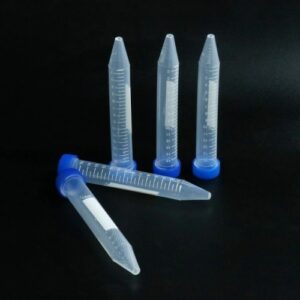
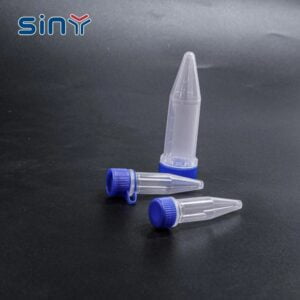
The Conical 0.5 Ml Falcon Centrifuge Tubes are small-volume polypropylene (PP) microcentrifuge tubes designed for laboratory sample preparation, liquid handling, and compatible centrifugation procedures. Their 0.5ml nominal capacity makes them suitable for workflows involving limited sample quantities.
The conical bottom helps concentrate sedimented material in a narrow area during centrifugation. This design supports the recovery of small pellets and the separation of liquid supernatants when the selected operating conditions are appropriate.
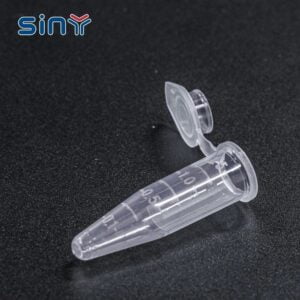
The listed 0.5ml configuration features graduation markings and an attached shield-style lid. These features support convenient sample handling and help users keep the closure connected to the tube during routine procedures.
Siny Medical supplies 0.5ml microcentrifuge tubes for research laboratories, hospital laboratories, diagnostic facilities, and medical consumables distributors.
The tube has a nominal capacity of 0.5ml, making it suitable for handling small liquid samples.
This format helps laboratory personnel process limited sample quantities without using larger containers.
However, nominal capacity does not necessarily equal the maximum permitted fill volume during centrifugation. Users should follow the selected tube’s operating instructions.
The tube body is made from polypropylene, a lightweight plastic widely used in laboratory consumables.
PP offers useful resistance to many common laboratory reagents. Nevertheless, compatibility depends on the chemical, concentration, temperature, and exposure time.
Laboratories should verify material compatibility before using aggressive solvents or specialized reagents.
The conical bottom directs sedimented material toward the narrow end of the tube during appropriate centrifugation.
This can make a small pellet easier to locate after separation.
For example, laboratory staff may use compatible tubes when collecting suspended particles or preparing small biological samples.
However, the amount and quality of recovered material depend on the sample properties and centrifugation procedure.
The 0.5ml configuration includes graduation markings that provide a visual reference during liquid handling.
These markings help laboratory personnel estimate sample quantities while preparing or transferring liquids.
For precise measurements, users should rely on calibrated pipettes or other appropriate measuring equipment.
The listed configuration includes an attached shield-style lid.
This design keeps the closure connected to the tube during opening and closing. As a result, users do not need to manage a separate cap during routine sample preparation.
However, an attached lid does not automatically provide a verified leakproof or aerosol-tight seal.
A 0.5ml conical centrifuge tube supports laboratory procedures that involve small sample quantities and compatible separation methods.
Laboratories often need to prepare small amounts of biological or chemical samples before testing.
A 0.5ml tube provides a compact container for compatible liquids, buffers, and sample mixtures.
Its small size can also help users organize multiple specimens during manual laboratory procedures.
Compatible microcentrifuge tubes can support the separation of suspended materials from liquids.
During centrifugation, particles may sediment toward the conical bottom.
After separation, laboratory personnel can remove the supernatant or recover the pellet according to their procedures.
The selected tube must be rated for the intended relative centrifugal force (RCF).
Aliquoting involves transferring a portion of a sample into another container.
A 0.5ml tube may be useful when laboratories need to prepare small sample portions for separate processing steps.
Proper labeling, pipetting technique, and contamination-control practices remain important.
Laboratory personnel may use these tubes to prepare small reagent mixtures or dilutions.
The attached lid provides convenient access during repeated liquid transfers.
However, users should confirm that the tube material and closure are compatible with the reagents and mixing method.
Small-volume tubes are commonly used in research and diagnostic sample preparation.
For example, compatible tubes may support selected protein, nucleic acid, or biological sample handling procedures.
Sensitive molecular assays may require documented purity characteristics. These should be verified for the selected product rather than assumed from the tube’s material.
The main advantage of the 0.5ml format is its suitability for handling limited sample quantities.
A 0.5ml tube provides a smaller container than a standard 1.5ml microcentrifuge tube.
This can be useful when the laboratory procedure requires only a limited amount of liquid.
However, smaller capacity does not automatically mean better sample recovery or lower sample loss.
The tapered bottom helps collect sedimented particles within a relatively small area.
This geometry can make the resulting pellet easier to identify during suitable separation procedures.
Nevertheless, successful pellet recovery also depends on sample composition, centrifugation conditions, and pipetting technique.
| Feature | 0.2ml Tube | 0.5ml Tube | 1.5ml Tube |
|---|---|---|---|
| Nominal Capacity | 0.2ml | 0.5ml | 1.5ml |
| Typical Selection Reason | Very small sample volumes | Small-volume sample processing | Larger microcentrifuge samples |
| General Product Category | Small laboratory tube | Microcentrifuge tube | Microcentrifuge tube |
| Equipment Compatibility | Verify selected model | Verify selected model | Verify selected model |
This comparison describes general tube formats. It does not imply that every size has identical operating characteristics.
The compact tube body and attached lid support routine manual handling.
Laboratories can organize small samples in compatible racks and access their contents during preparation.
Before use, staff should confirm that the selected tube fits the intended equipment.
Laboratories and distributors should consider sample volume, tube geometry, and operating conditions before purchasing.
Choose a 0.5ml tube when its capacity suits the intended procedure.
Consider the initial sample quantity, additional reagents, and space needed for mixing.
Do not assume that the nominal capacity represents the recommended maximum centrifugation fill volume.
The tube must fit the intended microcentrifuge rotor or adapter correctly.
Tube diameter, length, bottom shape, and lid geometry can affect compatibility.
Therefore, laboratories should verify the selected model’s dimensions before centrifugation.
Relative centrifugal force determines the force applied to a sample during centrifugation.
The maximum permitted RCF depends on the tube’s construction and operating conditions.
Users should follow the selected product’s documented rating and the centrifuge manufacturer’s instructions.
The attached lid supports convenient sample access.
However, laboratories should verify whether the closure meets the containment requirements of the intended procedure.
An attached cap should not be treated as proof of leakproof or aerosol-tight performance.
Polypropylene is suitable for many routine laboratory applications, but it is not compatible with every reagent.
Chemical concentration, exposure duration, and temperature can influence performance.
Laboratories should review material compatibility before using specialized chemicals.
Some laboratory procedures require sterile tubes or verified molecular biology purity characteristics.
For example, sensitive nucleic acid workflows may require documented DNase-free or RNase-free properties.
Buyers should check the selected model’s labeling and technical documentation before purchasing.
Inspect the tube and lid for visible damage before use.
Close the lid correctly, balance the centrifuge rotor, and follow the equipment manufacturer’s instructions.
Do not use the tube for PCR thermal cycling, autoclaving, or extreme-temperature storage unless the selected model is validated for those conditions.
After use, dispose of the tube according to its contents and applicable laboratory waste procedures.
They are used for handling and preparing small laboratory samples. Compatible applications may include microcentrifugation, pellet collection, reagent mixing, and sample aliquoting.
The listed product is made from polypropylene (PP), a lightweight plastic commonly used in laboratory consumables.
The conical bottom helps concentrate sedimented material in a narrow area during centrifugation. This can make small pellets easier to locate and recover.
Yes. The listed 0.5ml configuration includes graduation markings for approximate volume reference.
The listed 0.5ml configuration specifies an attached shield-style lid. It should not be described as a screw-cap tube without additional product verification.
The existing product information contains conflicting sterilization descriptions. The sterile status and sterilization method should be verified from the documentation for the selected configuration.
A 0.5ml tube may support compatible sample preparation procedures. However, PCR thermal cycling requires a tube specifically validated for the intended instrument and temperature program.
Laboratories should verify material, capacity, tube dimensions, lid design, centrifuge compatibility, maximum RCF, sterile status, and any required sample purity characteristics.
Siny Medical supplies microcentrifuge tubes and laboratory consumables for hospitals, research laboratories, diagnostic facilities, and medical distributors. Our Conical 0.5 Ml Falcon Centrifuge Tubes offer a compact polypropylene format with a conical bottom, graduation markings, and an attached lid for small-volume sample handling. Contact Siny Medical to discuss product specifications, bulk purchasing requirements, and quotation details.
Copyright © 2026 | Ningbo Siny Medical Technology Co., Ltd