| Specification | Details |
|---|---|
| Product Name | Plastic Integral Cap Microcentrifuge Tube |
| Product Category | Microcentrifuge Tube |
| Tube Material | Plastic |
| Cap Design | Integral / Attached Cap |
| Primary Application | Small-Volume Laboratory Sample Handling |
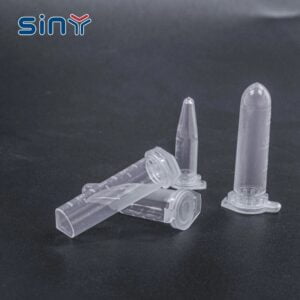
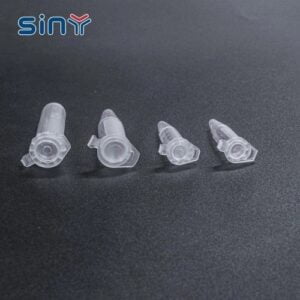
The Plastic Integral Cap Microcentrifuge Tube is a small-volume laboratory sample tube featuring an attached cap connected to the tube body. This integrated closure design allows laboratory personnel to open and close the tube without handling a separate cap.
Microcentrifuge tubes are widely used for preparing, transferring, mixing, and centrifuging small liquid samples. An integral cap adds convenience to these workflows by keeping the closure connected to its corresponding tube.
The attached-cap design is particularly useful when laboratory staff handle multiple samples, perform repeated pipetting steps, or organize specimens during routine procedures.
Siny Medical supplies plastic microcentrifuge tubes and other laboratory consumables for research facilities, diagnostic laboratories, and medical distributors. This product focuses on convenient small-volume sample handling with an integrated cap structure.
The defining feature of this microcentrifuge tube is its integral cap.
Unlike a tube with a completely separate closure, the attached cap remains connected to the tube body during opening and closing.
This arrangement helps users keep each cap with its corresponding tube. It also reduces the need to place loose caps on laboratory work surfaces.
However, the attached design does not eliminate contamination risks. Users must still follow appropriate sample-handling procedures.
An integral cap allows laboratory personnel to access the sample while keeping the closure attached.
This can be useful during repeated pipetting, mixing, and transfer operations.
For example, a technician preparing several small-volume samples can open each tube, add the required reagent, and close it without managing separate caps.
The actual opening force and closure performance depend on the selected tube design.
Microcentrifuge tubes are designed for handling relatively small liquid volumes.
Their compact format makes them suitable for procedures where larger centrifuge tubes would be unnecessary.
The correct tube size depends on the sample volume, mixing requirements, and equipment compatibility.
Plastic microcentrifuge tubes provide a lightweight alternative to glass containers.
Polypropylene is commonly used for this product category because of its useful mechanical and chemical properties.
However, the exact material grade and compatibility of the selected tube should be verified before use with demanding reagents or temperature conditions.
The attached cap helps keep the sample contained when correctly closed.
This supports routine laboratory handling and movement between workstations.
Nevertheless, an integral cap does not automatically establish a leakproof or aerosol-tight seal. Such performance requires product-specific verification.
Integral cap microcentrifuge tubes support workflows that involve frequent sample access and small liquid volumes.
Laboratories use microcentrifuge tubes to prepare small quantities of biological or chemical samples.
During preparation, technicians may add buffers, reagents, or other liquids using pipettes.
The integral cap remains attached while the tube is open, making repeated access more convenient.
Small-volume laboratory procedures often involve mixing reagents or preparing dilutions.
An attached-cap tube can serve as a convenient container for compatible solutions.
After adding the required liquids, users can close the cap before performing an appropriate mixing procedure.
However, the tube and cap must be suitable for the selected mixing method.
Microcentrifuge tubes may be used to separate suspended materials from liquids when the selected model is rated for the intended centrifugation conditions.
For example, laboratory staff may centrifuge compatible samples to collect a pellet or separate a supernatant.
Before use, they must verify the tube’s maximum relative centrifugal force and compatibility with the centrifuge rotor.
Microcentrifuge tubes are commonly used in molecular biology laboratories.
Typical workflows may involve handling nucleic acid preparations, protein extracts, buffers, or other small-volume samples.
However, sensitive molecular biology procedures may require verified DNase-free, RNase-free, or other purity characteristics.
An integral cap alone does not establish these properties.
Laboratories may use compatible microcentrifuge tubes to hold samples between preparation steps.
The attached cap provides convenient access while keeping the closure associated with the tube.
Storage conditions must follow the selected tube’s specifications and the requirements of the sample.
Users should not assume that all plastic microcentrifuge tubes support deep freezing or long-term storage.
The main difference between integral cap and separate cap designs is how the closure connects to the tube.
An integral cap remains attached to the tube body.
This design helps users keep the closure with its original tube during repeated handling.
It may also reduce the chance of misplacing a cap on a crowded laboratory bench.
However, the connected cap can affect how the tube fits certain racks, automated systems, or specialized instruments.
A separate cap can be completely removed from the tube.
This design may suit workflows where users need unrestricted access to the tube opening or use a specialized closure system.
However, users must manage the removed cap carefully to avoid mix-ups and contamination.
| Feature | Integral Cap Tube | Separate Cap Tube |
|---|---|---|
| Cap Connection | Attached to tube | Fully removable |
| Cap Handling | Remains with tube | Requires separate handling |
| Repeated Sample Access | Convenient attached closure | Removable closure |
| Risk of Misplacing Cap | Reduced during normal handling | Depends on handling practices |
| Equipment Compatibility | Verify tube and cap geometry | Verify tube and cap geometry |
| Leakproof Performance | Requires model-specific verification | Requires model-specific verification |
Neither closure design is universally better. The appropriate choice depends on laboratory procedures, equipment, and sample-handling preferences.
Laboratories and medical distributors should evaluate the complete tube design rather than focus only on the attached cap.
Start by identifying the amount of liquid the procedure requires.
Select a tube with sufficient capacity for the sample and any additional reagents.
The nominal capacity should not be treated as the maximum permitted working volume under every operating condition.
Consider how often laboratory personnel need to open and close the tube.
An attached cap may be useful for repeated pipetting and manual sample preparation.
However, the cap should not obstruct the intended pipette movement, tube rack, or equipment.
Not every small plastic tube is suitable for every centrifuge.
Users must confirm that the selected tube fits the rotor or adapter and can withstand the required relative centrifugal force.
They should also ensure that the cap is correctly closed before centrifugation.
Different reagents can affect plastic materials in different ways.
Compatibility depends on the chemical, concentration, exposure time, and temperature.
Laboratories should verify the selected tube’s material specifications before using aggressive solvents or specialized reagents.
Some procedures require sterile consumables or verified molecular biology purity characteristics.
For example, nucleic acid analysis may require tubes with documented nuclease-related specifications.
Buyers should confirm these properties through the actual product documentation rather than assume they apply to every microcentrifuge tube.
Temperature requirements vary between laboratory procedures.
Some applications involve refrigeration or freezing, while others require heating.
However, a plastic tube should not be used for autoclaving, thermal cycling, or extreme-temperature storage without confirmation that the selected model supports those conditions.
Before use, inspect the tube body, attached cap, and connecting section for visible damage.
Close the cap according to the product instructions and avoid applying excessive force.
If the tube is used in a centrifuge, follow the equipment manufacturer’s instructions and balance the rotor correctly.
After use, dispose of the tube according to the sample contents and applicable laboratory waste procedures.
It is a small-volume laboratory tube with a cap that remains attached to the tube body. The design supports convenient opening, closing, and sample handling.
The cap stays connected to its tube during handling. This reduces the need to manage separate closures and can make repeated sample access more convenient.
They are used in compatible small-volume laboratory workflows, including sample preparation, reagent mixing, liquid transfer, and centrifugation.
No. An integral cap is defined by its connection to the tube body. A screw cap uses a threaded closure. The terms describe different aspects of cap design.
Not necessarily. An attached cap does not automatically provide a verified leakproof seal. Users should check the selected model’s closure specifications.
Only when the selected model is rated for the intended centrifugal force. Users must verify the maximum RCF and equipment compatibility before use.
They may support compatible sample preparation workflows. However, PCR thermal cycling and sensitive nucleic acid applications may require specific temperature and purity specifications.
Buyers should verify tube capacity, material, cap design, centrifuge compatibility, maximum RCF, temperature limits, packaging, and any required sterile or molecular biology purity characteristics.
Siny Medical supplies laboratory consumables for research facilities, diagnostic laboratories, and medical distributors. Our Plastic Integral Cap Microcentrifuge Tube offers an attached-cap design for convenient small-volume sample handling. Contact Siny Medical to discuss available product configurations, purchasing requirements, and quotation details.
Copyright © 2026 | Ningbo Siny Medical Technology Co., Ltd