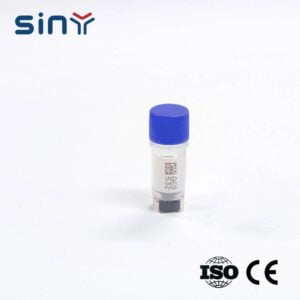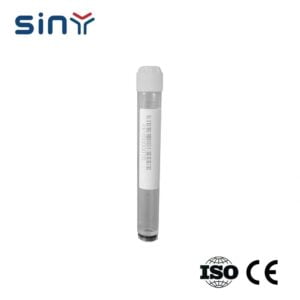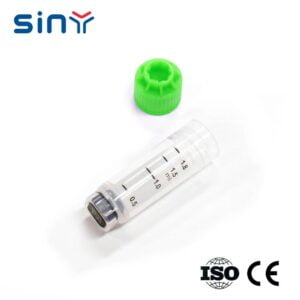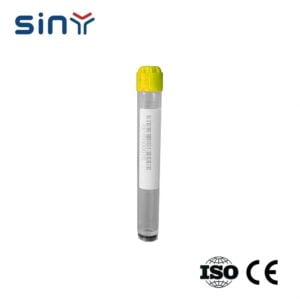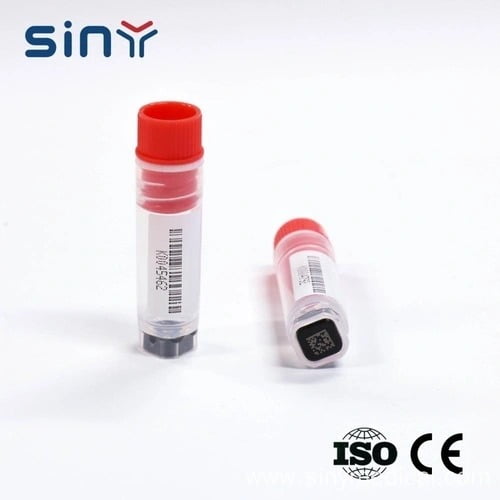
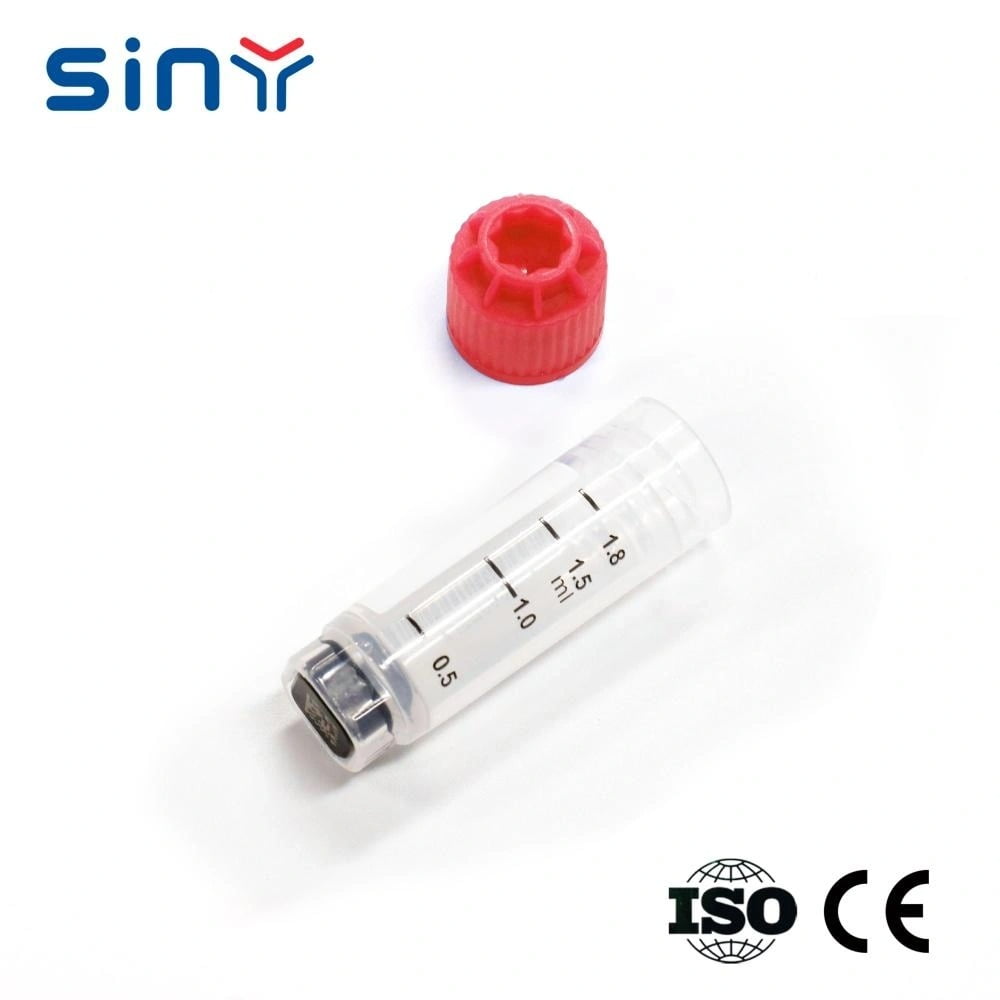
| Specification | Details |
|---|---|
| Product Name | 2D Bottom Barcodes Cryogenic Vials External Thread Cryotubes |
| Product Type | 2D Barcode Cryogenic Vial |
| Material | Polypropylene (PP) |
| Barcode Position | Bottom |
| Identification | Bottom 2D Barcode, Tube Barcode, Numerical Code |
| Coding | Unique Identification |
| Cap Type | External Screw Cap |
| Sealing Component | Silicone O-Ring |
| Temperature Range | −196°C to 121°C |
| Sterility | Non-Sterile |
Siny Medical supplies 2D Bottom Barcodes Cryogenic Vials External Thread Cryotubes for biological sample storage, identification, and laboratory inventory management. Made from polypropylene (PP), these cryogenic vials combine bottom-mounted 2D barcodes with external screw caps to support organized sample preservation.
Our 2D barcode cryogenic vials feature a unique identification system that links the bottom 2D code, tube barcode, and numerical code. This arrangement helps laboratories identify individual samples and maintain accurate records throughout preparation, freezing, storage, and retrieval.
The external screw cap provides convenient access to biological specimens while helping reduce contact between samples and threaded surfaces. In addition, the silicone O-ring supports the sealing interface between the cap and vial body.
These cryovials have a listed temperature range of -196°C to 121°C, making them a practical choice for compatible ultra-low-temperature storage workflows, including suitable liquid nitrogen vapor-phase systems.
Siny Medical supplies laboratory consumables to research institutions, biotechnology companies, biobanks, hospitals, and international distributors. Our 2D-coded cryogenic storage products help customers combine sample preservation with more efficient laboratory identification and inventory procedures.
The bottom 2D barcode is the defining feature of this cryogenic vial.
Each tube features a machine-readable code on its base. Laboratories can use a compatible barcode reader to capture the identifier and associate it with a sample record.
Bottom barcode placement is particularly useful in organized storage systems. It allows suitable scanners to identify vials from below when the tubes are positioned in compatible racks or trays.
This arrangement supports efficient sample identification without relying entirely on handwritten labels.
For laboratories managing large specimen collections, machine-readable identifiers help reduce manual data entry and improve record consistency.
Siny Medical’s 2D cryovial range features three linked identification elements:
The three identifiers correspond to the same cryogenic tube, and each tube has unique coding information.
This system gives laboratory personnel different ways to identify and record individual specimens.
For example, a technician may scan the bottom code during storage and use the visible numerical identifier when checking a sample record.
The tube barcode provides another identification method for compatible scanning procedures.
Together, these elements support accurate sample tracking across different laboratory workflows.
Our cryogenic vials feature external screw caps for convenient sample handling.
The threads are positioned outside the vial opening. As a result, this design helps reduce accidental contact between biological samples and threaded surfaces during preparation and retrieval.
The screw cap also provides a practical closure mechanism for routine laboratory operations.
Technicians can open and close individual vials while following established specimen handling procedures.
For biobanks and research laboratories, a suitable cap design helps maintain organized sample processing.
The cryovial design incorporates a silicone O-ring to support closure performance.
The O-ring provides a sealing interface between the screw cap and vial body.
This feature helps maintain the intended closure during compatible sample handling and storage procedures.
It also complements the external-thread design by providing a dedicated sealing component.
The complete cap assembly determines containment performance under specific operating conditions.
Our 2D-coded cryovials are made from polypropylene, a widely used material in laboratory consumables.
PP offers lightweight construction and useful resistance to many common laboratory chemicals.
It also provides a practical container format for biological specimen preparation and low-temperature storage.
Suitable polypropylene formulations can perform under ultra-low-temperature conditions.
For laboratories managing large sample collections, PP cryovials offer convenient handling and storage organization.
These cryogenic vials have a listed temperature range of -196°C to 121°C.
They are intended for compatible biological sample preservation procedures, including ultra-low-temperature freezers and suitable liquid nitrogen vapor-phase storage systems.
These environments are commonly used in biological research and biobanking.
The barcode identification system also supports specimen tracking during long-term storage.
For direct immersion in liquid nitrogen, the complete vial assembly must be specifically validated for that application.
The product range lists seven cap colors: red, yellow, blue, green, white, purple, and orange.
Color-coded caps can help laboratories organize samples by project, department, specimen category, or processing group.
For example, different colors may represent separate research studies or storage classifications.
Color identification provides a convenient visual reference. However, the unique barcode remains the primary identifier for individual sample records.
This combination of visual and machine-readable identification supports efficient laboratory organization.
The listed cryogenic vials are supplied non-sterile.
They provide a practical option for research and laboratory storage procedures that do not require sterile containers.
For aseptic sample preparation, laboratories should select products with verified sterile status.
Biobanks often manage thousands of individual biological specimens.
Accurate identification is essential for maintaining sample records and supporting reliable retrieval.
Our bottom-coded cryovials provide unique identifiers that laboratories can associate with their inventory systems.
For example, a biobank may record the sample category, preparation date, storage location, and related research information under a vial identifier.
When the sample is moved or retrieved, scanning the barcode can support updates to its inventory record.
This approach helps laboratories manage growing specimen collections more efficiently.
Automated identification is an important application of 2D-coded cryogenic containers.
Compatible barcode readers can capture vial identifiers during selected laboratory procedures.
Bottom-mounted codes are useful in systems designed to read tubes from below.
This can reduce the need for manual transcription of sample identification numbers.
In addition, unique identifiers help laboratories associate physical containers with electronic records.
The actual level of automation depends on the scanner, rack format, software, and laboratory equipment.
Cell research laboratories often preserve prepared cell suspensions for future experiments.
Cryogenic vials provide containers for compatible cell preparations during freezing and storage.
The 2D barcode helps laboratories identify individual vials within a larger cell collection.
For example, researchers may associate a unique code with a cell line, passage record, preparation date, or experimental group.
This supports organized sample management across research projects.
Successful cell cryopreservation also depends on suitable cryoprotectants, freezing procedures, and storage conditions.
Biotechnology laboratories handle biological materials across multiple experiments and processing stages.
Clear identification helps researchers maintain accurate records as samples move between workstations and storage areas.
Our 2D-coded cryovials provide a practical container format for compatible biological preparations.
Their unique identification system supports specimen tracking, while the external screw cap provides convenient handling.
These features are useful in laboratories that manage numerous research samples.
Microbiology laboratories maintain collections of compatible microbial preparations.
Cryogenic vials help organize these materials under suitable storage conditions.
A unique barcode can be associated with a strain identifier, preparation batch, or research project.
This supports accurate inventory records and efficient sample retrieval.
In addition, cap color options provide a convenient secondary visual reference for laboratory organization.
Long-term research projects may require biological materials to remain available for future analysis.
An effective specimen archive combines suitable storage containers with clear identification and accurate records.
Our 2D bottom barcode cryovials support this process by linking individual containers to unique identifiers.
Laboratories can use compatible scanning systems to record sample locations and retrieval activities.
As a result, barcode identification becomes an important part of organized specimen preservation.
Every sample container in a large collection needs a reliable identifier.
Our 2D-coded cryovials use unique coding information to distinguish individual tubes.
This helps laboratories associate each vial with the correct electronic or written record.
For example, two samples may have similar descriptions but different preparation dates.
Unique identifiers help distinguish these containers without relying on visual inspection alone.
Manual identification can become time-consuming when laboratories manage large sample collections.
A compatible barcode scanner reads the encoded identifier and transfers it into the connected system.
This reduces the need to type identification numbers manually.
It also helps laboratories maintain consistent records during routine sample processing.
Barcode scanning is particularly useful when technicians need to identify many tubes in a short period.
Many laboratories use electronic systems to organize sample information.
These may include laboratory information management systems, biobank databases, and other inventory platforms.
A unique cryovial barcode can serve as the identifier that connects the physical sample container with its digital record.
For example, a laboratory may associate the code with the specimen type, storage position, and processing history.
This approach supports organized sample management and traceability.
Software integration depends on the barcode format, scanning equipment, and selected information system.
Bottom and side barcodes provide different scanning arrangements.
Bottom-mounted 2D codes are particularly useful when laboratories use compatible readers designed to identify tubes from below.
Side barcodes provide another identification method when the tube body is accessible to the scanner.
Siny Medical’s cryovial identification system combines bottom and tube-body coding with a numerical identifier.
| Feature | Bottom 2D Barcode | Tube-Body Barcode |
|---|---|---|
| Position | Vial base | Tube body |
| Typical Reading Method | Compatible bottom scanner | Compatible side scanner |
| Main Advantage | Identification from below | Identification from the side |
| Laboratory Application | Organized rack-based workflows | Routine handling and scanning |
| Record Management | Links to sample identifier | Links to sample identifier |
Both barcode positions support sample identification when used with compatible scanning equipment.
Incorrect sample identification can create serious problems in laboratory research.
Barcode systems help reduce errors associated with handwritten labels and manual transcription.
A unique code allows technicians to identify a container and retrieve its associated record.
However, effective sample traceability also requires appropriate labeling procedures, accurate data entry, and consistent laboratory protocols.
Combining these practices with barcode identification helps laboratories maintain organized specimen records.
Start by reviewing how the laboratory identifies and tracks samples.
Our cryovials feature a bottom 2D code, tube barcode, and numerical identification code.
These linked identifiers support different sample management procedures.
For large collections, unique coding is especially useful for organizing individual specimens.
Different barcode readers support different scanning arrangements.
Bottom-mounted codes require equipment capable of reading the vial base.
Buyers should also consider barcode format compatibility with their laboratory software.
This helps ensure that the selected vials fit the existing identification workflow.
The external-thread design supports convenient sample handling.
It also helps reduce contact between samples and threaded surfaces during routine preparation.
Laboratories should consider the cap design alongside their storage and retrieval procedures.
The silicone O-ring provides a dedicated sealing interface within the cap assembly.
This feature supports the intended closure performance during compatible storage.
For applications with specific containment requirements, the complete vial assembly should match the laboratory procedure.
The listed temperature range is -196°C to 121°C.
These cryovials are intended for compatible low-temperature storage procedures, including suitable liquid nitrogen vapor-phase applications.
Direct liquid-phase immersion requires specific validation of the selected container.
Unique barcodes provide individual vial identification.
Meanwhile, cap colors can help laboratories organize sample categories visually.
Siny Medical lists seven cap color options.
Buyers can consider how these colors fit their laboratory’s existing identification procedures.
The listed cryovials are non-sterile.
They provide a practical option for laboratory procedures that do not require sterile containers.
For aseptic workflows, buyers should select products with verified sterile status.
Laboratories and distributors may need different purchasing arrangements.
Important factors include barcode identification, cap colors, packaging, supply volume, and compatibility with laboratory equipment.
Siny Medical supports OEM/ODM discussions and international laboratory consumables procurement.
We work with distributors, research institutions, and other institutional buyers to support different supply requirements.
They are used for biological sample storage and identification. Their bottom-mounted 2D codes help laboratories track individual specimens within organized cryogenic storage systems.
A bottom barcode allows compatible scanning equipment to identify a vial from below. This is useful in laboratory storage systems that support bottom-reading workflows.
Yes. The listed product uses unique coding information for individual cryovials. Its bottom 2D code, tube barcode, and numerical code form a linked identification system.
The barcode identifiers can support electronic sample records. Compatibility depends on the barcode reader, code format, software, and laboratory information system.
Siny Medical’s listed 2D bottom barcode cryovials are made from polypropylene (PP).
The listed temperature range is -196°C to 121°C, supporting compatible cryogenic storage procedures, including suitable liquid nitrogen vapor-phase workflows. Direct liquid-phase immersion requires specific validation.
The listed product is supplied non-sterile.
The product range lists red, yellow, blue, green, white, purple, and orange cap options.
Siny Medical supplies laboratory consumables for biobanks, biotechnology laboratories, research institutions, hospitals, and international distributors. Our 2D Bottom Barcodes Cryogenic Vials External Thread Cryotubes combine polypropylene construction, unique barcode identification, external screw caps, and silicone O-ring sealing structures to support organized biological sample storage and tracking. Contact Siny Medical to discuss product configurations, barcode requirements, OEM/ODM services, bulk purchasing, and quotation details.
Copyright © 2026 | Ningbo Siny Medical Technology Co., Ltd