| Specification | Details |
|---|---|
| Product Name | PP Cryovial Tube 5ml Sterile 2D Cryogenic Tube |
| Product Type | 2D Cryogenic Storage Tube |
| Material | Polypropylene (PP) |
| Capacity | 5ml |
| Sterility | Sterile |
| Identification | 2D Barcode |
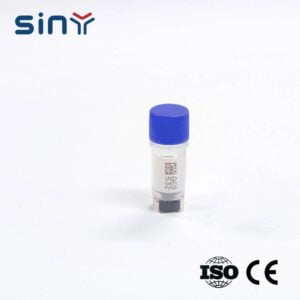
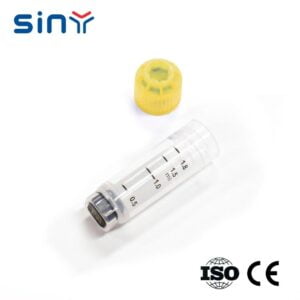
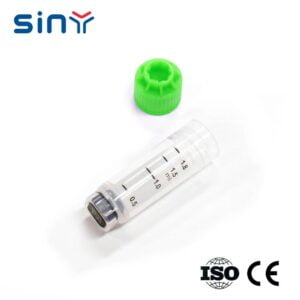
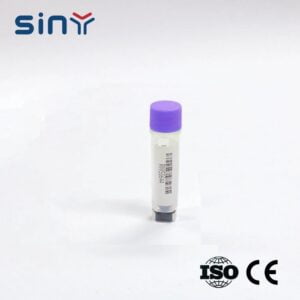
Siny Medical supplies PP Cryovial Tube 5ml Sterile 2D Cryogenic Tube products for biological sample freezing, preservation, and laboratory identification. These 5ml polypropylene cryovials combine sterile supply with machine-readable identification, providing a practical storage solution for laboratories handling larger biological sample aliquots.
Our 5ml sterile 2D cryogenic tubes are designed for workflows where container cleanliness, sample identification, and suitable low-temperature storage are important. The 5ml capacity provides more space than smaller cryovials, while the 2D barcode helps laboratory personnel associate each container with its corresponding specimen record.
The product description identifies a bottom 2D code, tube-body barcode, and numerical identifier. Together, these elements support individual vial identification and organized laboratory recordkeeping.
The listed cryogenic application includes storage in the vapor phase of liquid nitrogen at temperatures as low as -196°C. The selected vial assembly must be used according to its validated storage conditions and laboratory preservation procedures.
As a laboratory consumables supplier, Siny Medical provides cryogenic storage products for biotechnology companies, research institutions, biobanks, and international distributors. We support customers with practical product selection and bulk procurement requirements.
The 5ml capacity is one of the defining features of this product.
Compared with smaller cryovials, a 5ml container provides additional space for compatible biological preparations.
This can be useful when researchers need to preserve larger sample aliquots or prepare multiple portions from the same source material.
For example, a laboratory may use a 5ml cryogenic tube for a prepared biological suspension that requires more capacity than a standard small-volume vial.
However, nominal capacity does not necessarily equal the recommended working volume. Laboratories should follow the selected product’s filling instructions and preservation protocol.
Our 5ml cryogenic tubes are made from polypropylene (PP).
Polypropylene is widely used in laboratory consumables because it provides lightweight construction and useful resistance to many common laboratory chemicals.
Suitable PP formulations can also support low-temperature sample storage.
For research laboratories processing numerous biological specimens, polypropylene containers provide a practical format for preparation, freezing, and organized storage.
The complete vial assembly determines compatibility with the intended storage procedure.
The product is identified as sterile.
Sterile cryogenic containers are useful when a laboratory procedure requires a container supplied in a sterile condition.
This may be important for selected cell culture, biotechnology, and contamination-controlled sample preparation workflows.
However, sterile supply does not eliminate the need for aseptic handling.
Laboratory personnel must maintain appropriate procedures during opening, filling, closing, and storage.
Sterility also should not be interpreted as evidence of suitability for a particular clinical application.
The cryovial incorporates 2D barcode identification for laboratory sample management.
A two-dimensional code provides a machine-readable identifier that can be associated with an individual specimen.
With compatible scanning equipment, technicians can capture the identifier and retrieve the corresponding laboratory record.
The product description also identifies a coordinated coding system involving a bottom 2D code, a tube-body barcode, and a numerical identifier.
These identification elements support consistent sample tracking during preparation, freezing, storage, and retrieval.
The bottom-mounted 2D barcode provides an identification option for compatible scanning equipment.
This arrangement can be useful when laboratories organize cryovials in suitable racks or storage systems.
For example, technicians may scan individual containers during sample registration or retrieval.
However, compatibility depends on the code format, scanner, software, and physical storage arrangement.
Buyers should evaluate these requirements before integrating cryovials into an automated workflow.
The product description discusses screw cap designs and silicone O-ring sealing components.
Screw caps provide access to the specimen during preparation and retrieval.
A silicone O-ring can support the sealing interface between the cap and vial body.
The broader range includes internal-thread and external-thread arrangements.
The exact closure configuration should be verified for the selected 5ml sterile model.
Containment performance depends on the complete vial assembly and the conditions under which it is used.
The product description identifies liquid nitrogen vapor-phase storage at temperatures as low as -196°C.
This type of storage is used for compatible biological materials that require very low temperatures.
Cryogenic preservation may be part of cell research, biotechnology, and biological sample archiving.
However, suitability depends on the specimen, freezing protocol, and complete container assembly.
Direct immersion in liquid nitrogen requires separate validation and should not be assumed from the temperature rating alone.
The product’s identification system supports unique vial coding.
Individual identifiers help laboratories distinguish containers that may hold similar specimens.
For example, several vials may belong to the same experimental batch but contain separate aliquots.
A unique identifier allows each container to be associated with its own record.
This helps support organized laboratory inventory procedures.
Cell culture laboratories often prepare biological suspensions for freezing and future experiments.
A sterile cryogenic vial can provide a suitable container when the complete product meets the requirements of the cell preservation protocol.
The 5ml capacity may be useful for preparations that require more space than smaller cryovials.
Barcode identification also helps researchers distinguish cell preparations, experimental groups, and storage locations.
Successful cell cryopreservation depends on suitable cryoprotectants, freezing conditions, storage temperatures, and thawing procedures.
The cryovial is one component of the complete process.
Laboratories frequently divide biological preparations into separate aliquots.
This allows researchers to store individual portions for different experiments or analysis schedules.
A 5ml cryogenic vial provides additional nominal capacity for compatible sample portions.
The sterile configuration can be useful when the preparation procedure requires sterile containers.
Meanwhile, barcode identification supports individual specimen records.
Accurate aliquot volumes should be established with suitable liquid-handling equipment.
Biotechnology laboratories handle biological materials throughout different stages of research.
These may include sample preparation, processing, freezing, and long-term preservation.
A 5ml sterile cryovial provides a container option for compatible preparations.
Its barcode identifier helps personnel associate the physical specimen with processing and storage records.
This can support organized handling across different laboratory workstations.
Biobanks maintain biological specimens for future research.
Each sample requires suitable storage conditions and reliable identification.
Barcoded cryogenic vials help connect individual containers with specimen information and storage locations.
The 5ml format can be useful for selected larger aliquots.
Sterile supply may also be relevant when required by the specimen preparation workflow.
Long-term sample integrity still depends on validated preservation procedures, temperature monitoring, and accurate inventory records.
Microbiology laboratories preserve compatible microbial preparations for future research.
Cryogenic containers help organize individual samples under appropriate storage conditions.
A sterile vial may be selected when required by the preparation procedure.
The barcode identifier can be associated with strain information, preparation dates, or experimental records.
Suitable preservation conditions must be determined according to the microorganism and intended research application.
Research institutions may need to retain biological materials for extended periods.
Cryogenic storage can support the preservation of suitable specimens under controlled conditions.
A 5ml vial provides a practical container format for compatible sample volumes.
Barcode identification helps personnel locate and distinguish individual specimens during retrieval.
Effective archiving also requires appropriate storage equipment, temperature control, and laboratory records.
Sterile and non-sterile cryogenic tubes serve different laboratory requirements.
A sterile product is supplied in a condition intended to meet its specified sterility requirements.
A non-sterile product does not carry the same sterile supply claim.
The appropriate choice depends on the specimen preparation procedure and contamination-control requirements.
| Feature | Sterile 5ml Cryovial | Non-Sterile Cryovial |
|---|---|---|
| Supply Status | Sterile | Non-sterile |
| Main Selection Factor | Workflows requiring sterile containers | Workflows without a sterile container requirement |
| Sample Capacity | 5ml | Depends on selected model |
| Sample Identification | 2D barcode | Depends on selected model |
| Storage Suitability | Depends on validated vial assembly | Depends on validated vial assembly |
Sterile supply is not a substitute for aseptic laboratory procedures.
Likewise, non-sterile containers should not be selected for applications that require verified sterile consumables.
Capacity affects how laboratories prepare and organize specimens.
Smaller cryovials are useful for individual low-volume aliquots.
A 5ml container provides more space for compatible biological preparations.
However, a larger vial is not automatically better.
Laboratories should consider sample volume, required headspace, storage equipment, and preservation procedures.
Using an appropriately sized container helps support consistent specimen handling.
Handwritten labels provide a simple way to identify samples.
However, manual identification can become difficult when laboratories manage large specimen collections.
A 2D barcode provides a machine-readable identifier.
With compatible scanning equipment, personnel can associate the container with an electronic record.
This reduces dependence on repeated manual transcription.
Nevertheless, barcode systems still require accurate initial records and consistent laboratory procedures.
An effective cryogenic storage system involves several components.
These include suitable containers, appropriate racks, temperature monitoring, identification procedures, and inventory records.
Barcoded cryovials support the identification component.
For example, a laboratory may associate each vial with a storage box and rack position.
When a specimen is retrieved, personnel can use the identifier to locate its record.
This supports organized storage without relying entirely on visual inspection.
Cryogenic storage requires careful control of preparation and handling conditions.
Laboratories must select suitable containers and follow appropriate freezing procedures.
Sterile supply may help meet the requirements of contamination-controlled preparation workflows.
A suitable closure also supports containment during intended storage conditions.
However, sample integrity depends on the complete preservation process, not on the cryovial alone.
Start by identifying the volume of material that needs to be preserved.
The 5ml capacity is useful for compatible preparations that require more space than smaller cryovials.
Buyers should consider the recommended working volume and any required headspace.
This helps ensure that the selected container fits the preservation protocol.
The product is identified as sterile.
Buyers should determine whether their workflow requires sterile containers.
For regulated or contamination-sensitive applications, the relevant sterility documentation and packaging configuration should be reviewed before use.
The sterilization method should be confirmed from the applicable product documentation rather than assumed.
The product description identifies a bottom 2D code, tube-body barcode, and numerical identifier.
Buyers should consider how these identifiers will be used during sample preparation and storage.
Important factors include code format, scanner compatibility, reading position, and software integration.
This is especially relevant for laboratories using electronic inventory systems.
The broader product range describes internal-thread and external-thread screw cap designs.
Buyers should verify the exact closure supplied with the selected 5ml sterile model.
They should also review the associated sealing components.
The complete assembly must meet the laboratory’s handling and storage requirements.
The product description identifies liquid nitrogen vapor-phase storage at temperatures as low as -196°C.
Laboratories should confirm that the selected container is suitable for their intended storage equipment.
The complete vial assembly must match the preservation procedure.
Direct liquid nitrogen immersion requires separate validation.
Laboratories handling numerous samples benefit from consistent identification and storage procedures.
Barcodes can be associated with storage boxes, rack positions, and electronic specimen records.
The selected cryovial should fit the intended storage arrangement.
Scanner and rack compatibility should be evaluated when automated identification is required.
Sterile products require suitable packaging and handling to maintain their intended condition before use.
Buyers should review the applicable packaging configuration, labeling, and handling instructions.
They should also confirm that the supplied format fits their laboratory workflow.
These details are important for institutional purchasing and distributor inventory planning.
Research laboratories, biotechnology facilities, and distributors often purchase cryogenic consumables in bulk.
Purchasing teams should consider product specifications, identification requirements, supply arrangements, and order quantities.
Siny Medical supports OEM procurement discussions and international laboratory consumables supply.
We help customers identify practical cryogenic storage products for different research applications.
It is a 5ml cryogenic storage container with sterile product positioning and 2D barcode identification. It is used for compatible biological sample freezing, preservation, and tracking.
The product is identified as a polypropylene (PP) cryogenic tube.
A 5ml cryovial provides more nominal capacity than smaller freezing tubes. It can be useful for compatible biological preparations that require additional storage space.
Yes. The product is identified as sterile. Buyers should review the applicable sterility documentation and packaging configuration for their intended application.
The barcode provides a machine-readable identifier that can be associated with an individual specimen record using compatible scanning equipment.
The product description identifies storage in the vapor phase of liquid nitrogen at temperatures as low as -196°C. Direct liquid-phase immersion requires separate validation.
The product range describes screw cap configurations. Buyers should confirm the exact closure and sealing components supplied with the selected 5ml sterile model.
Yes. Siny Medical supplies cryogenic laboratory consumables to institutional buyers and international distributors and supports OEM procurement discussions.
Siny Medical supplies PP Cryovial Tube 5ml Sterile 2D Cryogenic Tube products for laboratories requiring larger sample capacity, sterile containers, and barcode identification. Our polypropylene cryogenic storage products support biological research, specimen organization, and laboratory procurement. Contact Siny Medical to discuss product specifications, sterility documentation, barcode configurations, bulk orders, and quotation details.
Copyright © 2026 | Ningbo Siny Medical Technology Co., Ltd