| Specification | Details |
|---|---|
| Product Name | 0.5ml Cryogenic Vials Cryotubes 2D Cryogenic Vials |
| Product Type | Cryogenic Storage Vial |
| Capacity | 0.5ml |
| Identification | 2D Barcode |
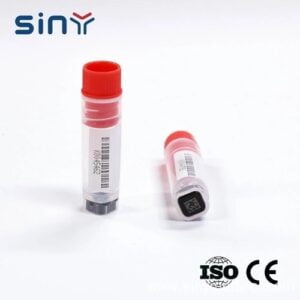
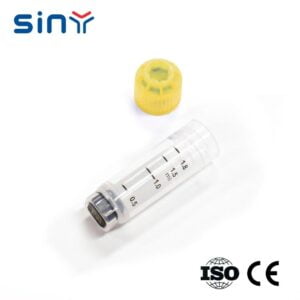
Siny Medical supplies 0.5ml Cryogenic Vials Cryotubes 2D Cryogenic Vials for small-volume biological sample storage and laboratory identification. These compact cryogenic tubes combine a 0.5ml capacity with 2D barcode identification, helping laboratories organize specimens throughout preparation, freezing, storage, and retrieval.
Our 0.5ml 2D cryogenic vials are designed for laboratories that handle numerous small-volume samples. The compact format allows researchers to divide biological materials into individual aliquots, while machine-readable identification supports accurate sample records.
A 2D barcode provides a convenient way to connect a physical sample container with its corresponding laboratory information. With compatible scanning equipment, technicians can identify specimens and manage inventory without relying entirely on handwritten labels.
These features make small-capacity barcoded cryovials useful for research laboratories, biotechnology facilities, biobanks, and other institutions managing biological sample collections.
As a laboratory consumables supplier, Siny Medical provides cryogenic storage products for institutional buyers and international distributors. Our focus is on practical sample storage solutions, efficient procurement, and reliable product identification.
The 0.5ml capacity is the defining physical feature of this cryogenic vial.
Small-volume containers are useful when researchers need to preserve individual sample aliquots without using larger tubes.
For example, a laboratory may divide a biological preparation into several smaller portions for different experiments. Each aliquot can then be stored and retrieved separately.
This approach supports organized specimen management and helps reduce unnecessary handling of larger sample preparations.
The compact size also makes 0.5ml cryovials practical for laboratories managing extensive collections of small specimens.
The product incorporates 2D barcode identification for laboratory sample management.
A two-dimensional code stores an identifier in a compact, machine-readable format. Laboratories can use compatible barcode scanners to capture this information and associate it with a specimen record.
This reduces dependence on handwritten identification and manual transcription.
The exact barcode placement and reading arrangement depend on the selected product configuration.
For this reason, laboratories should evaluate the barcode layout together with their scanning equipment and storage procedures.
Sample traceability is important in biological research and long-term specimen management.
A barcode identifier helps laboratories connect each physical cryovial with the appropriate record.
For example, a sample record may contain the specimen category, preparation date, research project, and storage location.
When technicians retrieve a vial, scanning its identifier can help them locate the corresponding information.
This approach supports organized laboratory workflows and more consistent inventory records.
Many research procedures involve biological materials available only in limited quantities.
Small-capacity cryogenic vials provide a practical format for dividing these materials into individual portions.
Researchers can prepare separate aliquots for different experiments or analysis schedules.
In addition, storing individual portions can help reduce repeated handling of the same preparation.
The appropriate filling volume should follow the laboratory’s preservation protocol and the selected vial’s working-volume requirements.
Cryogenic vials are used to preserve compatible biological specimens under controlled low-temperature conditions.
These storage procedures may involve ultra-low-temperature freezers or other suitable cryogenic systems.
The selected container must match the intended storage temperature, closure requirements, and preservation method.
In particular, suitability for direct liquid nitrogen immersion requires specific product validation.
The 0.5ml format provides a convenient container size for small-volume freezing and specimen archiving.
Managing a large sample collection requires more than suitable storage containers.
Laboratories also need accurate identification, organized storage locations, and consistent recordkeeping.
Barcoded cryovials help connect these activities.
For example, technicians can associate vial identifiers with storage boxes, rack positions, and electronic inventory records.
This helps laboratories locate samples and manage collections across multiple research projects.
Biological sample aliquoting is a common application of small-capacity cryogenic tubes.
Researchers divide prepared specimens into individual portions before freezing or storage.
A 0.5ml vial is useful when only a small quantity of material is required for each experiment.
Separate aliquots also help laboratories organize samples according to their intended use.
With barcode identification, each vial can be associated with a distinct specimen record.
Cell research laboratories often preserve prepared cell suspensions for future experiments.
Small cryogenic vials can provide containers for compatible cell preparations.
The 0.5ml capacity is useful when researchers work with limited sample quantities or small experimental batches.
Barcode identification also supports the organization of different cell preparations.
However, successful cryopreservation depends on the complete freezing protocol, including suitable cryoprotectants, cooling conditions, storage temperatures, and thawing procedures.
Microbiology laboratories maintain collections of compatible microbial preparations.
Small cryogenic containers help technicians organize specimens for future research.
For example, individual vials may be associated with different strains, experimental groups, or preparation dates.
The barcode identifier provides a convenient link between the physical container and its laboratory record.
This supports efficient sample management in research environments.
Biobanks frequently manage large numbers of biological samples.
Each specimen needs accurate identification and an organized storage location.
Our 0.5ml cryogenic vial format supports small-volume sample collections.
Meanwhile, 2D barcode identification helps laboratories connect individual containers with their inventory records.
These features are particularly useful when specimen collections grow over time.
Biotechnology laboratories handle biological materials across multiple experiments and processing stages.
A compact cryovial provides a convenient format for compatible small-volume samples.
Barcode identification supports organized tracking as specimens move between preparation, storage, and retrieval.
This combination helps laboratories manage research materials more efficiently.
Some research projects require biological specimens to remain available for future analysis.
Cryogenic storage can help preserve suitable materials under controlled conditions.
An effective sample archive combines appropriate containers, temperature monitoring, identification systems, and inventory records.
Barcoded cryovials support this process by providing identifiable containers for individual specimens.
A laboratory sample often has several associated data fields.
These may include specimen type, collection or preparation date, processing history, and storage location.
A 2D barcode can serve as an identifier linking the physical cryovial to these records.
With compatible scanning software, laboratory personnel can retrieve information without manually entering a long identification number.
This supports more consistent specimen documentation.
Handwritten labels and manually entered sample numbers can create identification challenges.
A machine-readable code provides an alternative method.
Technicians can scan the vial identifier during routine handling and use the captured information to access the corresponding record.
This reduces the need for repeated manual transcription.
However, accurate sample management still depends on correct initial data entry and established laboratory procedures.
As specimen collections grow, manual tracking becomes increasingly difficult.
Barcoded containers help laboratories organize larger inventories.
For example, a research facility may assign each cryovial to a specific storage location in its inventory system.
When the sample moves, staff can update the associated record.
This approach supports more efficient retrieval and inventory maintenance.
Not every barcode scanner supports every code format or placement.
Therefore, laboratories should evaluate the selected cryovial alongside their existing identification equipment.
Important considerations include barcode readability, scanner compatibility, software integration, and storage configuration.
The physical location of the code also affects how a vial can be scanned.
For automated workflows, buyers should verify compatibility with their intended equipment before selecting a product configuration.
Both barcoded and non-barcoded cryovials can serve as containers for compatible biological samples.
Their main difference is the identification method.
| Feature | 0.5ml 2D Barcoded Cryovial | Standard Non-Barcoded Cryovial |
|---|---|---|
| Sample Capacity | 0.5ml | Depends on model |
| Machine-Readable Identification | 2D barcode | Not integrated |
| Electronic Record Association | Supported with compatible systems | Requires a separate identification method |
| Inventory Management | Barcode-assisted tracking | Label-based or other tracking |
| Typical Selection Focus | Small-volume storage and identification | General sample storage |
The appropriate choice depends on the laboratory’s identification procedures and storage requirements.
Start by identifying the amount of material that needs to be stored.
The 0.5ml format is suitable for small-volume sample aliquots.
Laboratories should consider both nominal capacity and the working volume required by their preservation procedures.
This helps buyers select a suitable container size.
A 2D barcode should fit the laboratory’s sample identification process.
Buyers should consider how specimens are registered, scanned, and tracked.
For example, some laboratories use handheld readers, while others use integrated scanning equipment.
The selected barcode configuration should match the intended workflow.
Barcode placement affects scanning procedures.
Different configurations may require different reading arrangements.
Therefore, buyers should verify the selected vial’s barcode location and compatibility with their scanning equipment.
This is especially important for laboratories using automated sample identification systems.
Cryogenic storage requirements vary according to the specimen and preservation procedure.
Laboratories should review the intended temperature, storage equipment, and freezing method.
The selected vial assembly must be suitable for those conditions.
Direct liquid nitrogen immersion requires specific validation.
Cryovial closure designs can differ between products.
A suitable closure supports routine sample preparation, handling, and storage.
Buyers should review the selected cap configuration and any associated sealing components.
Containment performance depends on the complete vial assembly and operating conditions.
Barcode identification is most effective when combined with accurate laboratory records.
Technicians should associate each vial identifier with the correct specimen information.
Additional labeling may be useful according to the laboratory’s identification system.
Consistent procedures help maintain organized sample collections.
Laboratories that regularly prepare small-volume aliquots may consume large quantities of cryogenic vials.
Purchasing teams should estimate demand according to sample processing volumes and storage schedules.
For distributors, inventory planning also helps support regular customer supply.
Clear product identification and suitable packaging arrangements are important parts of procurement.
Buyers should consider product specifications, barcode configuration, supply arrangements, and intended applications.
Siny Medical supplies cryogenic storage consumables to research institutions, biotechnology facilities, and international distributors.
We support customers in selecting practical laboratory products for different sample management requirements.
They are used for small-volume biological sample storage and identification. Common applications include sample aliquoting, cell research, microbiology, and specimen banking.
The compact capacity is useful for storing smaller sample portions. It helps laboratories organize individual aliquots without using larger containers unnecessarily.
A 2D barcode provides a machine-readable identifier. Laboratories can associate this identifier with specimen information using compatible scanning and recordkeeping systems.
Not necessarily. Barcode placement depends on the selected product configuration. Buyers should verify the location when evaluating scanner compatibility.
Barcode identifiers can support electronic sample records. Integration depends on the scanner, code format, software, and laboratory system.
They can be used for compatible small-volume cell preparations when the selected vial and preservation protocol meet the laboratory’s requirements.
Direct liquid nitrogen immersion requires specific validation of the complete vial assembly. It should not be assumed from the product category alone.
Yes. Siny Medical supplies laboratory consumables to institutional buyers and international distributors, including customers purchasing cryogenic storage products in bulk.
Siny Medical supplies laboratory consumables for research institutions, biotechnology companies, biobanks, hospitals, and international distributors. Our 0.5ml Cryogenic Vials Cryotubes 2D Cryogenic Vials combine compact sample storage with barcode-based identification to support organized laboratory workflows. Contact Siny Medical to discuss available configurations, barcode requirements, bulk purchasing, and quotation details.
Copyright © 2026 | Ningbo Siny Medical Technology Co., Ltd