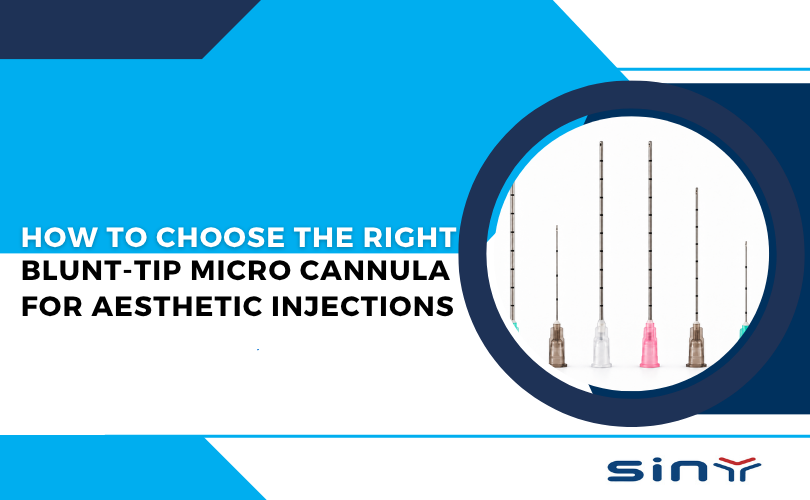
Blunt-Tip Micro Cannulas are thin, flexible medical tubes with a rounded, non-sharp tip. They are commonly used in aesthetic medicine to deliver dermal fillers and other compatible injectable materials into selected tissue planes. Unlike a conventional hypodermic needle with a sharp beveled point, a microcannula is designed to move through tissue with less direct cutting action.
That small difference in tip design changes how the device is used.
Instead of repeatedly puncturing the treatment area with a sharp needle, a practitioner typically creates an entry point first. The microcannula is then inserted through this opening and guided beneath the skin. Depending on the treatment area and technique, the practitioner may distribute material across a relatively broad region from one access point.
For aesthetic clinics, distributors, medical suppliers, and other professional buyers, choosing a microcannula involves more than simply selecting a gauge. Length, flexibility, internal lumen, tip design, side-port quality, and injectable viscosity can all influence handling and flow.
This guide explains what blunt-tip microcannulas are, how they work, how they differ from conventional needles, and what buyers should consider when choosing them.
What Are Blunt-Tip Micro Cannulas and How Are They Designed?
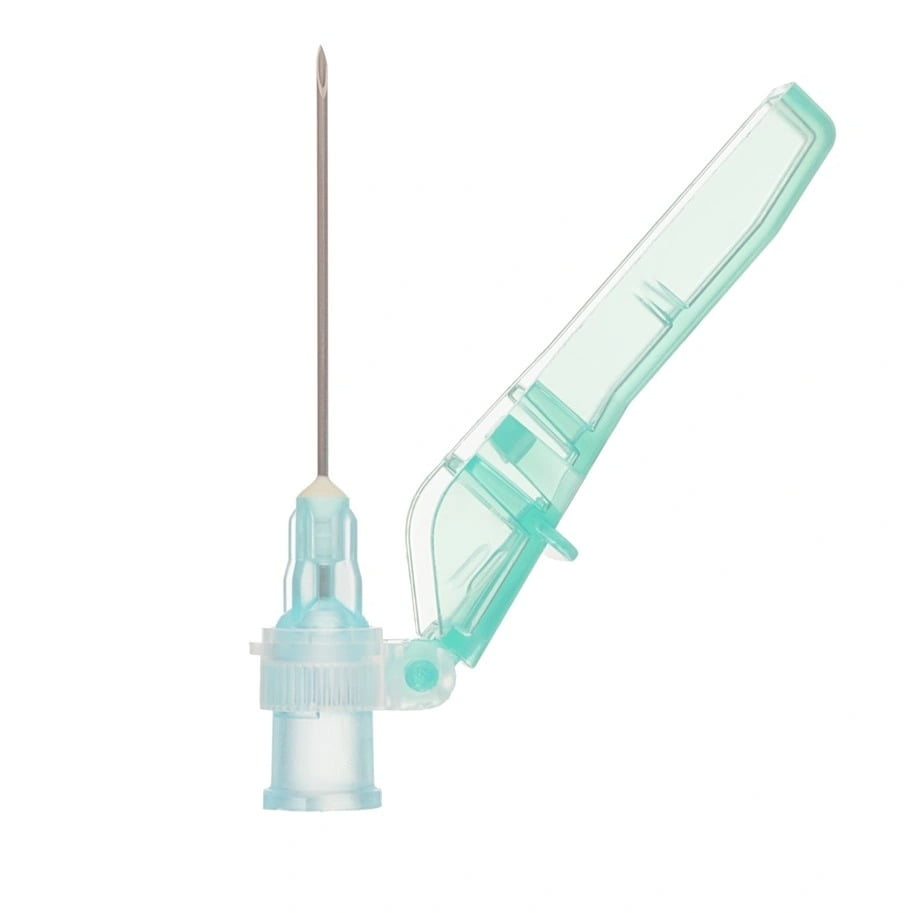
At first glance, a microcannula may look like an elongated injection needle. However, several structural differences distinguish the two devices.
Understanding these features is the first step toward selecting an appropriate cannula for aesthetic applications.
Rounded Blunt Tip
The most recognizable feature is the closed, rounded tip.
A conventional injection needle has a sharp bevel designed to penetrate the skin and tissue directly. A blunt cannula does not have the same cutting point.
Instead, its rounded distal end is designed to pass through a previously created entry point. As it advances, the tip may reduce direct cutting action compared with a sharp needle.
This design is one reason microcannulas are commonly considered when practitioners want to reach a wider treatment area while limiting the number of skin punctures.
However, “blunt” should not be interpreted as “risk-free.” A blunt cannula can still damage or enter blood vessels under certain conditions. Safe use continues to depend on anatomical knowledge, appropriate technique, injection plane, pressure control, and practitioner training.
Side Port for Material Delivery
Because the distal end is closed, the injectable material usually exits through a small lateral opening positioned near the tip.
This opening is commonly called the side port.
The practitioner can position the cannula within the intended tissue plane and distribute material through this lateral opening. The design is particularly suited to techniques in which material is delivered gradually while the cannula is withdrawn or redirected.
The finish and consistency of the side port also matter. Rough edges or inconsistent openings can affect tissue passage and product flow.
Flexible Cannula Shaft
Microcannulas are generally more flexible than conventional injection needles.
However, good performance requires a balance between flexibility and control.
A cannula needs enough flexibility to navigate through the intended tissue plane. At the same time, excessive flexibility can make it harder for the practitioner to control its direction.
For this reason, cannula performance should not be evaluated by gauge alone. Tube material, wall thickness, manufacturing consistency, and shaft characteristics can also affect handling.
Hub and Syringe Connection
At the proximal end, the cannula connects to the syringe through a hub.
A stable connection helps the practitioner maintain control while advancing the cannula and delivering the injectable material. Depending on the product design, the hub may also help indicate the orientation of the side port.
Together, the blunt tip, lateral opening, flexible shaft, and hub create a device designed for controlled delivery through an established access point.
For professional buyers sourcing aesthetic injection consumables, Siny Medical can help discuss suitable microcannula configurations according to your purchasing requirements.
How Do Blunt-Tip Micro Cannulas Work?
The practical difference between a blunt cannula and a sharp needle becomes clearer during an injection procedure.
Because the cannula has a rounded tip, an appropriate skin entry point is generally created first. The microcannula is then inserted through this opening and advanced into the intended tissue plane.
Once positioned, the injectable material is delivered through the side port.
One Entry Point Can Provide Broader Access
A relatively long microcannula can reach different areas beneath the skin without requiring a new puncture every time the direction changes.
For example, the practitioner may redirect the cannula from the same access point using a fanning technique.
In suitable procedures, this can reduce the number of skin punctures needed to cover a treatment region.
The exact number of access points still depends on the treatment area, cannula length, anatomy, injectable material, and injection technique.
Material Is Delivered Through the Side Port
A conventional needle generally delivers material through its distal opening. A microcannula typically releases the material laterally.
This makes the device suitable for techniques such as linear threading and fanning, where material is distributed along a planned pathway rather than deposited only at a single point.
In practice, the practitioner may advance the cannula into the desired position and gradually inject while withdrawing it.
Cannula Dimensions Affect Flow
Flow characteristics are particularly important when working with injectable materials of different viscosities.
A narrow internal lumen creates greater resistance to flow. Therefore, pushing a relatively viscous material through a very fine cannula may require more force.
This is why simply choosing the smallest available gauge is not always the best approach.
The practitioner must consider external diameter, internal lumen, cannula length, injectable viscosity, and desired flow characteristics together.
For buyers, this also explains why two cannulas carrying the same nominal gauge may not necessarily feel identical during use. Differences in wall construction and manufacturing tolerances can influence the internal lumen and overall performance.
Blunt-Tip Micro Cannula vs. Needle: What Is the Difference?
Microcannulas and conventional needles are often compared as if one must replace the other. In clinical practice, they are better understood as different tools for different injection objectives.
| Feature | Blunt-Tip Micro Cannula | Sharp Needle |
|---|---|---|
| Tip design | Rounded and blunt | Sharp and beveled |
| Initial skin entry | Usually requires a pre-made entry point | Can puncture skin directly |
| Shaft | Generally flexible | Generally rigid |
| Product exit | Usually through a lateral side port | Through the distal needle opening |
| Treatment reach | Can access a wider region from one entry point | More localized placement |
| Injection approach | Often used for linear or fanning distribution | Useful for direct focal placement |
| Skin punctures | May require fewer in suitable procedures | May require multiple punctures |
| Tissue interaction | Less direct cutting action | Designed to penetrate tissue |
Neither option is universally better.
When Might a Microcannula Be Used?
A blunt filler cannula can be useful when a practitioner wants to distribute material across a relatively broad tissue plane.
Its length and flexibility can allow several directions to be approached from one access point. This characteristic may be useful for facial contouring and volume restoration where smooth distribution across a larger area is desired.
Microcannula techniques are used in areas such as the cheeks, jawline, chin, temples, nasolabial region, lips, perioral area, and selected periorbital treatments.
The appropriate technique depends on the specific anatomy and treatment objective.
When Might a Sharp Needle Be Used?
A sharp needle offers direct tissue penetration and precise focal access.
It may therefore be selected when the practitioner needs a highly localized injection or when the treatment technique requires direct placement at a specific point.
In many aesthetic practices, needles and cannulas are therefore complementary rather than interchangeable devices.
The choice should be based on the treatment region, tissue plane, injectable material, desired placement, and professional judgment.
Why Are Blunt Cannulas Used for Dermal Fillers?
The growing use of microcannulas in aesthetic medicine is closely related to their handling characteristics.
Rather than simply asking whether a cannula is “safer” than a needle, it is more useful to understand what its design can offer during suitable procedures.
Potential for Fewer Skin Punctures
One practical advantage is the ability to access a larger treatment region through fewer entry points.
A longer cannula can be redirected beneath the skin without requiring the practitioner to puncture the surface at every new injection location.
For some procedures, this can simplify access to broader treatment areas.
Potential for Less Bruising and Discomfort
Clinical studies comparing microcannulas with conventional needles have reported lower pain and bruising in some filler applications.
The blunt tip does not cut through tissue in the same manner as a sharp bevel. As a result, it may reduce direct tissue disruption during suitable injection techniques.
However, outcomes vary. Treatment location, device dimensions, injectable material, anatomy, and practitioner technique can all influence bruising and discomfort.
Therefore, these benefits should be described as potential advantages rather than guaranteed outcomes.
Useful for Controlled Filler Distribution
Microcannulas can also support smooth distribution over a wider treatment region.
The combination of length, flexibility, and lateral delivery makes them suitable for techniques where the practitioner wants to distribute filler along a planned pathway.
This characteristic can be particularly useful during facial contouring or volume restoration.
What About Vascular Occlusion Risk?
This is an important distinction for both practitioners and medical product suppliers.
Research has found an association between microcannula use and a lower observed rate of vascular occlusion compared with needles in dermal filler injections. However, a blunt tip does not make intravascular penetration impossible.
Cannula diameter, anatomical location, insertion force, injection pressure, tissue plane, and practitioner experience can all influence risk.
Therefore, a microcannula should be viewed as one part of a broader safe-injection strategy. It does not replace anatomical knowledge, clinical judgment, appropriate technique, or professional training.
For distributors, this also matters when describing the product. Claims such as “completely prevents vascular occlusion” or “cannot enter a blood vessel” should be avoided.
How to Choose the Right Blunt-Tip Micro Cannulas
For professional buyers, understanding how a microcannula works is only the beginning.
The next question is usually: Which configuration should I purchase?
There is no single gauge or length suitable for every aesthetic procedure. A better selection process considers the intended application step by step:
Treatment Area → Injectable Viscosity → Gauge → Length → Flexibility → Product Quality and Packaging
Step 1: Consider the Treatment Area
Start with the intended clinical application.
Different facial areas vary in size, anatomy, tissue thickness, and access requirements. A cannula intended for broader facial contouring may therefore require different dimensions from one selected for a more localized area.
Buyers supplying multiple aesthetic applications may need several gauge and length combinations rather than one universal size.
Step 2: Consider Injectable Viscosity
Next, consider the material that needs to pass through the cannula.
Injectable fillers vary in rheological properties and viscosity. A material that flows easily through one lumen may require substantially more injection force through another.
Therefore, the relationship between injectable viscosity and cannula lumen should be considered before selecting the final configuration.
Step 3: Select the Appropriate Gauge
Gauge refers to the external diameter of the cannula.
One detail can initially seem counterintuitive:
A higher gauge number generally indicates a thinner cannula.
For example, a 27G cannula has a smaller external diameter than a 22G cannula.
Gauge can influence rigidity, internal lumen, flow resistance, and handling. A finer cannula is not automatically the better choice, especially when the injectable material requires a larger flow pathway.
Step 4: Choose the Cannula Length
Length affects both reach and control.
A longer cannula may allow a practitioner to cover a wider area from one entry point. A shorter cannula, by contrast, provides different handling characteristics for more localized applications.
The appropriate length should therefore reflect the treatment region and intended injection technique.
Step 5: Evaluate Flexibility and Wall Construction
Two products with the same gauge and length can still perform differently.
The shaft flexibility and wall thickness affect how the cannula responds during advancement and injection.
Thin-wall construction may allow a larger internal lumen without increasing the external diameter. This can improve flow characteristics for certain materials.
Meanwhile, controlled shaft flexibility helps balance tissue navigation with directional control.
For professional purchasing, these characteristics can be just as important as the printed gauge on the package.
Step 6: Inspect Tip and Side-Port Quality
The distal portion of the cannula deserves close attention.
A consistent rounded tip helps the device move through the intended tissue plane, while a well-finished side port supports predictable material delivery.
Manufacturing consistency is especially important for distributors purchasing large quantities. Significant variation between units or production batches can affect the end user’s experience.
Step 7: Check Sterility, Packaging, and Supplier Reliability
Microcannulas are invasive medical devices. Therefore, purchasing decisions should extend beyond dimensions and unit price.
Professional buyers should evaluate:
- intended use;
- sterility status;
- individual packaging integrity;
- product traceability;
- shelf life;
- applicable regulatory documentation;
- manufacturing quality controls;
- labeling requirements;
- and batch consistency.
For distributors and private-label buyers, OEM packaging, labeling, order quantity, export documentation, and supply stability may also influence supplier selection.
When comparing products, it is therefore better to ask “Is this cannula appropriate and consistently manufactured for my intended application?” rather than simply looking for the thinnest or least expensive option.
If you are sourcing microcannulas for an aesthetic clinic, distribution network, or OEM project, you can contact Siny Medical to discuss your required configuration and purchasing requirements.
FAQ About Blunt-Tip Micro Cannulas
What is a blunt-tip microcannula?
A blunt-tip microcannula is a thin hollow tube with a rounded, non-sharp distal end. In aesthetic medicine, it is commonly used to deliver dermal fillers and other compatible injectable materials through a previously created skin entry point.
What is the difference between a cannula and a needle for fillers?
A conventional needle has a sharp beveled tip and can penetrate the skin directly. A filler cannula generally has a rounded tip, flexible shaft, and lateral opening. It normally enters through a pre-made access point and can be guided beneath the skin to reach a broader treatment region.
Are blunt-tip cannulas safer for dermal fillers?
Microcannulas have been associated with less bruising and a lower observed rate of vascular occlusion in some studies. However, they do not eliminate vascular or other injection-related risks. Safe treatment still depends on anatomy, technique, treatment plane, device selection, and practitioner experience.
What size microcannula is best for dermal fillers?
There is no universal best size. The appropriate gauge and length depend on the treatment area, injectable viscosity, required flow, desired flexibility, injection plane, and practitioner technique.
Does a higher gauge mean a larger microcannula?
No. Gauge numbering generally works in the opposite direction. A higher gauge number usually indicates a smaller external diameter. Therefore, a 27G cannula is thinner than a 22G cannula.
Why does microcannula length matter?
Length determines how far the cannula can reach from an access point and influences handling. Longer cannulas can provide broader reach, while shorter cannulas may be preferred for more localized applications.
Does a microcannula need an introducer needle?
A skin entry point generally needs to be created before inserting a blunt microcannula because its rounded tip is not designed to puncture intact skin like a conventional sharp needle. The exact method depends on the device and clinical technique.
Can a blunt cannula enter a blood vessel?
Yes, it is possible. A blunt tip does not guarantee that vascular penetration cannot occur. Cannula diameter, force, anatomy, injection plane, and technique can all influence risk.
Can blunt-tip microcannulas be reused?
Microcannulas labeled for single use should not be reused. Practitioners should follow the manufacturer’s instructions for use and applicable local requirements.
Choosing a Reliable Microcannula Supplier
A microcannula may appear to be a simple medical consumable, but its performance depends on several small design and manufacturing details.
For professional buyers, selecting Blunt-Tip Micro Cannulas means looking beyond gauge alone. Length, internal lumen, wall construction, shaft flexibility, tip finishing, side-port consistency, syringe connection, sterility, packaging, and manufacturing quality should all be evaluated together.
The goal is not simply to choose the smallest cannula. It is to match the device to its intended application while maintaining predictable quality across production batches.
This is particularly important for distributors, aesthetic clinics, medical suppliers, and private-label customers purchasing in volume.
Siny Medical supplies medical consumables for international markets and supports professional purchasing requirements. If you are sourcing microcannulas for clinic supply, distribution, or OEM projects, visit our product range or contact the Siny Medical team to discuss specifications, packaging, and purchasing requirements.