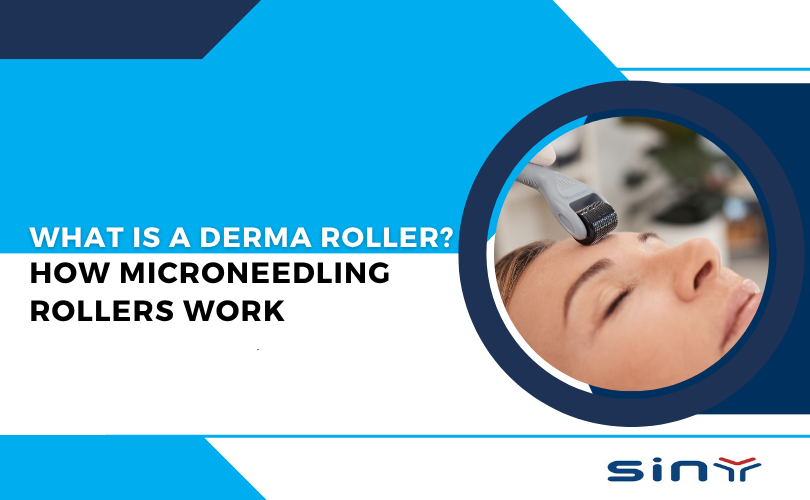
What is a derma roller? A derma roller is a handheld microneedling device covered with fine needles that create tiny, controlled microchannels in the skin. These micro-injuries trigger the skin’s natural repair response, which is why microneedling is widely associated with collagen remodeling and skin rejuvenation.
Also known as a microneedling roller, microneedle roller, or skin roller, the device usually consists of a handle and a rotating cylindrical head. Fine needles are distributed across the surface of the roller. As the device moves across the treatment area, the needles repeatedly contact the skin.
Derma rollers are used in different cosmetic and professional settings. Depending on the device, needle length, treatment area, and protocol, microneedling may be associated with skin rejuvenation, scar care, and certain hair-related treatments.
However, not every roller is designed for the same purpose. Needle quality, needle length, roller construction, hygiene, and manufacturing consistency can all affect how the device performs.
For clinics, aesthetic businesses, and distributors, understanding these differences is important before choosing a product or supplier.
What Is a Derma Roller Used For?
The basic purpose of a derma roller is to create controlled microchannels in the skin without producing the type of large wound associated with conventional skin injury.
This process is one form of microneedling, sometimes referred to as collagen induction therapy.
Professional microneedling has been studied for several aesthetic and dermatological applications, including:
- skin rejuvenation;
- fine lines and wrinkles;
- atrophic acne scars;
- uneven skin texture;
- certain pigmentation concerns;
- stretch marks;
- scalp and hair-related treatments.
The exact treatment approach can vary considerably between these applications.
A roller used for superficial cosmetic purposes, for example, should not automatically be treated as equivalent to a device used in a professionally controlled microneedling procedure. Needle depth, treatment frequency, skin condition, and operator technique all influence the treatment response.
Microneedling may also temporarily increase skin permeability. The tiny channels created during treatment can reduce some of the barrier function of the outer skin layer for a limited period.
However, this does not mean that every serum, cosmetic product, or medication is suitable for application to freshly microneedled skin. Products used during or after professional procedures should match the intended protocol.
For professional buyers exploring aesthetic consumables, you can explore Siny Medical’s product solutions or contact our team to discuss your purchasing requirements.
How Does a Derma Roller Work?
To understand how a derma roller works, it helps to look at what happens after the needles make controlled contact with the skin.
The process can be divided into several stages.
Creating Controlled Microchannels
As the cylindrical head rotates across the treatment area, its fine needles repeatedly enter and leave the skin.
The depth of this interaction depends on several factors, including needle length, roller design, applied pressure, treatment area, and technique.
Instead of removing a large area of tissue, the device creates many small points of controlled injury.
Starting the Natural Repair Response
The body recognizes these microscopic injuries and activates its normal wound-healing response.
Cell signaling begins around the treated tissue, and different growth factors participate in the repair process. Fibroblasts also play an important role because they are involved in producing components of the extracellular matrix.
This biological response forms the basis of collagen induction therapy.
Collagen and Tissue Remodeling
Collagen remodeling does not happen immediately after the roller passes over the skin.
It develops gradually during the healing process. New extracellular matrix components are produced and reorganized over time. This is one reason the results of professional microneedling are generally evaluated over weeks or months rather than immediately after a session.
This mechanism has made microneedling an area of interest for improving certain types of scars, fine lines, and skin texture.
The outcome, however, depends on the treatment indication, device, depth, technique, and individual skin response.
Temporary Changes in Skin Permeability
The microchannels can also temporarily alter the skin barrier.
This effect has led researchers to explore microneedling as a method of transdermal delivery. At the same time, increased permeability makes product selection and hygiene especially important after treatment.
A substance that is normally applied safely to intact skin is not automatically suitable for use on freshly microneedled skin.
The mechanism behind a microneedling roller is relatively straightforward, but good results depend on much more than simply rolling needles across the skin.
Derma Roller Needle Length: Why Size Matters
Needle length is one of the most important specifications when selecting a derma roller.
Different needle lengths interact with the skin at different depths. For this reason, they should not be viewed simply as interchangeable size options.
Common derma roller sizes include 0.25 mm, 0.5 mm, 1.0 mm, and 1.5 mm, although other needle lengths are also available. Shorter needles are generally associated with superficial cosmetic applications, while longer needles create deeper tissue interaction and require greater attention to technique and treatment protocols.
Common Derma Roller Needle Lengths and Applications
Different derma roller needle lengths are suited to different levels of skin interaction. Common sizes include:
- 0.20–0.30 mm: Mainly used for superficial cosmetic microneedling and temporary enhancement of skin permeability.
- 0.50 mm: Commonly associated with superficial aesthetic applications, including mild uneven skin texture, early fine lines, and some scalp or hair-related applications.
- 1.00 mm: Provides deeper skin interaction and may be used in professional procedures for atrophic acne scars, noticeable skin texture irregularities, and certain stretch marks.
- 1.50 mm: Generally associated with deeper professional microneedling for concerns such as more pronounced atrophic scars and striae (stretch marks).
These are general reference points rather than fixed treatment rules. The appropriate needle length depends on the treatment area, skin condition, intended application, and professional protocol. A longer needle does not automatically produce a better result.
For B2B buyers, needle length is an important product specification because different markets and professional users may require different configurations. If you are sourcing derma rollers for clinics, aesthetic businesses, or distribution, contact Siny Medical to discuss suitable options for your market.
Derma Roller vs. Derma Pen: What Is the Difference?
A derma roller and a derma pen both create controlled microchannels, but they do so in different ways.
A derma roller uses a rotating cylindrical head. The needles enter and leave the skin as the cylinder moves across the treatment area.
A derma pen usually uses a powered cartridge with needles that move rapidly up and down in a more vertical stamping motion.
This mechanical difference affects how the two devices are used.
How a Derma Roller Works
A roller has a relatively simple manual structure. Its advantages may include:
- portable design;
- straightforward manual operation;
- broad surface coverage;
- no electrical power requirement;
- simple device construction.
Because the user controls the movement manually, pressure and rolling speed depend more heavily on technique.
How a Derma Pen Works
A microneedling pen typically uses an electric drive system to create rapid needle movement.
Depending on the model, the operator may be able to adjust the treatment depth or operating speed. The smaller treatment head can also make it easier to work around localized areas or facial contours.
The better choice depends on how and where the device will be used.
A clinic performing controlled professional procedures may have different priorities from a distributor sourcing simple manual microneedling rollers for a particular market.
Neither should be confused with radiofrequency microneedling. RF microneedling combines needle penetration with radiofrequency energy and belongs to a different category of aesthetic equipment.
Understanding these distinctions helps buyers compare products based on their actual technology instead of treating every microneedling device as the same.
How to Choose a Derma Roller for Professional or Distribution Use
Knowing what a derma roller is explains the technology. Choosing a suitable product requires another level of evaluation.
For clinics, aesthetic suppliers, private-label businesses, and medical distributors, the quality of the finished device and consistency between production batches can be just as important as needle length.
Needle Quality
The needles are the working component of the roller.
Their dimensions and arrangement should be consistent, and the tips should be suitable for controlled skin contact. Poorly manufactured, bent, damaged, or irregular needles may produce unnecessary trauma instead of predictable microchannels.
Buyers should also confirm the needle material and relevant product specifications with the supplier.
Needle Length
The intended application should be identified before selecting needle length.
Instead of simply asking which length is “best,” buyers should consider who will use the product, where it will be used, and how it will be positioned in the target market.
Clear specifications are especially important when a distributor carries several configurations.
Roller Construction
The cylindrical head should rotate smoothly and remain stable during operation.
Poor alignment or an unstable roller can affect how consistently the needles contact the treatment area.
The handle also matters. A practical design should provide sufficient control without making the device unnecessarily complicated.
Hygiene and Packaging
Microneedling disrupts the skin barrier, so hygiene deserves particular attention.
Professional buyers should examine packaging, storage requirements, intended use, product handling, and relevant supplier documentation.
Products designed for single use should also have clear handling and disposal instructions.
Reusable consumer products and single-use professional products should not be assumed to have identical hygiene requirements.
Batch-to-Batch Consistency
A sample can show what one derma roller looks like. It does not necessarily show whether thousands of units will maintain the same quality.
For bulk buyers, batch consistency matters.
Needle arrangement, dimensions, roller construction, packaging, labeling, and overall workmanship should remain consistent between production runs.
This becomes increasingly important for distributors and private-label customers because inconsistent products can create quality complaints further down the supply chain.
Supplier Capability
Price is only one part of B2B purchasing.
Buyers may also need to consider production capacity, quality control, packaging options, customization capabilities, communication, and repeat-order stability.
A slightly lower unit price offers little advantage if product quality varies significantly between shipments.
For distributors and professional buyers evaluating microneedling supplies, Siny Medical can support bulk purchasing, distribution, and customization inquiries.
Derma Roller Safety, Hygiene, and Common Mistakes
Microneedling is minimally invasive, but it still disrupts the skin barrier.
Temporary redness, tenderness, swelling, dryness, or irritation can occur after treatment. The likelihood and severity of these reactions can vary with treatment depth, device type, technique, and individual skin characteristics.
Hygiene is particularly important.
A microneedling device should not be shared between users. Products intended for single use should be discarded according to the manufacturer’s instructions and applicable local requirements.
Microneedling should also not simply be performed over unhealthy or actively inflamed skin.
People with active skin infections, open wounds, active herpes lesions, significant inflammatory skin conditions, or other relevant medical concerns may require assessment by a qualified healthcare professional before undergoing treatment.
Another common mistake is assuming that more pressure means better results. It does not.
Excessive pressure may increase unnecessary tissue trauma without guaranteeing a better treatment response.
Treatment frequency also matters. The skin needs time to recover, particularly after deeper professional microneedling. Repeating the procedure too aggressively can increase irritation and compromise the skin barrier.
Post-treatment products deserve similar care.
Because fresh microchannels temporarily change skin permeability, products that are normally well tolerated on intact skin may behave differently after microneedling.
Clean technique, appropriate treatment parameters, suitable products, and proper aftercare are therefore essential parts of responsible microneedling.
FAQ About Derma Rollers
What is a derma roller?
A derma roller is a handheld microneedling device with a cylindrical head covered in fine needles. As the roller moves across the skin, these needles create controlled microscopic channels that trigger a natural repair response.
Is a derma roller the same as microneedling?
A derma roller is one type of microneedling device. Microneedling can also be performed with pen-style devices, stamping systems, and other professional equipment. Therefore, derma rolling is a form of microneedling, but not every microneedling treatment uses a roller.
How does a derma roller stimulate collagen?
The fine needles create controlled micro-injuries in the skin. These injuries activate wound-healing pathways involving cell signaling, fibroblast activity, and gradual collagen remodeling. The process develops over time rather than immediately after treatment.
What needle length should a derma roller have?
There is no single needle length suitable for every application. Common options include 0.25 mm, 0.5 mm, 1.0 mm, and 1.5 mm. The appropriate choice depends on the treatment area, intended purpose, skin characteristics, and whether the roller is intended for superficial cosmetic use or professionally controlled treatment.
How often should you use a derma roller?
There is no universal treatment frequency. It depends on needle length, treatment depth, skin response, intended application, and recovery time. Deeper professional microneedling generally requires more recovery time than superficial cosmetic rolling.
Can a derma roller be used for acne scars?
Professional microneedling has been studied for certain types of atrophic acne scars. However, active inflammatory acne is different from acne scarring. Rolling over active lesions may increase irritation or contamination concerns, so professional assessment is recommended.
Can a derma roller be used on the scalp?
Microneedling has been investigated as part of some hair-loss treatment approaches. Studies have used different devices, treatment depths, frequencies, and combination therapies, so there is no single microneedling protocol suitable for every scalp or hair condition.
Is a derma roller better than a derma pen?
Neither device is better for every situation. Derma rollers provide simple manual operation and broad surface coverage, while microneedling pens typically provide powered vertical needle movement and may offer adjustable treatment settings. The appropriate choice depends on the intended application.
Can a derma roller improve product absorption?
Microneedling creates temporary microchannels that can increase skin permeability. However, increased permeability does not mean every cosmetic or topical product is suitable for use immediately after microneedling.
Are derma rollers reusable?
It depends on the product design and intended use. Some consumer rollers are marketed as reusable with specific care instructions, while professional microneedling products may be designed for single use. Always follow the manufacturer’s instructions.
What should buyers look for when purchasing derma rollers?
Professional buyers should consider needle quality, needle length, roller construction, hygiene, packaging, batch consistency, manufacturing quality, and supplier capability. Distributors should also consider whether the available configurations match the requirements of their target market.
Choosing the Right Microneedling Roller
A derma roller may look like a simple device, but its performance depends on the interaction between needle design, treatment depth, roller construction, manufacturing consistency, hygiene, and technique.
Its basic principle is controlled microneedling. Fine needles create microscopic channels in the skin, initiating a natural repair response associated with tissue and collagen remodeling.
Different devices and needle configurations serve different purposes. Choosing a roller should therefore begin with the intended application rather than simply selecting the longest needle or the lowest price.
For clinics and distributors, product consistency becomes even more important. A reliable microneedling roller should combine consistent needle construction, stable rolling performance, appropriate packaging, and clearly defined specifications.
If you are looking for a Derma Roller supplier or sourcing aesthetic and medical consumables for your market, contact Siny Medical to discuss bulk purchasing, distribution, and customization requirements.