| Item | Specification |
|---|---|
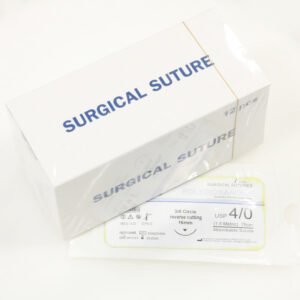
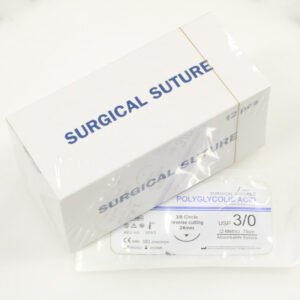
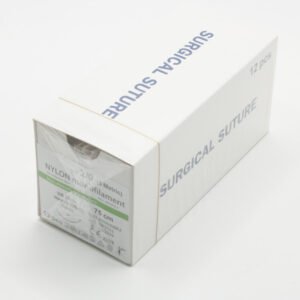
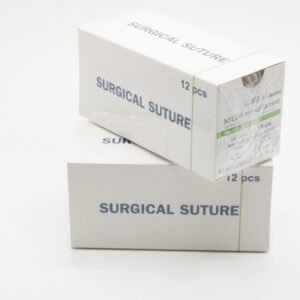
| Product Name | Nylon Suture Hospital Nonabsorbable Surgical Sutures |
| Product Type | Non-Absorbable Surgical Suture |
| Suture Material | Polyamide (Nylon) |
| Suture Structure | Monofilament |
| Absorption Type | Non-Absorbable |
| Suture Color | Blue |
| Application | Soft Tissue Approximation and Skin Closure |
Nylon Surgical Sutures are synthetic, non-absorbable surgical threads made from polyamide. They provide reliable tissue approximation for selected surgical procedures, especially skin closure. Their smooth monofilament structure allows controlled tissue passage and offers lower capillarity than braided alternatives.
Nylon sutures are widely used in hospitals, surgical departments, and outpatient clinics. Surgeons often choose them for external wound closure because they provide temporary mechanical support and can be removed after the wound has healed sufficiently.
Although nylon belongs to the non-absorbable suture category, its tensile strength may gradually decrease during prolonged implantation. Therefore, clinicians should consider the required support period before selecting this material.
Siny Medical supplies nylon surgical sutures for healthcare facilities and medical distributors. Different thread sizes, lengths, and needle configurations help meet specific surgical requirements.
Nylon is a synthetic polyamide material with distinctive mechanical and handling properties. Its monofilament construction makes it suitable for selected procedures that require smooth tissue passage and controlled wound approximation.
Nylon is manufactured from synthetic polymers rather than natural fibers. It provides mechanical strength during wound closure and does not undergo the predictable absorption process associated with absorbable sutures.
However, non-absorbable does not mean that the thread maintains its original strength indefinitely. Nylon may gradually lose tensile strength after prolonged implantation.
Monofilament nylon consists of a single continuous strand. This structure creates a smooth surface and generally produces less tissue drag than braided materials.
In addition, monofilament sutures have lower capillarity because they lack the spaces between fibers found in multifilament threads. Nevertheless, proper wound care remains essential because no suture material eliminates infection risks.
Nylon provides support while approximated tissues heal. Its performance depends on the thread diameter, wound tension, and surgical technique.
For external skin closure, the suture can maintain wound approximation during early healing. The clinician then removes it when the wound has developed sufficient strength.
Nylon offers useful handling characteristics, although monofilament threads may exhibit material memory. This means the thread tends to return toward its original shape.
As a result, surgeons should use appropriate knotting techniques to maintain secure closure. Thread diameter and needle design also influence handling during surgery.
The relatively smooth surface of nylon helps reduce friction as the thread passes through tissue. This characteristic can support controlled placement during skin closure and selected soft tissue procedures.
However, tissue trauma also depends on the needle, wound condition, and surgical technique.
Nylon sutures are commonly used when a synthetic non-absorbable thread is appropriate. Their applications range from routine skin closure to selected reconstructive procedures.
Skin closure is one of the most common uses of nylon. The thread helps hold wound edges together during healing and supports accurate tissue approximation.
Because nylon does not undergo controlled absorption, clinicians generally remove external sutures after an appropriate healing period. The timing depends on the wound location and patient condition.
Nylon may be used for selected soft tissue closures during general or minor surgical procedures. Its smooth surface and monofilament structure support controlled thread placement.
However, surgeons must consider wound tension and healing requirements before choosing the material.
Fine nylon sutures are used in selected plastic and reconstructive procedures. They can help surgeons position skin edges precisely when combined with an appropriate needle and closure technique.
Nevertheless, the final scar appearance depends on several factors, including tissue tension, wound care, and individual healing.
Clinicians may use nylon for selected traumatic skin wounds after proper wound assessment and preparation.
Before closure, they must evaluate contamination, tissue viability, and wound depth. Some wounds require alternative treatment or delayed closure.
Different suture materials offer different handling properties and long-term performance. Understanding these differences helps hospitals and distributors choose suitable products.
| Suture Material | Common Structure | Main Characteristics |
|---|---|---|
| Nylon | Monofilament | Smooth tissue passage; commonly used for skin closure |
| Polypropylene | Monofilament | High chemical stability and prolonged strength retention |
| Silk | Braided Multifilament | Flexible handling and good knot security |
| Polyester | Braided Multifilament | High-strength synthetic material for selected procedures |
Both materials are synthetic and non-absorbable. They are also commonly available in monofilament form.
However, polypropylene generally retains its mechanical properties more consistently during prolonged implantation. Nylon may gradually lose tensile strength over time.
Therefore, the choice depends on the required support period and surgical application.
Silk is a natural braided suture, while nylon is a synthetic monofilament material.
Silk offers flexible handling and favorable knot characteristics. In contrast, nylon generally has lower capillarity and a smoother surface.
Surgeons should consider tissue conditions, knot handling, and wound requirements when comparing these materials.
Polyester is another synthetic non-absorbable suture material. It is commonly supplied in braided form and serves selected procedures requiring particular mechanical characteristics.
Nylon differs in construction and long-term strength behavior. Therefore, the two materials should not be treated as interchangeable.
Hospitals and distributors should review several technical details before ordering surgical sutures. Material, thread diameter, length, and needle configuration all affect product selection.
USP size identifies the standardized diameter classification of a surgical suture.
Fine threads may be suitable for delicate tissue approximation. Larger diameters may be necessary when a procedure requires different mechanical support.
The surgeon should determine the appropriate size according to the tissue and closure technique.
Thread length affects the amount of material available during surgery.
Different procedures require different lengths. Therefore, buyers should specify the required thread length when preparing purchasing documents.
Nylon sutures may be supplied with different surgical needle designs.
Needle curvature, point geometry, and length affect tissue penetration and surgical access. For example, reverse-cutting needles are commonly used for selected skin closures.
However, the final configuration should match the intended procedure.
Monofilament nylon may exhibit material memory. Consequently, knot security and handling characteristics deserve attention during product selection.
Surgeons should use suitable knotting techniques and follow the instructions for the selected product.
For sterile surgical applications, the packaging must maintain the sterile barrier until use.
Purchasing teams should verify the product label, package integrity, expiration date, and selected configuration.
Hospitals often require multiple suture sizes and needle combinations.
Organizing inventory by material, USP size, thread length, and needle configuration helps reduce purchasing errors. It also makes routine stock management easier.
Proper handling helps maintain suture performance before and during use.
Before opening the package, check the material, thread size, needle configuration, and expiration date. If the product is supplied sterile, inspect the sterile barrier carefully. Do not use damaged or compromised packaging.
During surgery, avoid excessive gripping, crushing, or unnecessary tension on the thread. Mechanical damage may affect its strength and handling.
Because monofilament nylon can exhibit material memory, surgeons should pay attention to knot placement and security.
For external skin closure, the clinician determines the appropriate removal time. This decision depends on wound stability, location, and individual healing.
Store unused sutures according to their labeled instructions. Protect the packaging from excessive heat, moisture, direct sunlight, and physical damage.
Nylon surgical sutures are synthetic threads made from polyamide. They are commonly supplied as monofilaments and classified as non-absorbable.
No. Nylon is classified as non-absorbable. However, it may gradually lose tensile strength during prolonged implantation.
They are widely used for skin closure and selected soft tissue approximation procedures.
Nylon is a synthetic polyamide material, not a natural fiber.
Both are synthetic non-absorbable materials. However, polypropylene generally offers greater long-term chemical stability.
External nylon sutures are generally removed after an appropriate healing period. The clinician determines the timing based on wound conditions.
Nylon sutures can have different constructions. However, monofilament nylon is commonly used for skin closure.
Hospitals should confirm the material, USP size, thread length, needle configuration, packaging, and required quantities.
Siny Medical supplies Nylon Surgical Sutures for hospitals, surgical departments, clinics, and medical distributors. Their synthetic polyamide material and smooth monofilament construction make them suitable for selected skin closure and soft tissue approximation procedures. Contact Siny Medical to discuss available suture sizes, needle configurations, packaging options, samples, and bulk purchasing requirements.
Copyright © 2026 | Ningbo Siny Medical Technology Co., Ltd