| Specification | Details |
|---|---|
| Product Name | Laboratory Disposable Plastic Micro Centrifuge Test Tube |
| Product Category | Microcentrifuge Tube |
| Material | Polypropylene (PP) |
| Nominal Capacities | 0.2ml / 0.5ml / 1.5ml |
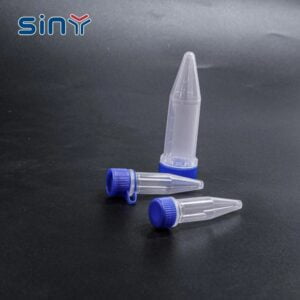
The Laboratory Disposable Plastic Micro Centrifuge Test Tube is a polypropylene (PP) laboratory consumable designed for handling, preparing, and centrifuging small-volume samples. Its compact format supports routine liquid transfers, reagent preparation, sample aliquoting, and compatible separation procedures.
Microcentrifuge tubes are commonly used in research laboratories, hospital laboratories, and diagnostic facilities. They provide convenient containers for biological samples, chemical solutions, and laboratory reagents when the tube material and operating conditions are suitable.
Siny Medical’s listed microcentrifuge tube range includes 0.2ml, 0.5ml, and 1.5ml configurations. These capacities help laboratories select an appropriate container for different sample volumes and processing requirements.
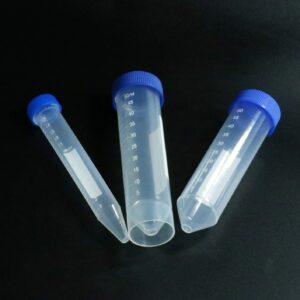
Unlike larger centrifuge tubes, which are commonly used for bulk sample preparation, microcentrifuge tubes focus on smaller quantities of liquid. Their compact dimensions also support organized workflows involving multiple samples.
Siny Medical supplies disposable laboratory tubes for medical distributors, research facilities, and laboratories seeking practical small-volume sample-handling solutions.
These laboratory microtubes are made from polypropylene, a plastic widely used in laboratory consumables.
Polypropylene offers low weight, practical rigidity, and useful resistance to many common laboratory reagents. These characteristics make it suitable for various routine sample-handling applications.
However, polypropylene is not universally compatible with every chemical. Its performance depends on reagent composition, concentration, temperature, and exposure time.
Laboratories should verify material compatibility before using aggressive solvents or specialized chemicals.
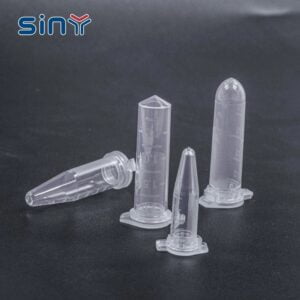
The product range includes three nominal capacities: 0.2ml, 0.5ml, and 1.5ml.
Each format serves different sample-volume requirements.
Smaller tubes may be useful for limited liquid quantities, while the 1.5ml format provides additional capacity for routine sample preparation and mixing.
The nominal capacity describes the tube size. It does not automatically establish the maximum recommended fill volume during centrifugation.
The listed microcentrifuge tube range includes different cap configurations.
The 0.2ml format is listed with flat-lid and domed-lid options. The 0.5ml and 1.5ml formats are listed with shield-style lids.
These closure designs support routine opening and closing during sample preparation.
Nevertheless, cap shape alone does not establish leakproof performance, aerosol containment, or suitability for thermal cycling.
The listed 0.5ml and 1.5ml configurations include graduation markings.
These markings provide a convenient visual reference when estimating liquid quantities.
The listed 0.2ml configurations do not include graduation markings.
For procedures requiring accurate volume measurement, laboratories should use calibrated pipettes rather than rely on tube graduations.
Disposable microcentrifuge tubes are intended for single-use sample-handling workflows.
Using a new tube for each procedure can help reduce contamination risks associated with reusing laboratory containers.
However, disposable construction does not automatically mean that a product is sterile, DNase-free, RNase-free, or endotoxin-free.
These characteristics must be verified for the selected product configuration.
Microcentrifuge tubes support a wide range of small-volume laboratory procedures.
Sample preparation often involves transferring a small quantity of liquid into a separate container.
For example, a laboratory technician may divide a specimen into smaller portions for different analytical procedures.
Microcentrifuge tubes provide compact containers for these aliquots.
Appropriate labeling and contamination-control practices remain essential, especially when processing clinical specimens.
Laboratory personnel frequently prepare small volumes of buffers, reagent mixtures, and other compatible solutions.
Microcentrifuge tubes provide a practical format for these procedures.
Users can add measured quantities of liquid using calibrated pipettes and mix the contents using a suitable method.
Before mixing, laboratories should confirm that the tube and closure are compatible with the equipment and operating conditions.
Compatible microcentrifuge tubes can be used to separate suspended particles from liquids.
During centrifugation, denser material may sediment toward the bottom of the tube.
After processing, laboratory personnel may remove the supernatant or collect the resulting pellet.
However, separation performance depends on the sample, centrifugal force, processing time, and equipment.
The selected tube must be rated for the intended centrifugation conditions.
Microcentrifuge tubes are commonly used in molecular biology laboratories for sample preparation and liquid handling.
For example, compatible tubes may support selected workflows involving nucleic acid extracts, proteins, or laboratory buffers.
Sensitive molecular biology procedures may require products with verified purity characteristics.
Buyers should confirm any DNase-free, RNase-free, or other specialized requirements before purchasing.
Hospital and diagnostic laboratories use small-volume containers during various specimen preparation procedures.
Microcentrifuge tubes may support selected preparation steps when the material, closure, and processing conditions meet the laboratory’s requirements.
However, not every microcentrifuge tube is suitable for direct patient specimen collection or every diagnostic assay.
Clinical laboratories should follow their validated procedures and relevant instrument instructions.
Selecting the appropriate tube capacity helps laboratories manage liquid volumes and equipment compatibility.
The 0.2ml format is intended for very small liquid quantities.
The listed product range includes flat-lid and domed-lid configurations without graduation markings.
Although 0.2ml tubes are commonly associated with PCR-related workflows, capacity alone does not establish suitability for thermal cycling.
Laboratories must verify that the selected model is compatible with the intended instrument and temperature program.
The 0.5ml format provides additional space for small-volume sample preparation.
The listed configuration includes graduation markings and a shield-style lid.
This format may suit compatible procedures involving reagent mixing, sample aliquoting, and microcentrifugation.
Before centrifugation, users should confirm rotor compatibility and the maximum permitted relative centrifugal force.
The 1.5ml format provides greater capacity for routine small-volume laboratory procedures.
The listed configuration includes graduation markings and a shield-style lid.
It may be useful for preparing sample mixtures, transferring aliquots, and processing compatible samples in a microcentrifuge.
However, the tube’s dimensions and operating limits must be checked before use with laboratory equipment.
| Feature | 0.2ml | 0.5ml | 1.5ml |
|---|---|---|---|
| Nominal Capacity | 0.2ml | 0.5ml | 1.5ml |
| Material | PP | PP | PP |
| Graduation Markings | No | Yes | Yes |
| Listed Lid Design | Flat or Domed | Shield Lid | Shield Lid |
| Packaging Format | Bulk Pack | Bulk Pack | Bulk Pack |
| Selection Focus | Very small liquid volumes | Small-volume preparation | Routine microtube workflows |
The table describes the listed product configurations. It does not imply that all capacities share identical centrifugation or temperature ratings.
Laboratories and medical distributors should consider the complete product configuration before purchasing.
Begin by determining the volume of liquid required for the intended procedure.
Consider whether the sample will be mixed with additional reagents or processed in several stages.
Choose a tube that accommodates the required liquid quantity without exceeding its documented operating limits.
Microcentrifuge tubes must fit the intended rotor or adapter correctly.
Tube dimensions, bottom geometry, and cap design can influence equipment compatibility.
Therefore, laboratories should not assume that all tubes with the same nominal capacity have identical dimensions.
Relative centrifugal force (RCF) is an important parameter in centrifugation.
The maximum permitted RCF depends on the selected tube’s construction and operating conditions.
Before use, laboratories should confirm the tube’s documented rating and follow the centrifuge manufacturer’s instructions.
A general description such as “high-speed centrifuge compatible” is not a substitute for a verified RCF limit.
Cap configuration can influence access to the sample and compatibility with laboratory equipment.
Flat, domed, and shield-style lids may serve different handling preferences.
However, buyers should verify closure performance when procedures require resistance to leakage or additional containment.
Polypropylene is useful for many laboratory procedures, but its compatibility is not unlimited.
Certain chemicals or temperature conditions may affect the tube body or closure.
Likewise, autoclaving, boiling, freezing, and PCR thermal cycling require product-specific compatibility information.
Users should not assume that every polypropylene microcentrifuge tube supports these conditions.
Some laboratory procedures require sterile consumables or defined molecular biology purity characteristics.
These may include DNase-free, RNase-free, or endotoxin-related specifications.
Such properties should be confirmed from the documentation for the selected product.
Sterilization methods should also be verified rather than inferred from the product category.
Packaging can affect storage, distribution, and daily laboratory operations.
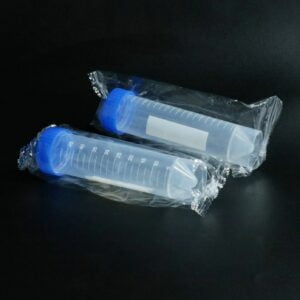
The listed microcentrifuge tube configurations use bulk packaging.
For procurement planning, buyers should review the product capacity, cap type, packaging quantity, and other documented characteristics.
A consistent purchasing specification helps laboratories avoid receiving tubes that are incompatible with existing procedures.
Inspect the tube and cap before use.
Check for visible damage and ensure that the closure is correctly fitted.
When centrifuging samples, balance the rotor and follow the equipment manufacturer’s instructions.
After use, dispose of the tubes according to the sample contents and applicable laboratory waste procedures.
A microcentrifuge tube is a small-volume laboratory container used for preparing, handling, and centrifuging compatible liquid samples.
The listed microcentrifuge tubes are made from polypropylene (PP), a plastic commonly used in laboratory consumables.
Siny Medical’s listed product range includes 0.2ml, 0.5ml, and 1.5ml microcentrifuge tubes.
No. The listed 0.5ml and 1.5ml configurations have graduation markings, while the 0.2ml configurations are listed without them.
The existing product information contains conflicting sterilization descriptions. Sterile status and sterilization method should be verified for the selected configuration before use.
Some microcentrifuge tubes are suitable for PCR-related sample preparation. However, PCR thermal cycling requires a tube specifically validated for the intended temperature program and instrument.
Only when the selected model is rated for the required RCF. Laboratories should verify the maximum centrifugal force and equipment compatibility before use.
Important factors include capacity, material, cap design, graduation markings, packaging, centrifuge compatibility, maximum RCF, and any required sterility or purity characteristics.
Siny Medical supplies laboratory consumables for research facilities, hospital laboratories, diagnostic centers, and medical distributors. Our Laboratory Disposable Plastic Micro Centrifuge Test Tube range includes polypropylene microtubes in 0.2ml, 0.5ml, and 1.5ml capacities for compatible small-volume sample-handling procedures. Contact Siny Medical to discuss available configurations, bulk purchasing requirements, and quotation details.
Copyright © 2026 | Ningbo Siny Medical Technology Co., Ltd