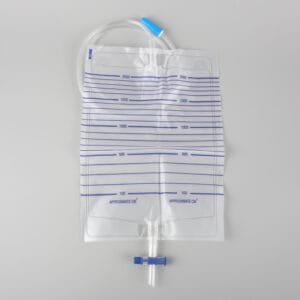
| Specification | Details |
|---|---|
| Product Name | 2-Way Foley Catheters For Urine Drainage |
| Product Type | Indwelling Urinary Catheter |
| Material | Latex |
| Configuration | 2-Way |
| Functional Channels | Urine Drainage |
| Primary Function | Continuous Urinary Drainage |
The 2-Way Foley Catheters For Urine Drainage are indwelling urinary catheters designed to provide continuous bladder drainage when patients cannot empty their bladder normally or require catheterization for medical care. Each catheter has two functional channels: one for urine drainage and another for inflating the retention balloon.
The latex-based catheter body provides flexibility during insertion and positioning. Once the catheter is correctly placed, urine flows through the drainage channel into a compatible collection bag. The retention balloon helps maintain the catheter’s position inside the bladder.
Unlike three-way Foley catheters, two-way models do not include a separate irrigation channel. They are primarily intended for urinary drainage rather than continuous bladder irrigation.
Siny Medical supplies two-way Foley catheters for hospitals, clinics, and medical distributors. These products support routine urinary care when indwelling catheterization is clinically indicated.
A two-way Foley catheter has two independent channels that perform different functions.
The drainage channel supports continuous urine collection. Meanwhile, the balloon helps prevent the catheter from slipping out after correct placement.
This straightforward configuration makes two-way Foley catheters suitable for clinical situations that require bladder drainage without a dedicated irrigation pathway.
This product uses a latex-based catheter body. Latex provides flexibility, which can help the catheter follow the urethral pathway during insertion.
However, catheter flexibility does not eliminate the possibility of discomfort or urethral injury. Correct sizing, insertion technique, and clinical assessment remain essential.
Natural rubber latex can also trigger allergic reactions. Therefore, clinicians should avoid latex-containing catheters in patients with known latex allergy.
The catheter has an inflatable balloon near its tip. After the catheter reaches the bladder and correct placement is confirmed, a trained healthcare professional inflates the balloon according to the selected model’s instructions.
The balloon helps maintain the catheter’s position during drainage.
Before insertion, healthcare professionals should check the product labeling for the required inflation volume and medium. Balloon specifications can vary between models.
The drainage outlet connects to a compatible urine collection system.
A properly assembled drainage system allows urine to flow into a collection bag without repeated disconnection. This is important because unnecessary breaks in the system can increase contamination risks.
Healthcare staff should check the connection and tubing arrangement during catheter care.
An indwelling Foley catheter remains in place to provide ongoing bladder drainage.
However, continuous drainage does not mean that catheterization should continue indefinitely. Healthcare professionals should reassess the indication regularly and remove the catheter when it is no longer needed.
Two-way Foley catheters are used in hospitals and other healthcare settings when an indwelling urinary drainage device is necessary.
Acute urinary retention occurs when a patient cannot empty the bladder adequately.
A healthcare professional may insert a Foley catheter to relieve retention and provide drainage while the underlying cause is assessed.
The decision to use an indwelling catheter depends on the patient’s condition and clinical requirements.
Some surgical procedures require temporary urinary catheterization.
For example, a two-way Foley catheter may be used during selected operations when clinicians need to manage bladder drainage or measure urine output.
However, routine catheterization is not necessary for every surgical patient. The indication and expected duration should be assessed before insertion.
Urine output can provide useful information during the care of certain critically ill patients.
An indwelling catheter connected to a collection system allows healthcare professionals to measure urine output when accurate monitoring is clinically necessary.
Nevertheless, catheterization should not replace less invasive monitoring methods when those methods are suitable.
Some patients require ongoing urinary drainage because of particular medical conditions.
A Foley catheter may be used when clinically indicated and when other bladder-management methods are unsuitable.
During extended use, healthcare professionals must follow the product instructions, monitor for complications, and regularly review the need for continued catheterization.
A Foley catheter is only one part of the urinary drainage system. Correct connection, positioning, and maintenance also affect how well the system functions.
A closed urinary drainage system helps limit unnecessary exposure of the drainage pathway to the surrounding environment.
After catheter insertion, staff should maintain secure connections between the catheter and collection tubing.
They should avoid disconnecting the system unless there is a clinical reason to do so.
If the system becomes disconnected or contaminated, healthcare professionals should follow the facility’s infection-prevention procedures.
Urine normally drains through the catheter and tubing into a collection bag.
The bag should generally remain below bladder level without resting on the floor. This arrangement helps reduce the risk of urine flowing backward toward the bladder.
Staff should also ensure that the tubing is not kinked or compressed.
Healthcare professionals should monitor drainage according to the patient’s clinical needs.
Reduced or absent urine flow may result from tubing obstruction, catheter blockage, or changes in the patient’s condition.
If drainage stops unexpectedly, staff should assess the system and follow appropriate clinical procedures rather than attempting unapproved manipulation.
Indwelling urinary catheters are associated with a risk of catheter-associated urinary tract infection (CAUTI).
Appropriate catheter use, aseptic insertion, a maintained closed drainage system, and timely removal are important infection-prevention measures.
A Foley catheter cannot eliminate infection risk through its material or design alone.
Two-way Foley catheters are intended primarily for urinary drainage and balloon retention.
When continuous bladder irrigation is necessary, clinicians generally select a suitable three-way catheter with a dedicated irrigation channel.
The catheter configuration should always match the intended procedure.
Hospitals and medical distributors should review the clinical application and product specifications before selecting a urinary drainage catheter.
First, determine whether the patient needs an indwelling urinary catheter.
A two-way Foley catheter is appropriate for selected situations requiring continuous bladder drainage. However, intermittent catheterization or other approaches may be preferable for some patients.
Foley catheter diameters are expressed in French (Fr) units.
Healthcare professionals should choose a size that provides adequate drainage while avoiding unnecessary urethral trauma.
The appropriate diameter depends on patient anatomy, clinical condition, and drainage requirements. A larger catheter is not automatically better.
Balloon capacity must match the selected catheter model.
Before use, clinicians should confirm the required inflation volume and medium from the product labeling and instructions.
Catheter diameter alone does not establish the correct balloon volume.
This product uses latex-based construction.
Because latex may cause allergic reactions, it is not appropriate for patients with known latex allergy. In these cases, healthcare professionals should select a verified latex-free alternative.
The catheter should connect securely to the intended urine collection bag and drainage tubing.
Buyers should review the connection design and equipment compatibility before ordering.
Medical buyers should verify the selected catheter’s size, length, balloon specifications, material, sterile status, packaging, and instructions for use.
For hospitals and distributors, clear product information supports appropriate selection, stock management, and purchasing decisions.
A two-way Foley catheter provides continuous urinary drainage. Healthcare professionals may use it for urinary retention, selected surgical procedures, or accurate urine output monitoring when clinically indicated.
The catheter has a drainage channel that carries urine from the bladder into a connected collection bag. A separate channel allows inflation of the retention balloon.
A two-way catheter has channels for urine drainage and balloon inflation. A three-way catheter includes an additional channel for bladder irrigation.
Yes. The drainage outlet is designed to connect to a compatible urine collection system. Healthcare professionals should verify the connection before use.
Keeping the collection bag below bladder level helps support gravity drainage and reduces the risk of urine flowing backward toward the bladder.
No. Latex-containing urinary catheters should be avoided in patients with known latex allergy. A suitable latex-free catheter should be selected instead.
The appropriate duration depends on the selected product’s instructions and the patient’s clinical condition. Healthcare professionals should regularly reassess the need for an indwelling catheter.
Hospitals should confirm catheter diameter, length, material, balloon specifications, sterile status, packaging, and compatibility with their urine collection systems.
Siny Medical supplies urinary catheters and other medical consumables for hospitals, healthcare facilities, and medical distributors. Our 2-Way Foley Catheters For Urine Drainage support continuous bladder drainage in appropriate clinical settings. Contact Siny Medical to discuss available product specifications, purchasing requirements, and quotation details.
Copyright © 2026 | Ningbo Siny Medical Technology Co., Ltd