Choosing a Foley catheter may look simple until you compare actual products. Different French sizes, catheter materials, balloon capacities, lengths, and 2-way or 3-way configurations can make the selection process more complicated than expected.
For hospitals, clinics, distributors, and medical supply buyers, understanding how to choose a Foley catheter means looking at these specifications together. Size alone does not determine whether a catheter is suitable for a particular application.
A suitable Foley catheter should provide effective urinary drainage while avoiding unnecessary urethral pressure and trauma. The intended application, expected catheterization period, urine characteristics, patient needs, and required drainage capacity all influence the choice.
This guide explains the main factors buyers should compare before selecting Foley catheters or building a product range.
How to Choose a Foley Catheter Size
Foley catheter diameter is normally expressed in French size, abbreviated as Fr, F, or sometimes Ch/CH. The French scale refers to the catheter’s external diameter.
The basic relationship is:
1 Fr ≈ 0.33 mm external diameter
For example, a 12 Fr catheter has an external diameter of approximately 4 mm, while an 18 Fr catheter measures approximately 6 mm.
However, a larger catheter is not automatically better.
Clinical guidance generally favors using the smallest catheter diameter that can still provide adequate drainage. This approach can reduce unnecessary pressure on the urethra and bladder neck.
A practical reference range is:
| Patient or Application | Common Foley Catheter Size |
|---|---|
| Pediatric patients | 6–10 Fr |
| Small adults / clear urine | 10–12 Fr |
| Routine adult urinary drainage | 12–14 Fr |
| Mild debris or light hematuria | 16 Fr |
| Heavier debris or moderate blood clots | 18 Fr |
| Heavy hematuria/irrigation requirement | 20–24 Fr |
These ranges are general selection references, not fixed prescriptions. The final catheter size should follow clinical assessment, institutional protocols, the intended application, and the manufacturer’s instructions for use.
There is another detail buyers should understand: French size measures external diameter, not internal drainage lumen.
Two 16 Fr catheters can have the same external diameter but different internal lumen dimensions. Material and wall construction influence how much internal space is available for drainage.
This becomes particularly relevant when comparing silicone and latex-based products. Increasing the French size is therefore not the only way to evaluate drainage performance.
For procurement teams, Foley catheter size should always be considered together with material, lumen design, and clinical application.
Choosing Foley Catheter Material: Latex vs. Silicone
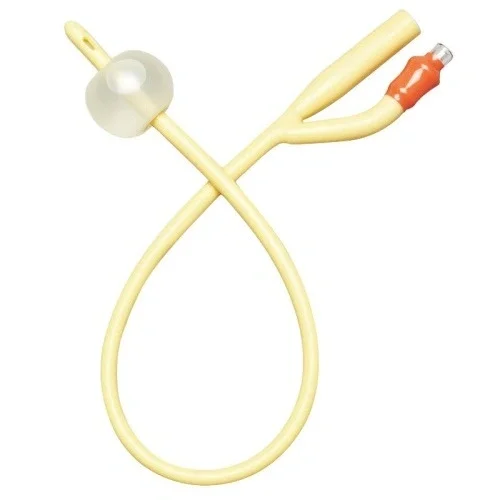
Material is another important factor in Foley catheter selection. Common options include latex-based catheters, coated latex catheters, and 100% silicone catheters. Their construction differs, so buyers should look beyond general product names and confirm the actual material stated in the specification.
Latex Foley Catheters
Latex provides a flexible catheter shaft and is widely used in Foley catheter manufacturing. Latex-based catheters may also be supplied with a surface coating, depending on the product design.
The key point for buyers is to distinguish between coated latex and all-silicone construction. A silicone-coated latex Foley catheter still has a latex-containing catheter body. It should therefore not be considered equivalent to a 100% silicone catheter.
This distinction becomes particularly important when latex exposure is a concern. When comparing quotations or technical documents, check the stated catheter material rather than relying on the word “silicone” in the product description alone.
100% Silicone Foley Catheters
A 100% silicone Foley catheter is made without a latex catheter body and provides a latex-free option. Silicone construction can also result in different wall and internal lumen characteristics compared with latex-based designs.
This matters because the French size describes the catheter’s external diameter. Two catheters with the same Fr size may not necessarily have identical internal lumen dimensions if their materials and construction differ.
Indwelling duration is another factor when comparing catheter materials. Latex-based Foley catheters are commonly associated with shorter-term use, while 100% silicone catheters are often considered when longer-term catheterization is required. However, the actual permitted duration depends on the specific product, manufacturer labeling, and applicable clinical requirements.
For hospitals and distributors, first determine whether a latex-containing or latex-free product is required, then consider the expected indwelling period and other specifications for the intended application.
Foley Catheter Selection by Application
Once the required size and material have been considered, the next question is how the catheter will be used.
The application often determines whether a standard 2-way catheter or a more specialized configuration is required.
Routine Urinary Drainage
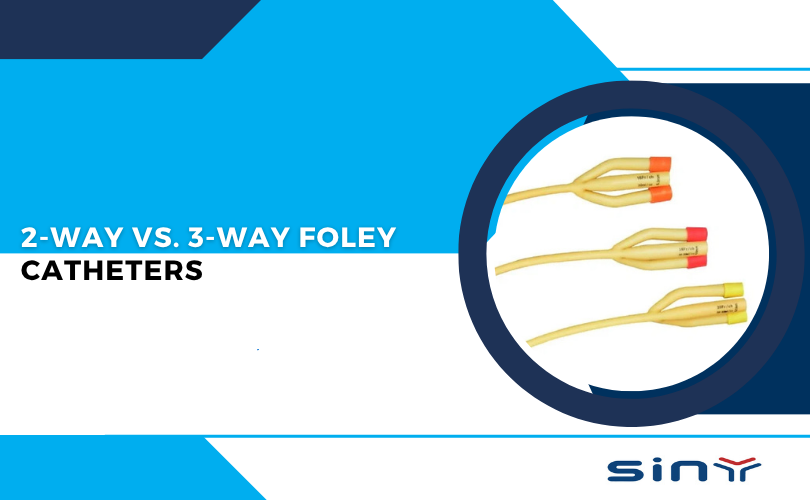
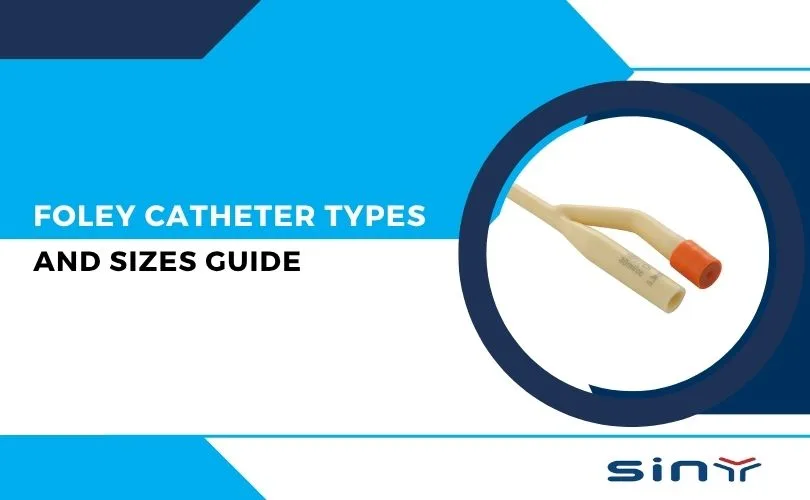
A 2-way Foley catheter is the standard configuration for many routine drainage applications.
It contains two separate channels:
- One lumen drains urine from the bladder.
- The second lumen is used to inflate the retention balloon.
This design may be used for perioperative drainage, acute urinary retention, urine-output monitoring, and other situations where continuous bladder drainage is clinically indicated.
For uncomplicated drainage with clear urine, an appropriately smaller adult size is generally preferred when it can provide sufficient flow.
Hematuria and Bladder Irrigation
Patients with significant hematuria, blood clots, or a need for continuous bladder irrigation may require a 3-way Foley catheter.
It contains three channels:
- A drainage lumen
- A balloon inflation lumen
- An irrigation lumen
The additional channel allows irrigation fluid to enter the bladder while fluid, urine, blood, and other material can drain through the catheter.
Because irrigation and clot management require sufficient flow capacity, 3-way catheters are commonly available in larger French sizes.
This distinction matters when planning inventory. A hospital that performs urological procedures may require both standard 2-way Foley catheters and 3-way irrigation catheters rather than simply stocking more sizes of one configuration.
Difficult Catheterization
Tip design can also change according to the application.
Standard Foley catheters usually have a relatively straight tip and are suitable for many routine catheterizations.
A Coudé or Tiemann tip has a curved end. This design may assist catheter passage in selected difficult catheterization situations, including some cases involving prostatic obstruction.
These catheters should not simply be viewed as upgraded standard Foley catheters. They are designed for specific clinical situations and should be used by appropriately trained healthcare professionals.
For distributors supplying urology departments, adding specialty tip options can broaden the catheter range without unnecessarily duplicating routine products.
Foley Catheter Balloon, Length and Other Specifications
Size, material, and catheter configuration usually receive the most attention, but several smaller specifications can also affect product selection.
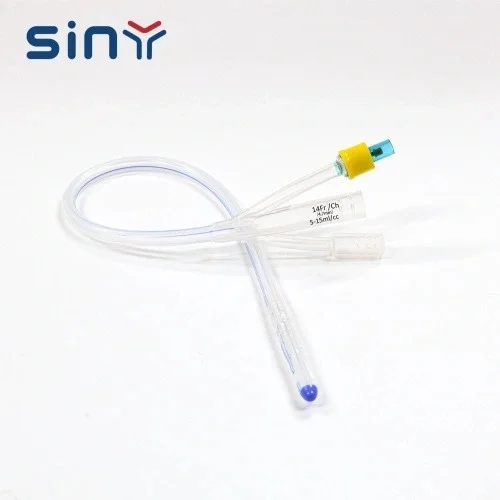
Balloon Capacity
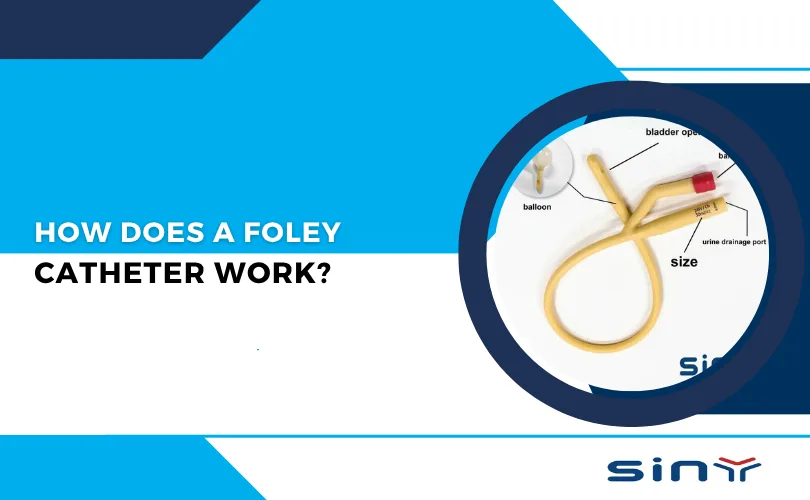
The retention balloon sits close to the catheter tip. Once the catheter is correctly positioned in the bladder, the balloon is inflated according to the manufacturer’s instructions to help retain the catheter.
Balloon capacity varies according to catheter design and application.
A larger balloon should not be selected simply because greater retention seems desirable. Balloon volume needs to match the intended use and product instructions.
For purchasing purposes, balloon capacity should always be specified together with catheter size and configuration.
Catheter Length
Length is another specification that should not be overlooked.
Adult male urethral catheters are generally longer because of male anatomy. Female-length catheters may be shorter, while pediatric catheters require dimensions appropriate for younger patients.
When comparing suppliers, confirm the actual catheter length rather than relying only on descriptions such as “adult Foley catheter.”
Drainage Eyes
Drainage eyes are the openings near the catheter tip through which urine enters the drainage lumen.
Their shape, placement, and surface finish contribute to catheter drainage and insertion characteristics. Smoothly finished drainage eyes can also help reduce rough contact with surrounding tissue.
For bulk purchasing, buyers can evaluate drainage-eye finishing together with shaft consistency, connectors, balloon performance, and packaging quality.
Color-Coded Connectors
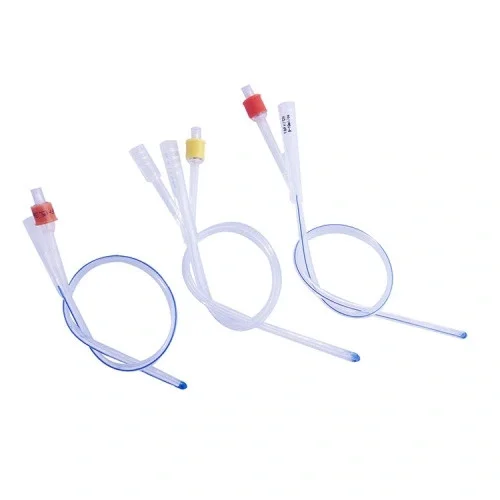
Many catheter ranges use color-coded connectors to make French sizes easier to identify.
This is useful in busy clinical environments and can simplify stock management. However, healthcare professionals should still verify the printed catheter size rather than relying solely on connector color.
These features may appear minor when comparing specification sheets. In practice, they can matter when large numbers of catheters are stored and used across several hospital departments.
How to Choose a Foley Catheter for Purchasing
For hospitals and distributors, the goal is not to stock every available Foley catheter. It is to build a practical range around actual clinical applications.
Start with the departments and procedures you need to supply. General wards may mainly require standard 2-way catheters, while urology departments may also need larger sizes, 3-way irrigation catheters, or specialty tip designs. Pediatric applications require a different size range.
Next, determine the required French sizes and materials. If latex exposure is a concern, confirm whether the catheter is latex-free rather than assuming that a silicone-coated product is equivalent to 100% silicone.
Before ordering, check the complete specification:
- French size and catheter length
- Latex, coated latex, or 100% silicone
- 2-way or 3-way configuration
- Balloon capacity and tip design
- Sterilization and individual packaging
- Shelf life and lot identification
- Required regulatory and quality documentation
This helps buyers compare like-for-like products. Two 16 Fr Foley catheters, for example, may differ in material, balloon capacity, lumen configuration, or intended application.
For larger orders, samples can also help verify catheter construction, connectors, balloon performance, packaging, and overall product quality before final purchasing.
FAQ About Foley Catheter Selection
What is the most common Foley catheter size for adults?
There is no single size suitable for every adult.
For uncomplicated drainage with clear urine, 12–14 Fr is a common reference range in adult catheterization guidance. Larger sizes may be required when debris, hematuria, blood clots, or irrigation needs affect drainage.
The smallest suitable size that provides adequate drainage is generally preferred.
Is a 16 Fr Foley catheter bigger than a 14 Fr catheter?
Yes.
French size measures external catheter diameter. Since 1 Fr equals approximately 0.33 mm, a 16 Fr catheter has a larger external diameter than a 14 Fr catheter.
However, French size does not directly indicate internal lumen diameter. Material and wall construction also influence the available drainage lumen.
Which is better: silicone or latex Foley catheters?
Neither material is universally better.
Latex-based products offer flexibility and are commonly used for shorter-term catheterization, while 100% silicone provides a latex-free option and is often considered for longer-term use.
The actual choice and permitted indwelling duration should follow the specific product labeling, clinical requirements, and intended application.
Is silicone-coated latex the same as a 100% silicone Foley catheter?
No.
A silicone-coated latex catheter still contains a latex-based catheter body beneath the coating. A 100% silicone Foley catheter does not use a latex catheter body.
Buyers should therefore confirm the material specification when comparing products, particularly when latex exposure is a concern.
What is the difference between a 2-way and 3-way Foley catheter?
A 2-way Foley catheter has one channel for urinary drainage and another for balloon inflation.
A 3-way catheter adds an additional irrigation channel. It is commonly used when bladder irrigation is required, including selected cases involving significant hematuria or postoperative urological care.
Does a larger Foley catheter provide better drainage?
Not necessarily.
A larger French size increases the catheter’s external diameter, but drainage also depends on internal lumen size, material, wall thickness, drainage-eye design, and the presence of debris or clots.
The objective is adequate drainage with an appropriately sized catheter rather than simply selecting the largest available size.
What should buyers confirm before ordering Foley catheters in bulk?
Confirm the French size, material, number of lumens, balloon capacity, catheter length, tip design, sterilization, packaging, shelf life, labeling, and applicable regulatory documentation.
Buyers should also verify whether products described as silicone are 100% silicone or silicone-coated latex.
Choose the Right Foley Catheter for Your Market
A reliable Foley catheter range should be built around its intended applications. Size determines external diameter, while material, lumen configuration, balloon capacity, catheter length, and tip design help determine where and how the product can be used.
For hospitals, clinics, importers, and medical distributors, defining these requirements before comparing suppliers makes product selection much easier.
If you are sourcing Foley catheters for hospitals, distribution, or tender projects, explore the Siny Medical product range or contact us to discuss your required specifications and packaging.