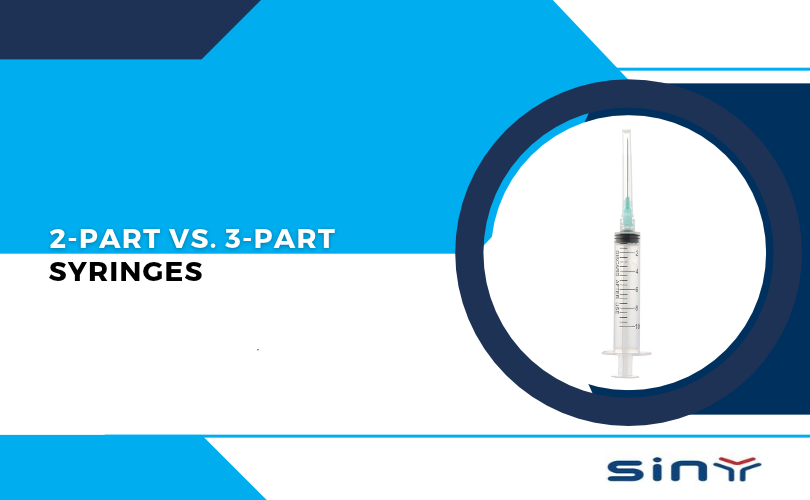
When comparing 2-Part vs. 3-Part Syringes, the main difference is how the plunger seals against the barrel. A two-piece syringe uses a shaped plastic plunger to create the seal. A three-piece syringe adds a separate elastomer stopper to the plunger rod. This changes the sealing arrangement, the materials that contact the fluid, and the factors that influence plunger movement.
For medical buyers, those differences matter when evaluating handling, matching customer specifications, and comparing quotations. A useful purchasing decision brings construction together with capacity, graduation, connector type, and intended application. Understanding how these details work together makes it easier to select a suitable product and maintain consistent repeat orders.
What Defines a Two-Piece or Three-Piece Syringe?
Two-piece syringes: a barrel and an integral sealing plunger
A two-piece syringe consists of a graduated barrel and a plastic plunger. The sealing end of the plunger is shaped to fit the inner barrel wall without a separate elastomer gasket. Withdrawing the plunger draws fluid into the barrel; advancing it expels fluid through the tip.
This construction is relevant when customers request a syringe without a separate rubber component. Two-piece syringes also have established medical injection and aspiration applications. Their suitability depends on the intended use and the performance of the specific product.
Three-piece syringes: a separate stopper forms the seal
A three-piece syringe consists of a barrel, plunger rod, and separate stopper, also called a gasket or piston. The stopper sits at the fluid-facing end of the rod and maintains contact with the barrel during movement.
The flexible sealing component allows its material and geometry to be designed separately from the rigid plunger rod. Together with a suitable barrel and lubrication system, it supports controlled aspiration and injection. This sliding seal is the central functional feature of three-piece construction.
The component count describes the syringe assembly. Needle inclusion, capacity, and connector type are separate ordering details.
| Comparison point | Two-piece syringe | Three-piece syringe |
|---|---|---|
| Main components | Barrel and plastic plunger | Barrel, plunger rod, and separate stopper |
| Sealing surface | Integral plastic plunger end | Flexible elastomer stopper |
| Factors affecting movement | Plunger geometry, barrel fit, and material formulation | Stopper geometry, barrel fit, and lubrication |
| Material considerations | Barrel, plunger, and any additives or lubricating agents | Barrel, plunger, stopper, and any lubricating agents |
| Lubrication considerations | Some models are specified without silicone oil; plastic formulations may contain slip agents | Many conventional models use silicone lubrication |
| Relevant purchasing preference | An assembly without a separate elastomer stopper | A flexible stopper arrangement for controlled plunger movement |
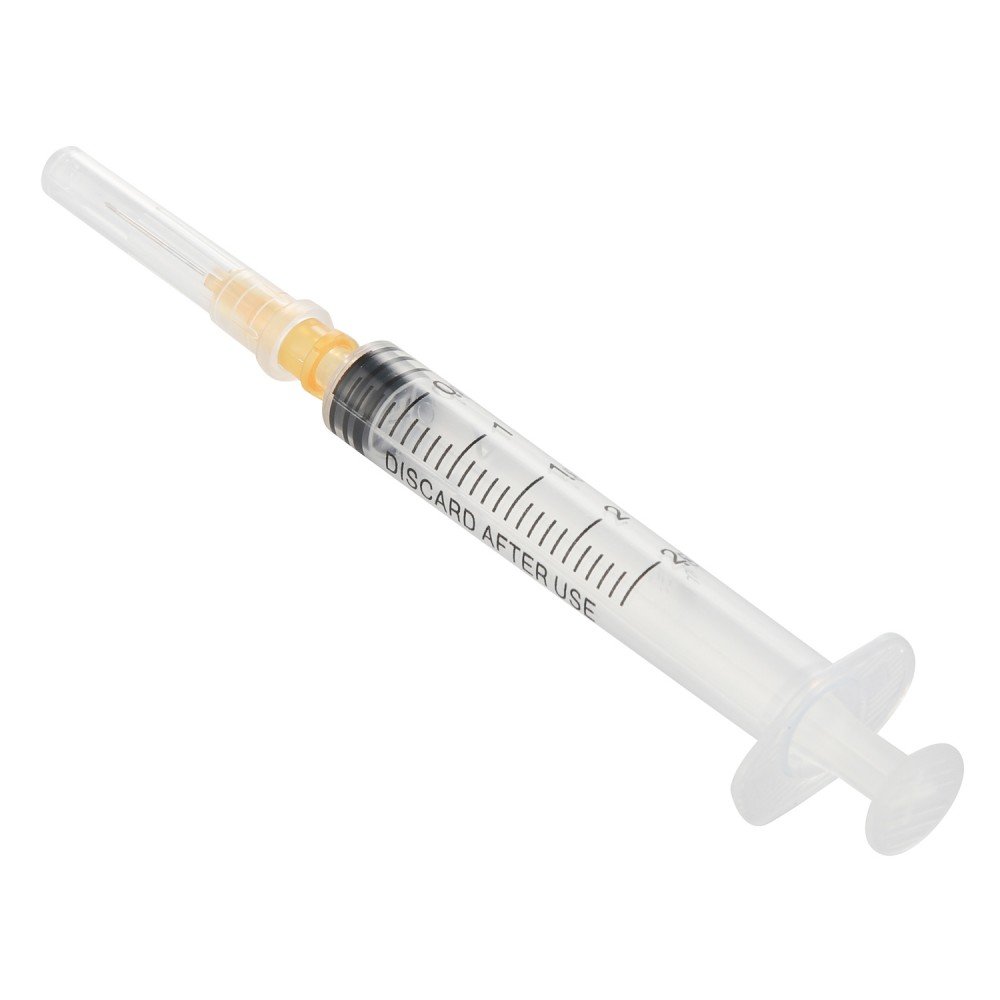
How Syringe Design Affects Sealing and Plunger Control
Why the flexible stopper matters
In a three-piece syringe, the elastomer stopper forms the moving seal against the barrel. Its flexibility helps it maintain sealing contact as the user withdraws or advances the plunger. The stopper’s shape and material work with the barrel dimensions to determine the sealing and sliding behavior.
Suitable lubrication reduces friction at this interface. When these features work together, the plunger can move evenly during aspiration and administration. For buyers, the practical benefit is a syringe that feels predictable as the user starts, continues, and stops movement.
A two-piece syringe achieves its seal through the fit between its integral plunger end and the barrel. Well-designed products can also provide smooth operation. Evaluating actual samples reveals how the two approaches perform in the handling conditions relevant to your customers.
Starting force and sliding force
The force required to start plunger movement is called break-loose force. Glide force describes the force needed to keep it moving. Both contribute to the operator’s experience.
Static friction between the stopper and barrel, often described as stiction, contributes to break-loose force. This interaction can change while the plunger remains stationary during storage. Material choice, lubrication, and aging influence the resulting force profile. For bulk purchasing, review available evidence of plunger performance over the stated shelf life alongside the remaining shelf life on arrival.
During sample assessment, compare syringes of the same capacity under equivalent conditions. Observe whether the plunger starts predictably, travels evenly, and responds to small adjustments. Sudden jumps or noticeable changes in resistance are more useful observations than a general description such as “soft” or “premium.”
Also assess the finger flanges and thumb rest. A comfortable grip helps the user control the syringe, so handling should be evaluated as a complete assembly.
Connecting handling with dosing accuracy
Smooth movement supports handling, while dosing accuracy depends on graduation quality, dimensional consistency, and correct use. The stopper contributes to sealing and plunger control; the scale provides the reference for measuring the fluid.
Purchasing teams should therefore review both usability and documented performance. Sample evaluation addresses user preferences, while relevant test information supports the assessment of graduation accuracy and sealing. This gives buyers a clearer basis for approval than choosing by component count alone.
2-Part vs. 3-Part Syringes: Materials and Lubrication
Reviewing the materials that contact the fluid
Common industry material combinations include a polypropylene (PP) barrel with a polyethylene (PE) plunger for two-piece syringes. A common three-piece arrangement uses a PP barrel and PP plunger rod with a separate elastomer stopper. In a technical specification, identify the barrel, plunger, and stopper materials individually.
Stopper formulations can include synthetic polyisoprene or butyl-based rubber. The selected compound contributes to flexibility, sealing, and compatibility with the intended fluid. Buyers should review the documented formulation together with any lubricating agents.
Synthetic stopper options allow some three-piece syringes to be manufactured without natural rubber latex. Where a purchasing program has a latex-related requirement, the documented material statement for the complete product should guide selection. Stopper color is a visual feature, not a reliable material identifier.
For two-piece syringes, the barrel and integral plunger end form the main fluid-contact surfaces. Their materials and any additives remain relevant when assessing compatibility with the intended fluid.
Distinguishing silicone oil from other lubricating agents
Many conventional three-piece syringes use silicone lubrication to reduce friction between the stopper and barrel. Some two-piece models are specified without silicone oil. That distinction can matter when an application has a particular material-contact requirement.
For example, particle-sensitive laboratory testing may require control of silicone oil droplets. Certain protein-based formulations also require evaluation of interactions with silicone oil. The material requirement should reflect the actual analytical method or formulation and its contact conditions.
However, a silicone-oil-free product may still contain a slip agent within its plastic formulation. These agents assist movement without an applied silicone oil layer. A purchasing specification should therefore distinguish a requirement to avoid silicone oil from a broader requirement concerning lubricating agents.
The intended fluid and contact conditions also belong in the review. If a syringe will hold a prepared medicine before administration, the pharmacy or hospital should assess the proposed syringe and closure for that storage workflow.
Choosing Two-Piece or Three-Piece Syringes for Your Customers
When to prioritize three-piece construction
Three-piece syringes are worth prioritizing when customers value a flexible stopper arrangement and controlled plunger movement. They are also a logical starting point for replacing existing three-piece stock, where staff familiarity is part of the acceptance criteria.
For hospital buyers, the next step is to identify the required capacity, scale, connector, and supplied contents. Distributors can use the same approach to organize their range around the specifications customers regularly reorder.
At Siny Medical, we supply both constructions, with a primary focus on three-piece syringes. Our product selection discussions can therefore start with the three-piece design while also accommodating purchasing programs that specify two-piece products.
When two-piece products fit the requirement
Two-piece syringes suit purchasing programs that call for an assembly without a separate elastomer stopper. They may also meet an established customer preference for that construction or a documented requirement for a particular silicone-oil-free model.
Budget comparisons should use equivalent configurations. Capacity, packaging, needle inclusion, order volume, and delivery terms all affect the quotation. Comparing the complete specification gives a clearer picture of value than assuming a price difference from the number of components.
Approving a replacement
Compare the proposed syringe with the existing product and involve the intended users in sample evaluation. Record the handling characteristics and specifications that influenced acceptance.
For pump applications, check the exact syringe model and capacity against the equipment manufacturer’s compatibility information. Pump suitability depends on the approved syringe and equipment combination.
Explore Siny Medical’s syringe products to begin comparing options for your customers’ intended applications.
Key Specifications for Bulk Syringe Purchasing
Capacity and graduation
Specify both nominal capacity and graduation interval. Capacity identifies the syringe’s stated volume; graduation interval identifies the volume represented by adjacent scale markings. The clinical team’s measurement requirements should guide the combination selected.
For example, “5 mL three-piece syringe” identifies capacity and construction. Adding the required scale and connector makes the order more precise.
Connector and supplied needle
Select the connector independently of construction. Luer slip uses a fitted taper, while Luer lock adds a locking arrangement. Match the connector to the intended procedure and compatible accessories.
Also specify tip position. A concentric tip aligns with the barrel’s center, while an eccentric tip is offset toward its side. An eccentric arrangement can help position an attached needle closer to the skin at a lower angle. Tip position and the locking mechanism are separate specifications, and available combinations vary by model and capacity. Confirm the exact tip and connector combination for each size in the order.
State whether the order requires a syringe alone or supply with a needle. Where applicable, include needle gauge, length, and whether it is attached or supplied separately. Record these details against the exact product reference.
Safety mechanisms, auto-disable features, and fixed-needle configurations are additional specification choices. Identify them separately from the two-piece or three-piece sealing design.
Residual volume
Dead space is the volume remaining after the plunger is fully depressed under the specified conditions. The syringe tip, plunger-end geometry, and needle connection contribute to residual fluid in the complete assembly.
Where minimizing residual volume is important, compare documented information for the proposed configuration. Low dead space is a specific design characteristic that should be evaluated separately from two-piece or three-piece construction.
Packaging and repeat-order consistency
For sterile clinical supply, review the sterile presentation, packaging integrity, lot identification, expiry date, and storage information. Check the documentation and labeling required by the destination market.
For technical review, ISO 7886-1 provides requirements and test methods for sterile single-use hypodermic syringes intended for manual use. ISO 80369-7 addresses small-bore connectors for intravascular or hypodermic applications. Use the applicable requirements to guide requests for product-specific test information, including graduation tolerances, leakage, residual volume, and connector performance where relevant.
Retain an approved sample and written specification for repeat orders. Include construction, capacity, scale, connector, supplied contents, and agreed material requirements. Review proposed changes against that specification.
Finally, compare delivered cost alongside pack quantities, lead time, and remaining shelf life on arrival. These details connect the product choice with practical inventory requirements.
FAQ
What is the main difference between two-piece and three-piece syringes?
A two-piece syringe uses an integral plastic plunger end to seal against the barrel. A three-piece syringe adds a separate elastomer stopper to the plunger rod. This changes the sealing arrangement and the materials involved.
Why choose a three-piece syringe?
Its separate flexible stopper works with the barrel and lubrication system to support controlled aspiration and injection. Buyers may prioritize this construction when its handling suits users or matches existing purchasing requirements.
Does a three-piece syringe provide better dosing accuracy?
Dosing accuracy depends on the specific product’s scale, dimensions, manufacturing consistency, and correct use. Three-piece construction supports a particular sealing approach, while accuracy should be evaluated through the relevant product information.
Can two-piece syringes be used for medical injections?
Yes. Two-piece syringes are available for medical injection and aspiration. Selection should reflect the product’s intended use and the required capacity, connector, and performance specifications.
How should buyers check natural rubber latex content?
Use the material statement for the exact product. Some three-piece syringes use synthetic stoppers and are made without natural rubber latex. Evaluate the complete assembly, including any supplied accessories relevant to the requirement.
Does silicone-oil-free mean lubricant-free?
No. A product can be specified without silicone oil while containing a slip agent in its plastic formulation. Buyers should state which substances their application needs to avoid and review the supporting material information.
Can both constructions have Luer lock connectors?
Yes. Luer lock describes the connector rather than the internal sealing mechanism. Products with either construction can have a locking connector. Availability should be checked for the capacity and model required.
What should buyers check for syringe pump use?
Verify the exact syringe model and capacity against the pump manufacturer’s compatibility information. Barrel dimensions and other design details affect the equipment combination, so approval should identify the specific syringe rather than its construction alone.
Selecting the Right Syringe for Your Next Order
A useful comparison of 2-Part vs. 3-Part Syringes connects sealing design with the intended application. Three-piece construction provides a separate flexible stopper for the moving seal, while two-piece construction serves requirements for an integral plastic sealing plunger. Sample evaluation and a clear specification help buyers choose the product that fits their customers’ needs.
For your next order, contact Siny Medical through sinymedical.com with your intended application, required capacity, connector, needle requirements, and quantities to discuss suitable syringe products and a quotation.