| Item | Specification |
|---|---|
| Product Name | Universal Low Adsorption Sterile Filter Pipette Tip |
| Product Type | Disposable Filter Pipette Tip |
| Design | Universal-Fit Style |
| Surface Property | Low Adsorption |
| Filter Configuration | Integrated Filter Barrier |
| Sterility | Sterile |
| Primary Function | Liquid Transfer with Adsorption and Aerosol-Related Contamination Control |
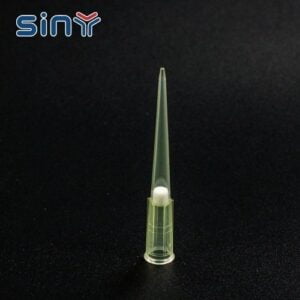
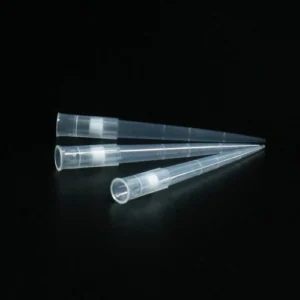
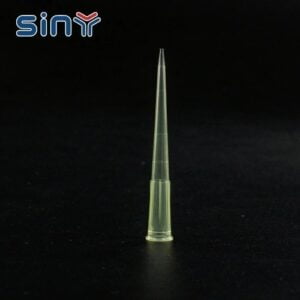
Siny Medical Universal Low Adsorption Sterile Filter Pipette Tips combine a low-adsorption liquid-contact surface, an integrated filter barrier, and a sterile product configuration. These disposable tips support compatible laboratory liquid handling procedures where sample recovery and contamination control are important.
During pipetting, sample molecules may attach to the inner surface of a conventional tip. Proteins and other biomolecules can be particularly sensitive to this type of interaction. As a result, some material may remain on the surface instead of reaching the receiving vessel.
Low-adsorption tips are designed to reduce unwanted molecular attachment. Meanwhile, an integrated filter provides a barrier intended to limit the movement of aerosols and droplets toward the pipette under suitable operating conditions.
The sterile configuration supports procedures requiring sterile consumables. Together, these features make the product relevant to biological sample preparation, reagent transfer, and other laboratory workflows with multiple handling requirements.
Siny Medical supplies pipette tips and laboratory consumables for research and routine liquid handling. Our universal-style filtered tips are intended for use with compatible pipettes, with actual fit determined by the pipette and tip configuration.
The product combines several characteristics that serve different purposes. Understanding each feature helps laboratories select tips according to their actual workflow.
Adsorption occurs when molecules attach to a surface.
During liquid transfer, certain proteins, peptides, and other compounds may interact with the inner wall of a pipette tip. This can reduce the amount of analyte recovered after dispensing.
A low-adsorption surface is designed to minimize these interactions under suitable conditions.
The potential benefit depends on the sample’s composition, concentration, contact time, and the tip surface.
For example, a dilute protein solution may behave differently from a concentrated buffer solution. Therefore, low adsorption should not be interpreted as a guarantee of complete sample recovery.
Filter pipette tips contain a barrier positioned between the liquid-contact region and the pipette connection.
The barrier is intended to help limit the movement of aerosols and droplets toward the pipette during appropriate use.
This feature may reduce one pathway of contamination during laboratory liquid handling.
However, a filter does not eliminate every contamination risk.
Poor pipetting technique, contact with contaminated surfaces, or unsuitable handling can still introduce unwanted material into a sample.
The filter’s specific performance also depends on its construction. A defined filtration efficiency should only be stated when supported by product testing.
Sterile pipette tips are relevant to procedures that require sterile consumables.
Their use may support aseptic workflows when combined with suitable handling practices.
However, sterile tips do not make the entire working environment sterile.
Users must still consider the pipette, containers, reagents, and surrounding workspace.
Sterility also does not automatically establish that a product is RNase-free, DNase-free, endotoxin-free, or suitable for every molecular biology procedure.
Those characteristics require separate verification.
Universal-style pipette tips are intended to fit a range of compatible pipettes.
Nevertheless, connection geometry varies between pipette manufacturers and models.
A tip that attaches to one pipette may not provide an equally reliable seal on another.
For this reason, laboratories should verify tip fit before routine use.
Compatibility is especially important when working with small liquid volumes or procedures that require consistent aspiration and dispensing.
Disposable tips support routine liquid transfer and help laboratories manage sample-to-sample contamination risks.
A fresh tip can be used when moving between specimens or reagents, according to the laboratory procedure.
However, correct disposal remains important.
Used tips may contain biological material or hazardous chemicals and must be handled according to the associated risks.
These pipette tips can support several laboratory procedures where sensitive samples, sterile consumables, or aerosol-related contamination control are important.
The appropriate application depends on the sample and the complete experimental method.
Some proteins and peptides may attach to conventional liquid handling surfaces.
This behavior can become relevant when samples are dilute or available only in limited quantities.
Low-adsorption tips are designed to reduce surface-related losses during compatible transfer procedures.
Meanwhile, the filter barrier provides an additional contamination-control feature.
However, the level of analyte recovery depends on the sample and handling conditions.
Laboratories should evaluate recovery performance when the procedure requires a defined result.
Molecular biology laboratories frequently transfer reagents and biological samples between tubes and reaction vessels.
Filter tips may be useful when reducing aerosol-related contamination is part of the workflow.
A sterile configuration may also be appropriate for certain preparation steps.
However, sterility alone does not confirm freedom from nucleases or other molecular contaminants.
Where these requirements are critical, laboratories should verify the relevant product documentation.
Cell culture workflows often require careful contamination control.
Sterile pipette tips may support compatible transfers of media, buffers, and other laboratory reagents.
The filter barrier may provide an additional precaution against aerosol movement toward the pipette.
Nevertheless, the overall procedure still requires appropriate aseptic technique.
Tip selection should also reflect the sample properties and pipette compatibility.
Biological reagents may contain compounds that interact with liquid-contact surfaces.
When surface adsorption is a concern, a low-adsorption tip may be useful.
The product’s sterile and filtered characteristics can address separate handling requirements.
For this reason, laboratories should consider all three features rather than selecting a tip based on a single label.
Research laboratories use pipette tips for sample preparation, dilution, reagent transfer, and other routine tasks.
Different experiments may prioritize different product characteristics.
For example, one procedure may require a filter barrier, while another may place greater emphasis on minimizing molecular adsorption.
A combined-feature tip can be practical when these requirements occur together.
However, compatibility and performance should still be evaluated for the intended application.
Different pipette tip features address different sources of sample loss and contamination.
Understanding these distinctions helps laboratories avoid treating unrelated product characteristics as equivalent.
Although the terms sound similar, they describe different properties.
Low adsorption focuses on reducing the attachment of sample molecules to the inner surface of the tip.
Low retention, by comparison, refers to reducing the amount of bulk liquid remaining inside the tip after dispensing.
Both characteristics may influence sample recovery, but they address different mechanisms.
For example, a tip designed to reduce protein adsorption does not necessarily have verified low-liquid-retention performance.
Likewise, a low-retention tip may not minimize the attachment of every biomolecule.
The appropriate choice depends on the sample and the laboratory procedure.
A filter tip includes a barrier intended to limit aerosol or droplet movement toward the pipette.
Non-filter tips do not include this feature.
Both designs can support liquid transfer, but their contamination-control characteristics differ.
For procedures involving aerosol-related risks, a filter tip may be preferable.
However, a filter does not replace appropriate pipetting technique or laboratory contamination-control measures.
Sterile tips are supplied with a defined sterility characteristic.
Non-sterile tips do not necessarily meet the same requirement.
The correct choice depends on the laboratory procedure.
Sterile consumables may be important for certain biological workflows, but not every liquid handling task requires them.
| Tip Type | Main Characteristic | Typical Selection Reason |
|---|---|---|
| Standard Pipette Tip | General liquid transfer | Routine pipetting |
| Low Adsorption Tip | Reduced molecular attachment | Adsorption-sensitive samples |
| Low Retention Tip | Reduced residual liquid | Liquid dispensing recovery |
| Filter Pipette Tip | Integrated barrier | Aerosol-related contamination control |
| Sterile Pipette Tip | Sterile configuration | Procedures requiring sterile consumables |
| Universal Low Adsorption Sterile Filter Tip | Combined surface, filter, and sterile features | Workflows requiring multiple handling characteristics |
These features can coexist in a single product. Nevertheless, each claimed characteristic should be supported by the actual product configuration.
Selecting a suitable pipette tip requires more than checking the product name.
Laboratories should consider pipette fit, sample characteristics, contamination-control requirements, and working volume.
A secure fit helps the pipette aspirate and dispense liquid consistently.
Poor tip sealing may affect transfer performance or cause handling difficulties.
Because pipette connections vary, universal-style tips should not be assumed to fit every instrument.
Before routine use, confirm that the tip attaches securely and performs appropriately with the intended pipette.
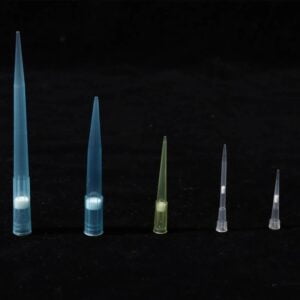
The tip must be suitable for the intended liquid volume.
A mismatch between the pipette, tip, and operating range can affect transfer performance.
For this reason, laboratories should check the available nominal capacities and the pipette’s specifications.
Exact product capacities should be confirmed from the applicable technical documentation.
Some samples are more sensitive to surface interactions than others.
Protein concentration, buffer composition, contact time, and molecular properties may influence adsorption.
When analyte recovery is critical, laboratories should evaluate the tip using representative samples.
A general low-adsorption designation does not establish identical performance for all compounds.
The integrated filter is intended to reduce aerosol or droplet movement toward the pipette.
However, filter construction and performance can differ between products.
Laboratories requiring a defined filtration characteristic should verify the relevant product information.
The presence of a filter should not be interpreted as proof of a particular efficiency or pore size.
Sterile tips may be appropriate when the procedure requires sterile consumables.
Before use, check the packaging and applicable product labeling.
If a laboratory requires specific sterilization documentation or additional cleanliness testing, these details should be verified separately.
A sterile label does not establish every contamination-control characteristic.
Packaging affects how unused tips are stored and accessed.
For sterile products, package integrity is especially important.
Users should follow the product’s labeled storage and handling instructions.
Damaged packaging may compromise suitability for procedures requiring sterility.
Proper handling helps preserve the intended product characteristics and supports consistent laboratory performance.
Before use, inspect the packaging and confirm that the selected tip is suitable for the pipette and procedure.
When sterile handling is required, open the packaging using appropriate aseptic technique.
Avoid touching the liquid-contact region or filter area.
Attach the tip securely to the pipette without excessive force.
During aspiration, use an appropriate immersion depth and pipetting speed.
Avoid drawing liquid into the filter region.
If liquid reaches or compromises the filter, follow the laboratory procedure for replacing the tip and assessing possible pipette contamination.
Dispense the sample according to the required method.
Use a fresh tip when necessary to prevent cross-contamination between samples.
After use, discard the tip according to the laboratory’s waste handling requirements.
Keep unused tips in their original protective packaging.
Follow the storage conditions stated on the product label.
Protect the packaging from moisture, contamination, and physical damage.
For sterile applications, inspect package integrity before use.
Do not assume that a tip remains sterile after its packaging has been compromised.
They are disposable pipette tips combining a low-adsorption surface, an integrated filter barrier, and a sterile product configuration.
The filter is intended to help limit aerosol and droplet movement toward the pipette during suitable liquid handling procedures.
No. Universal-style tips may fit a range of compatible models, but actual fit and sealing performance must be verified.
No. Low adsorption concerns molecular attachment to the tip surface, while low retention concerns residual liquid after dispensing.
They may support compatible protein transfer procedures where reducing surface adsorption is important.
Not automatically. These characteristics require separate product-specific verification.
No. A filter can help address aerosol-related contamination pathways, but correct handling and laboratory procedures remain essential.
They may be suitable for compatible molecular biology workflows. Any additional cleanliness requirements should be verified.
Available capacities should be confirmed from the product specifications.
Keep them in protective packaging under the labeled storage conditions and inspect package integrity before use.
Siny Medical supplies universal low adsorption sterile filter pipette tips for compatible biological sample preparation, reagent transfer, and laboratory liquid handling. Our pipette tip range supports laboratories that require a combination of low-adsorption surfaces, filter barriers, and sterile consumables. Explore our pipette tip products or contact Siny Medical to discuss available capacities, pipette compatibility, packaging configurations, and laboratory supply requirements.
Copyright © 2026 | Ningbo Siny Medical Technology Co., Ltd