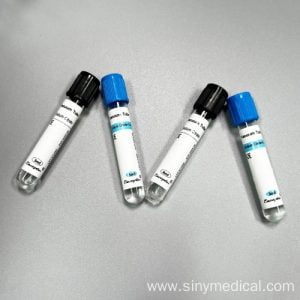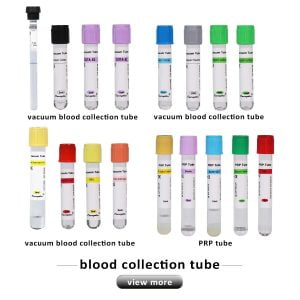

| Product Name | Blood Collection Tube |
| Tube Material | PET/Glass |
| OEM/ODM | Yes |
| Certificate | CE, ISO13485, ISO9001 |
| Usage | Blood Collection |
| Sterile | Irradiation Sterilization |
| Sample | Free |
| Service | The groups we serve are distributors, import traders, government procurement, buying agents, and medical chain stores. We provide one-stop procurement for you to simplify your procurement process |
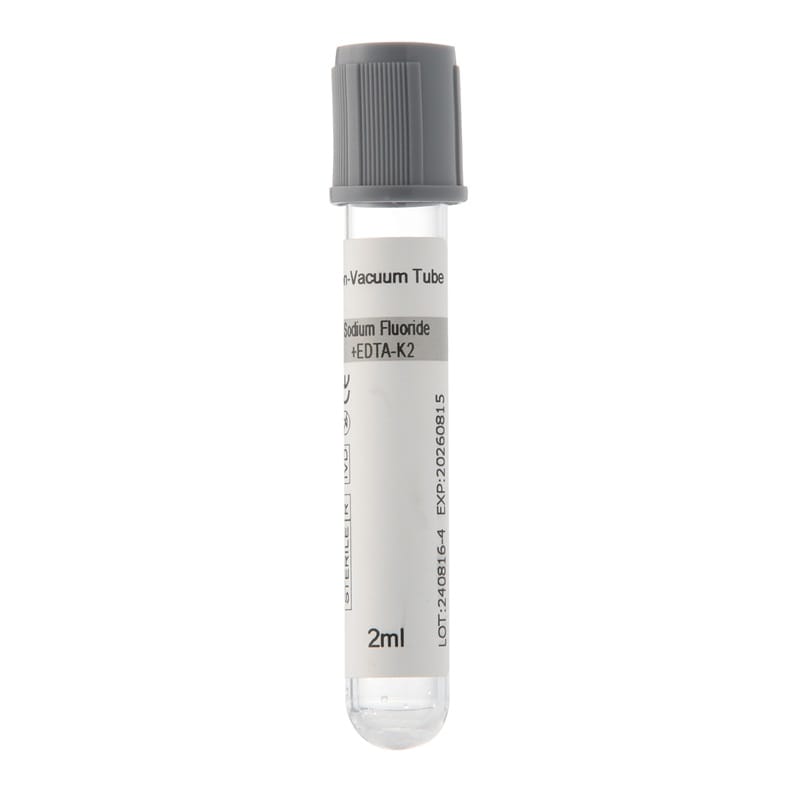
The Sodium Fluoride + EDTA K2 Blood Collection Vessel combines two additives with different roles in blood specimen handling: sodium fluoride for glycolysis inhibition and EDTA K2 for anticoagulation.
This combination gives the tube a clear purpose in compatible glucose-related laboratory workflows.
After blood collection, blood cells may continue consuming glucose through glycolysis. Sodium fluoride helps inhibit this process. Meanwhile, EDTA K2 binds calcium ions involved in coagulation and helps keep the specimen anticoagulated.
As a result, this blood collection tube supports procedures where both anticoagulation and control of post-collection glycolysis are important.
The tube should not be confused with a standard EDTA hematology tube or a sodium fluoride + potassium oxalate tube. Although these products share some functions, their additive systems and laboratory applications differ.
A Sodium Fluoride + EDTA K2 blood collection tube contains two functional additives.
Sodium fluoride primarily acts as a glycolysis inhibitor, while EDTA K2 acts as an anticoagulant.
EDTA K2 binds calcium ions that participate in blood coagulation. Therefore, it helps prevent the collected specimen from clotting.
Sodium fluoride has a different function. It helps limit continued glucose consumption by blood cells after collection.
Together, these additives support compatible laboratory procedures where glucose stability during specimen handling is an important consideration.
Laboratories should select the tube according to the validated test method, analyzer requirements, and specimen-handling procedure.
Blood does not become biologically inactive immediately after collection.
Cells within the specimen can continue metabolic activity. One important process is glycolysis, during which cells consume glucose.
If glycolysis continues during specimen handling, the glucose concentration can change before laboratory analysis.
For this reason, glucose-related testing requires careful control of the pre-analytical stage as well as accurate laboratory analysis.
Several factors can influence the specimen before testing, including:
Sodium fluoride helps inhibit glycolysis after collection.
However, the collection tube forms only one part of the complete testing workflow. Laboratories must still process and analyze specimens according to their validated procedures.
Sodium fluoride and EDTA K2 perform different functions in the tube.
EDTA K2 provides the anticoagulant action.
Calcium ions play an important role in several stages of blood coagulation. EDTA binds these ions and interrupts calcium-dependent coagulation reactions.
As a result, the collected specimen remains anticoagulated for compatible laboratory procedures.
Sodium fluoride serves a different purpose because it focuses on glycolysis inhibition.
The two additives can therefore be understood as:
EDTA K2 → Anticoagulation
Sodium Fluoride → Glycolysis Inhibition
Together, they create an additive system for compatible glucose-related specimen collection and handling.
Glucose testing depends on more than blood collection alone.
The specimen must also remain properly handled between collection and analysis.
A Sodium Fluoride + EDTA K2 tube supports this workflow by combining anticoagulation with glycolysis control.
Depending on the validated laboratory method, laboratories may use this additive combination for compatible glucose-related testing.
However, the tube does not automatically make every glucose result more accurate.
Reliable specimen handling also depends on:
Therefore, the tube supports the pre-analytical workflow but does not replace correct specimen handling.
Both tube types contain EDTA K2, but they have different primary laboratory roles.
A standard EDTA K2 tube uses EDTA as its main functional additive. Laboratories commonly use this type of tube for compatible hematology procedures that require anticoagulated whole blood.
A Sodium Fluoride + EDTA K2 tube also contains sodium fluoride.
This additional component changes the purpose of the tube. Instead of focusing mainly on hematology, it supports compatible procedures where glycolysis inhibition matters during glucose specimen handling.
The difference can be summarized simply:
EDTA K2 Tube → Anticoagulation for compatible whole-blood procedures
Sodium Fluoride + EDTA K2 Tube → Anticoagulation + glycolysis inhibition for compatible glucose-related procedures
Therefore, laboratories should select the tube according to the required specimen and test rather than cap color alone.
These two glucose tube configurations are easy to confuse because both contain sodium fluoride.
However, they use different anticoagulants.
The product on this page combines:
Sodium Fluoride + EDTA K2
Another common configuration combines:
Sodium Fluoride + Potassium Oxalate
In both systems, sodium fluoride provides the glycolysis-inhibiting function.
The difference lies in the anticoagulant.
This product uses EDTA K2, while the alternative uses potassium oxalate.
Therefore, these additive combinations should not automatically be treated as interchangeable.
If a validated laboratory method specifies Sodium Fluoride + EDTA K2, the collection tube should match that requirement. Likewise, a procedure validated for Sodium Fluoride + Potassium Oxalate should use the specified configuration.
Always follow the laboratory method, analyzer instructions, and specimen requirements when choosing between them.
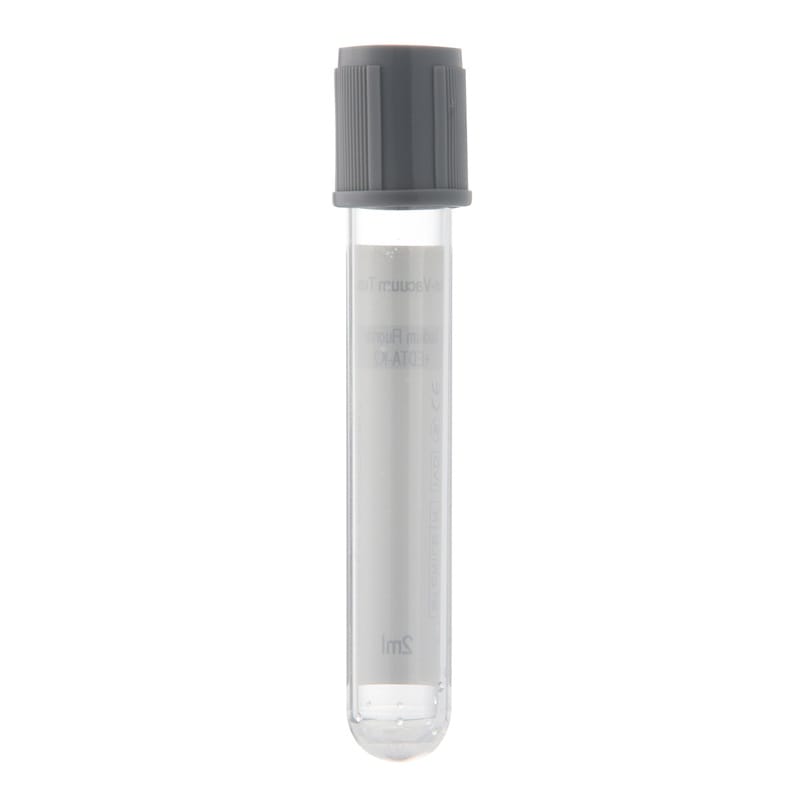
Glucose-related blood collection tubes are commonly associated with gray identification.
Color can provide a useful visual reference during blood collection and laboratory handling. However, cap color should never be the only basis for tube selection.
Different manufacturers and product configurations may use different additive combinations in glucose-related tubes.
Therefore, always check the written label and additive specification.
For this product, the key identification is:
Sodium Fluoride + EDTA K2
This information is more important than simply identifying the product as a “gray-top tube.”
Before collection, confirm:
Checking these details helps distinguish Sodium Fluoride + EDTA K2 tubes from other glucose tube formulations.
Correct specimen handling starts with proper blood collection.
Fill the tube according to its intended specification and the validated collection procedure.
After collection, appropriate mixing helps bring the blood into contact with the additives. Follow the product instructions and laboratory protocol for the required mixing procedure.
Avoid vigorous shaking, because excessive agitation can compromise specimen quality.
After mixing, handle, transport, process, and analyze the specimen according to the laboratory method.
In addition, do not assume that sodium fluoride keeps a specimen suitable indefinitely.
The allowable time before analysis and suitable storage conditions depend on the validated test method and laboratory procedure.
A glucose collection tube helps control one important pre-analytical factor. However, specimen quality depends on the entire workflow.
Important considerations include:
These factors matter because glucose metabolism and specimen conditions can continue changing after blood collection.
Therefore, laboratories should not rely on the collection tube alone to determine storage time or analysis timing.
The validated laboratory method should remain the primary reference.
This product has a specific laboratory purpose.
Different tests require different specimen types and additives. Therefore, a blood collection tube should never be selected simply because the procedure involves blood.
For example:
Standard EDTA tubes support compatible hematology procedures.
Sodium citrate tubes support compatible coagulation testing.
Serum tubes are used when a procedure requires serum.
Heparin tubes provide anticoagulated specimens for compatible plasma chemistry applications.
Sodium Fluoride + EDTA K2 tubes combine anticoagulation with glycolysis inhibition for compatible glucose-related specimen handling.
The laboratory test should therefore determine the appropriate collection tube.
Start with the laboratory procedure.
First, confirm whether the test requires a specimen collected with a glycolysis-inhibiting additive.
Next, confirm the required anticoagulant.
If the validated method specifies Sodium Fluoride + EDTA K2, choose a tube with that exact additive combination.
Key specifications to check include:
Do not substitute another gray-top tube simply because the closure color looks similar.
The additive combination should match the validated laboratory procedure.
Siny Medical can discuss Sodium Fluoride + EDTA K2 blood collection tube requirements based on the confirmed product configuration and order quantity.
Available requirements may include:
Confirm the final technical and packaging specifications before quotation and production.
Contact Siny Medical with your required Sodium Fluoride + EDTA K2 tube configuration, quantity, packaging, and labeling requirements for product information or a quotation.
It is a blood collection tube that combines sodium fluoride for glycolysis inhibition with EDTA K2 for anticoagulation. The combination supports compatible glucose-related specimen collection and handling procedures.
Sodium fluoride helps inhibit glycolysis and limits continued glucose consumption by blood cells after specimen collection.
EDTA K2 binds calcium ions involved in coagulation. This anticoagulant action helps prevent the collected blood from clotting.
Yes, this additive combination can support compatible glucose-related laboratory procedures where both glycolysis inhibition and anticoagulation are required. Laboratories should follow their validated methods and analyzer instructions.
No. A standard EDTA K2 tube mainly provides anticoagulation and is commonly associated with hematology. Sodium Fluoride + EDTA K2 adds a glycolysis-inhibiting function for compatible glucose-related specimen handling.
No. Both contain sodium fluoride, but the anticoagulants differ. One uses EDTA K2, while the other uses potassium oxalate. They should not automatically be treated as interchangeable.
Blood cells can continue consuming glucose after collection. Sodium fluoride helps inhibit this process during specimen handling.
No. The collection tube should not be treated as a guarantee that the specimen remains unchanged under all conditions. Processing time, temperature, storage, and the validated laboratory method still matter.
Yes. Mix the specimen according to the product instructions and laboratory procedure so that the blood contacts the additives properly. Avoid vigorous shaking.
No. Always confirm the written additive specification. Gray identification may be associated with different glucose tube formulations.
Tube capacity, material, closure, packaging, labeling, and related requirements can be discussed according to the confirmed product configuration and order quantity.
The Sodium Fluoride + EDTA K2 Blood Collection Vessel has a clearly defined role within the blood collection tube category.
Its two additives perform different functions:
Sodium Fluoride → Glycolysis Inhibition
EDTA K2 → Anticoagulation
Together, they separate this product from standard EDTA hematology tubes and glucose tubes that use potassium oxalate as the anticoagulant.
Therefore, tube selection should focus on the complete additive combination and validated laboratory procedure, not simply the gray cap.
Contact Siny Medical with your required Sodium Fluoride + EDTA K2 tube specifications, quantity, packaging, and labeling requirements to request additional product information or a quotation.
Copyright © 2026 | Ningbo Siny Medical Technology Co., Ltd