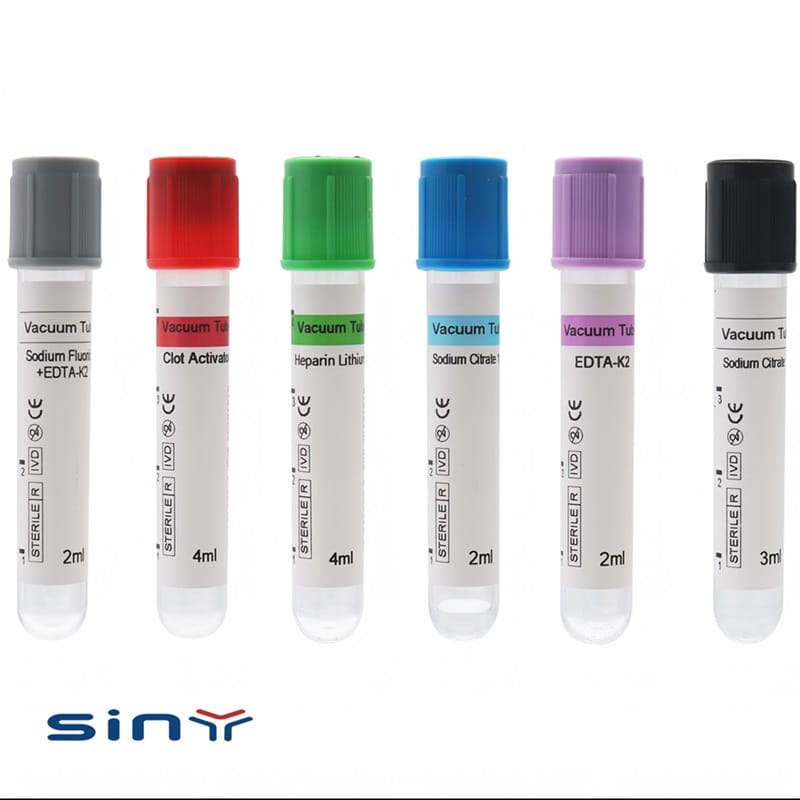

| Product Name | Blood Collection Tube |
| Tube Material | PET/Glass |
| OEM/ODM | Yes |
| Certificate | CE, ISO13485, ISO9001 |
| Usage | Blood Collection |
| Sterile | Irradiation Sterilization |
| Sample | Free |
| Service | The groups we serve are distributors, import traders, government procurement, buying agents, and medical chain stores. We provide one-stop procurement for you to simplify your procurement process |
The Vacuum Tube Blood Collection Set from Siny Medical provides a practical range of evacuated blood collection tubes for routine specimen collection in hospitals, clinical laboratories, diagnostic centers, and other professional healthcare settings. Different tube types contain specific additives to support the preparation of whole blood, plasma, or serum samples for compatible laboratory testing.
Rather than relying on one tube for every procedure, laboratories select blood collection tubes according to the required specimen type and test method. The Siny Medical range includes EDTA-K2 tubes, clot activator tubes, lithium heparin tubes, sodium citrate tubes, glucose tubes, and ESR tubes, giving medical distributors and laboratory suppliers access to multiple commonly used configurations from one manufacturer.
Each tube uses a preset vacuum to draw a controlled amount of venous blood when used correctly with a compatible blood collection system. Color-coded closures and clear labeling also help healthcare professionals distinguish between tube types during routine specimen collection.
For distributors, laboratories, and medical supply companies purchasing multiple blood collection tube types, Siny Medical supports bulk orders, customized labeling, packaging, and OEM requirements.
Blood samples do not all require the same preparation. Some tests use whole blood, others require plasma, while many clinical chemistry procedures use serum. The additive inside the collection tube determines how the blood behaves after collection and therefore plays an important role in selecting the appropriate tube.
A vacuum blood collection tube combines the tube, additive, closure, and preset vacuum in a ready-to-use format. Once a compatible blood collection needle enters the tube, the pressure difference allows blood to flow into the tube until the intended draw volume is reached.
This closed collection approach simplifies routine venous blood sampling and helps laboratories maintain a consistent specimen collection workflow.
The Vacuum Tube Blood Collection Set is available with several additive options so purchasers can build a product range around different laboratory departments rather than sourcing each tube category separately.
Choosing the correct tube starts with understanding the required specimen and laboratory application.
| Tube Type | Common Closure Color | Additive | Specimen | Typical Application |
|---|---|---|---|---|
| EDTA-K2 Tube | Purple | EDTA-K2 | Whole Blood | Hematology and routine blood cell analysis |
| Clot Activator Tube | Red | Clot Activator | Serum | Clinical chemistry and serum testing |
| Lithium Heparin Tube | Green | Lithium Heparin | Plasma | Clinical chemistry and compatible plasma testing |
| Sodium Citrate Tube | Light Blue | Sodium Citrate | Citrated Plasma | Coagulation testing |
| Glucose Tube | Gray | Sodium Fluoride + EDTA-K2 | Plasma | Glucose-related laboratory testing |
| ESR Tube | Black | Sodium Citrate | Whole Blood | Erythrocyte Sedimentation Rate testing |
Closure colors can help with rapid tube identification, but laboratories should always confirm the tube label, additive, required draw volume, and validated test procedure rather than selecting a tube by cap color alone.
EDTA-K2 works as an anticoagulant by binding calcium ions and preventing the collected blood from clotting. This allows the specimen to remain as whole blood for compatible hematology procedures.
Purple-top EDTA tubes are commonly selected for routine hematological examinations such as complete blood count and other compatible blood cell analyses.
Proper mixing after collection helps distribute the anticoagulant throughout the specimen. Laboratories should follow their validated collection procedures for the required number of inversions and subsequent sample handling.
The red-top clot activator tube takes a different approach. Instead of preventing coagulation, the additive promotes the clotting process so that serum can subsequently be separated from the blood cells.
These tubes are commonly used where a laboratory procedure requires a serum specimen, including many routine clinical chemistry and immunological applications.
The sample should receive sufficient time to clot before centrifugation according to the laboratory’s established procedure.
Lithium heparin acts as an anticoagulant and supports the preparation of plasma samples for compatible laboratory testing.
Green-top lithium heparin tubes are widely associated with clinical chemistry workflows where plasma rather than serum is required. After collection and appropriate mixing, laboratories can process the specimen according to their validated centrifugation and testing procedures.
Light-blue sodium citrate tubes are primarily associated with coagulation testing. Sodium citrate temporarily prevents coagulation by binding calcium in the collected blood.
Coagulation testing depends strongly on the relationship between blood volume and anticoagulant volume. For this reason, the tube should reach its intended fill level to maintain the required blood-to-citrate proportion.
Common applications include compatible coagulation procedures such as PT, aPTT, fibrinogen, D-dimer, and other hemostasis tests.
Gray-top tubes containing sodium fluoride and EDTA-K2 are designed for applications where glucose stability is an important part of specimen handling.
EDTA-K2 provides anticoagulant action, while sodium fluoride acts as a glycolysis inhibitor. This combination makes the tube suitable for compatible glucose-related laboratory procedures.
Actual sample handling and allowable storage conditions should follow the laboratory’s validated testing method and analyzer requirements.
The black-top sodium citrate tube is intended for blood collection associated with Erythrocyte Sedimentation Rate (ESR) testing.
Unlike the light-blue citrate tube used for coagulation studies, the ESR tube uses a citrate configuration intended for ESR specimen preparation. Laboratories should therefore treat these as separate tube categories even though both contain sodium citrate.
Correct filling and gentle mixing after collection help prepare the specimen for subsequent ESR testing according to the laboratory’s validated method.
The vacuum inside the tube controls blood entry during venous specimen collection.
When a healthcare professional inserts a compatible blood collection needle into the vein and then introduces the other end into the evacuated tube, the pressure difference draws blood into the tube automatically. Blood continues to enter until the vacuum decreases and the intended collection volume is reached.
This system offers several practical advantages in routine blood collection. It reduces the need to manually transfer blood between collection devices and tubes, supports more consistent draw volumes, and allows healthcare professionals to change between compatible tube types when several specimens are required from the same venipuncture.
The preset vacuum becomes particularly important for tubes where the additive-to-blood relationship affects specimen suitability, such as sodium citrate tubes.
Healthcare professionals should always follow the appropriate order of draw, collection procedure, and laboratory protocol when collecting multiple tube types.
A dependable blood collection tube needs more than a recognizable cap color. Tube construction, additive preparation, vacuum consistency, labeling, closure performance, and production control all contribute to everyday usability.
Preset Vacuum for Controlled Blood Collection
Each tube contains a predetermined vacuum designed to draw its nominal blood volume when used correctly. This provides a convenient way to standardize specimen collection across routine laboratory workflows.
Multiple Additive Options
Siny Medical supplies commonly used anticoagulant, clot activator, glucose, coagulation, and ESR tube configurations. Buyers can therefore source several categories of blood collection tubes for different laboratory departments.
Clear Tube Identification
Color-coded closures and printed labels make it easier to identify different tube types during collection, transportation, and laboratory processing. Labels can display relevant product information according to the selected configuration and purchasing requirements.
Secure Tube Closure
The stopper and cap system helps maintain tube closure during routine collection, handling, and transportation. The design also allows the collection needle to access the evacuated tube through the stopper during blood collection.
Single-Use Design
The tubes are intended for single-use professional blood specimen collection. This suits the established workflow of hospitals, laboratories, diagnostic centers, and blood collection facilities.
Different Tube Configurations
Purchasing requirements vary between markets and laboratory systems. Siny Medical can discuss available tube volumes, additives, closure configurations, labeling, and packaging according to customer requirements.
The cap color is useful for quick identification, but the required laboratory test should always determine the final tube selection.
Before ordering, buyers should consider four basic questions:
For example, a hematology laboratory may mainly purchase EDTA tubes, while a clinical chemistry department may require both serum and lithium heparin tubes. A distributor supplying an entire hospital network may need all of these tube types in different quantities.
If you are unsure which configurations to include in your order, Siny Medical can help you match tube types with your target laboratory applications and purchasing requirements.
Vacuum blood collection tubes form part of the daily specimen collection workflow in a wide range of healthcare environments.
Typical users include:
For distributors, carrying several tube types provides a practical way to serve different laboratory departments through one blood collection product category.
For laboratories, selecting the appropriate tube for each procedure helps maintain a standardized process from specimen collection through transportation, preparation, and analysis.
Medical distributors rarely purchase only one type of blood collection tube. Different customers may need different additives, collection volumes, packaging quantities, or label formats.
Siny Medical supports B2B customers sourcing vacuum blood collection tubes for wholesale distribution, laboratory supply, healthcare procurement, and private-label projects.
Depending on the selected product and order requirements, customization can include:
This flexibility allows distributors to develop a blood collection tube range that better matches the needs of their local market instead of purchasing every configuration separately from different suppliers.
For current product options, packaging information, MOQ, lead time, and quotation details, send your requirements to Siny Medical for a tailored proposal.
In this product range, Vacuum Tube Blood Collection Set refers to a selection of evacuated blood collection tubes containing different additives for clinical specimen collection. Available configurations can support the preparation of whole blood, plasma, serum, coagulation, glucose, and ESR specimens.
No. Different tubes contain different additives and support different specimen types. An EDTA tube, for example, serves a different laboratory purpose from a clot activator or sodium citrate tube. Laboratories should select tubes according to the required test and validated procedure.
Color coding provides a convenient visual reference for distinguishing common tube categories. However, color conventions can vary, so healthcare professionals should always verify the tube label and additive before collection.
Both prevent blood from clotting, but they use different anticoagulants and serve different laboratory applications. EDTA tubes commonly support hematology testing, while lithium heparin tubes commonly support compatible plasma chemistry procedures.
No. Although both may use sodium citrate, they serve different laboratory purposes and may use different citrate formulations or blood-to-additive relationships. Light-blue citrate tubes generally support coagulation testing, while black-top citrate tubes are intended for ESR testing.
Yes. Buyers sourcing a broader laboratory consumables range can discuss multiple tube types and quantities with Siny Medical. This can include EDTA-K2, lithium heparin, sodium citrate, clot activator, glucose, ESR, and other available blood collection tube configurations.
Siny Medical supports OEM and private-label requirements for eligible bulk orders. Available options depend on the tube configuration, quantity, packaging format, and destination-market requirements. Send us your required tube types, quantities, and customization details for confirmation.
Whether you need one specific blood collection tube or a mixed range for wholesale distribution, choosing the right additive, draw volume, labeling, and packaging is an important part of the purchasing process.
Siny Medical supplies vacuum blood collection tubes for laboratories, healthcare suppliers, distributors, and OEM customers.
Tell us the tube types, required volumes, quantities, packaging preferences, and destination market you are sourcing for. Our team can provide suitable product options and prepare a quotation based on your purchasing requirements.
Copyright © 2026 | Ningbo Siny Medical Technology Co., Ltd


