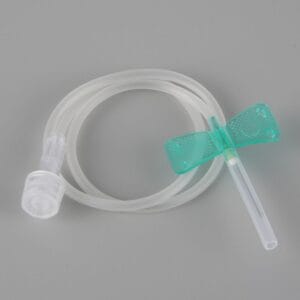
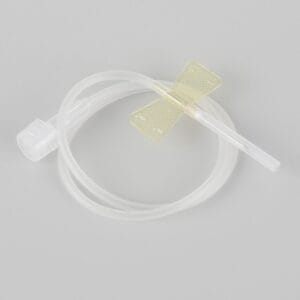
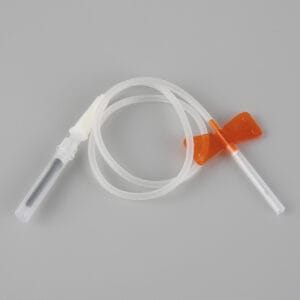
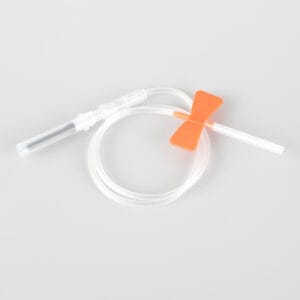
| Product Name | Butterfly Blood Collection Needle |
| Material | Stainless steel |
| OEM/ODM | Yes |
| Certificate | CE, ISO13485, ISO9001 |
| Usage | Blood Collection |
| Specification | 18G |
| Sample | Free |
| Service | In the groups we serve: distributors, import traders, government procurement, buying agents, and medical chain stores, we provide one-stop procurement for you to simplify your procurement process |
The Siny Medical Disposable 18G Safety Butterfly Blood Collection Needle is a large-bore winged needle designed for professional venous blood collection.
Its main distinction is the 18G needle size.
Compared with finer butterfly needle gauges, 18G has a larger needle diameter. This can support a higher blood-flow capacity when the vein, collection procedure, and specimen requirements allow the use of a larger-bore needle.
The butterfly configuration adds flexible wings and tubing to the blood collection pathway. Meanwhile, the safety design helps manage needle exposure after the collection procedure.
This combination makes the product suitable for blood collection workflows that require a large-bore butterfly needle with an integrated safety feature.
An 18G safety butterfly needle is a winged venipuncture device with an 18-gauge needle diameter.
The current Siny Medical product information lists:
The butterfly design usually includes flexible wings near the needle hub and tubing that connects the needle with the downstream collection system.
The 18G specification defines the needle diameter.
Gauge numbering works in reverse. Therefore, a lower gauge number generally means a larger needle diameter.
For this reason, 18G is larger than 19G, 20G, 21G, 22G, and 23G.
An 18G butterfly needle may be selected when the intended blood collection procedure requires a relatively large needle diameter.
A larger lumen can support greater blood flow than finer gauges when other conditions are suitable.
This can matter when the workflow involves:
However, 18G should not be treated as the default choice for every blood draw.
Needle selection should always consider the vein, required specimen volume, collection speed, patient characteristics, and institutional procedure.
The largest needle is not automatically the best needle.
Needle diameter has a direct relationship with the internal blood-flow pathway.
An 18G needle has a larger internal diameter than finer gauges such as 21G, 22G, or 23G.
As a result, it can provide more blood-flow capacity when used under compatible conditions.
This does not mean that an 18G needle always produces a faster collection.
Actual blood flow also depends on:
Therefore, gauge should be considered as one part of the complete blood collection setup.
Some blood collection procedures require a greater total specimen volume.
In those situations, a larger-bore needle may help support the collection workflow.
An 18G butterfly needle can be considered when the vein is suitable and the procedure requires a relatively large volume of blood.
For example, several specimen tubes may be required during a single venipuncture.
The larger internal diameter can provide more flow capacity than finer needle options.
However, users should still follow the required order of draw, tube fill instructions, and laboratory procedures.
The butterfly needle provides venous access, but each collection tube determines the required specimen type.
The difference between 18G and 19G is needle diameter.
An 18G needle is larger.
A 19G needle is slightly finer.
The 18G option may be selected when the collection procedure requires greater blood-flow capacity.
The 19G option provides a smaller diameter while still remaining a relatively large-bore needle compared with 21G, 22G, or 23G.
Neither gauge is universally better.
The correct choice depends on the vein, specimen volume, collection speed, and validated procedure.
The difference becomes more noticeable when 18G is compared with 21G.
An 18G needle has a substantially larger diameter than a 21G needle.
This gives 18G greater potential blood-flow capacity.
By contrast, 21G provides a more moderate needle diameter and is widely used for compatible routine blood collection workflows.
An 18G needle may be appropriate when the procedure calls for a larger bore.
A 21G needle may be preferred when the workflow does not require the same degree of blood-flow capacity.
The intended venipuncture procedure should guide the choice.
22G and 23G are finer than 18G.
This creates a clear difference in their intended positioning.
An 18G butterfly needle focuses on larger-bore venous access and greater flow capacity.
A 22G or 23G butterfly needle provides a smaller needle diameter for compatible procedures where a finer gauge is preferred.
The choice should not be based on the idea that thinner is always better.
Instead, the user should match the gauge to:
This is why the 18G product should remain a distinct gauge-specific page rather than sharing the same content as finer butterfly needles.
The safety feature is another important part of this product.
After venous blood collection, the used needle becomes a contaminated sharp.
A safety mechanism can help reduce direct exposure to the needle during post-collection handling.
The exact safety configuration should be confirmed for the product being ordered.
Users should follow the operating instructions for the confirmed safety mechanism.
The safety design may support safer handling, but it does not eliminate all needlestick risk.
Correct technique, staff training, infection control, and prompt sharps disposal remain necessary.
A standard butterfly needle provides winged venous access and flexible tubing.
A safety butterfly needle adds an integrated feature intended to help manage needle exposure after use.
This is the main difference.
Both devices may perform the same basic blood collection function.
However, the safety version adds a post-collection handling step.
For facilities that require safety-focused blood collection devices, this additional mechanism may be an important specification.
The correct product should therefore be selected based on both the gauge and the safety configuration.
The butterfly design includes flexible wings near the needle hub.
These wings provide a surface for holding and positioning the needle during venipuncture.
They can also help the user maintain control around the puncture site during blood collection.
However, the wings do not determine the needle gauge.
Instead, they work together with the 18G needle, tubing, connection type, and safety mechanism.
For this product, the defining combination is:
18G Needle + Butterfly Wings + Flexible Tubing + Safety Design
That combination gives the product a clear role within the Siny Medical butterfly needle range.
Flexible tubing separates the venipuncture site from the downstream collection components.
This structure can reduce the need to directly move the needle hub when blood collection tubes or connectors are handled.
That can be useful during multi-tube workflows.
However, tubing also adds internal volume to the blood collection pathway.
For procedures that depend on precise tube fill volume, users should follow the validated collection method.
The complete blood collection system matters, not only the needle gauge.
An 18G butterfly needle can support compatible multi-tube blood collection procedures.
After successful venipuncture, more than one blood collection tube may be collected when the system and procedure allow it.
A larger-bore 18G needle can provide useful flow capacity when the vein is suitable.
However, multi-tube collection still requires proper specimen handling.
Users should follow:
The butterfly needle provides venous access.
The collection tubes determine the required specimen type.
The current Siny Medical product information lists a 20 mm needle length.
Needle length and needle gauge describe different specifications.
Gauge defines needle diameter.
Length defines the physical length of the needle.
Both should be confirmed before ordering or use.
An 18G needle can still be supplied in different configurations, so the complete specification should always be checked.
This 18G safety butterfly needle is intended for single use.
It should not be reused between patients.
After blood collection, users should follow the operating instructions for the safety feature and dispose of the used device in an appropriate sharps container.
Important steps include:
The safety feature supports safer handling.
It does not replace proper sharps disposal.
Start with the venipuncture requirement.
First, confirm whether the procedure requires a large-bore butterfly needle.
Next, determine whether 18G is suitable for the vein and specimen requirements.
Then confirm the safety and connection configuration.
Key factors include:
The complete configuration should match the intended procedure.
Siny Medical can discuss 18G safety butterfly needle requirements according to the confirmed product configuration and order quantity.
Requirements may include:
Final specifications should be confirmed before quotation and production.
Contact Siny Medical with your required 18G safety butterfly needle configuration, quantity, packaging, and labeling requirements for product information or a quotation.
It is a winged venipuncture needle with an 18-gauge diameter and an integrated safety configuration for professional blood collection.
18G refers to the needle gauge. A lower gauge number generally means a larger needle diameter.
Yes. An 18G needle has a larger diameter than a 19G needle.
Yes. 18G is significantly larger in diameter than both 21G and 22G.
An 18G needle may be selected when the procedure requires a relatively large needle diameter and higher blood-flow capacity.
No. Actual blood flow also depends on vein condition, needle position, collection system, tubing, and venous pressure.
No. The correct gauge depends on the vein, specimen volume, collection speed, patient characteristics, and clinical procedure.
The current Siny Medical product information lists a 20 mm needle length.
The safety feature helps manage exposure to the used needle after blood collection. The exact mechanism should be confirmed for the selected product configuration.
No. It can help reduce exposure, but correct technique, safety activation, infection control, and sharps disposal remain necessary.
Yes, when used with compatible collection components and an appropriate procedure.
No. It is intended for single use and should be discarded after blood collection.
Needle configuration, safety design, packaging, labeling, and related requirements can be discussed according to the confirmed specification and order quantity.
The Siny Medical Disposable 18G Safety Butterfly Blood Collection Needle has a clear role within the butterfly needle category.
Its defining feature is the 18G large-bore needle diameter.
Compared with finer gauges, 18G provides greater potential blood-flow capacity when the vein and procedure support its use.
The butterfly wings and flexible tubing support the venipuncture workflow, while the safety configuration adds a post-collection needle-handling feature.
This combination separates the product from finer 21G, 22G, and 23G butterfly needles as well as from non-safety winged needle designs.
Contact Siny Medical with your required 18G safety butterfly needle specifications, quantity, packaging, and labeling requirements to request additional product information or a quotation.
Copyright © 2026 | Ningbo Siny Medical Technology Co., Ltd