| tem | Specification |
|---|---|
| Product Name | Dental Surgical Sutures Hospital Surgical Needles with Needle |
| Product Type | Dental Surgical Suture with Needle |
| Suture Material | Polyamide (Nylon) |
| Suture Structure | Monofilament |
| Absorption Type | Non-Absorbable |
| Needle Configuration | Attached Surgical Needle |
| Application | Oral Soft Tissue Approximation |
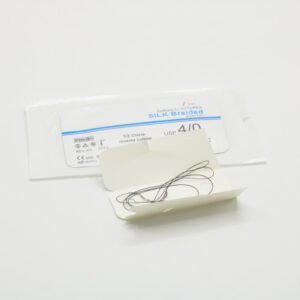
Dental Surgical Sutures Hospital Surgical Needles with Needle are designed for selected oral soft tissue closure procedures. This product uses synthetic nylon suture material with an attached surgical needle, providing a non-absorbable option for dental and oral surgical applications.
Dental sutures help approximate soft tissue edges after procedures such as tooth extraction, periodontal surgery, and dental implant treatment. They also help stabilize repositioned gingival flaps during the early stages of healing. The appropriate suture and needle combination depends on the surgical site, tissue thickness, and closure technique.
Nylon is a synthetic polyamide material commonly used in non-absorbable surgical sutures. Its monofilament structure offers a relatively smooth surface and lower capillarity than braided alternatives. These properties can be useful in the oral environment, where moisture and bacterial exposure are important considerations.
However, nylon sutures do not eliminate infection risks. Proper surgical technique, oral hygiene, and postoperative care remain essential.
Siny Medical supplies dental surgical sutures for dental clinics, oral surgery departments, hospitals, and medical distributors. Buyers should select the required thread diameter, length, and needle configuration according to the intended dental procedure.
The material and construction of a dental suture influence tissue handling, knot placement, and postoperative management.
For oral procedures, clinicians must also consider the limited working space and the characteristics of gingival tissue.
Nylon is a synthetic polyamide polymer used in surgical sutures.
Unlike natural silk or collagen-based catgut, nylon is produced from synthetic materials. It is classified as non-absorbable because it does not undergo a predictable absorption process after placement.
Nevertheless, nylon may gradually lose tensile strength during prolonged implantation. Its non-absorbable classification should not be confused with permanent mechanical stability.
Monofilament nylon consists of a single continuous strand.
Its smooth surface generally produces less tissue drag and capillarity than braided suture structures.
In dental procedures, this can be helpful when the thread passes through gingival or oral mucosal tissue.
However, monofilament sutures can have greater material memory. Clinicians should use appropriate knotting techniques to maintain secure closure.
The suture is supplied with an attached surgical needle.
This needle-and-thread assembly allows the clinician to place sutures using a needle holder without separately threading the needle.
Needle curvature, point geometry, and length affect tissue penetration and maneuverability.
For dental applications, these features are especially important because access may be limited by adjacent teeth, the tongue, and surrounding oral structures.
Although nylon is non-absorbable, it can be used for temporary external or accessible tissue closure.
The thread holds the tissue edges together during early healing. The clinician can then remove it when the wound has reached an appropriate stage of recovery.
The removal schedule depends on the procedure and the patient’s healing response.
Dental procedures often involve delicate gingival tissues.
The selected suture should provide sufficient support without excessive tension.
A suitable needle-and-thread combination helps the surgeon position tissue edges accurately. However, final wound outcomes also depend on flap design, surgical technique, and postoperative care.
Dental sutures are used in a range of oral procedures that require soft tissue approximation or flap stabilization.
The appropriate material and configuration depend on the surgical site and clinical requirements.
Some tooth extraction procedures require sutures to approximate gingival tissue after surgery.
This may be necessary when a flap has been raised or the wound requires additional tissue stabilization.
Nylon sutures can be considered for selected closures where non-absorbable material is appropriate.
However, uncomplicated extractions do not always require suturing.
Implant procedures may involve repositioning and closing gingival flaps.
Sutures help stabilize the tissue during early healing and support the intended flap position.
The surgeon should choose the thread diameter and needle configuration according to tissue thickness, wound tension, and the surgical approach.
A suture alone cannot guarantee implant success or prevent wound complications.
Periodontal procedures may involve delicate soft tissue manipulation.
For example, flap surgery and selected gingival procedures require careful tissue approximation.
Monofilament nylon offers a smooth thread surface, although its material memory may influence knot handling.
Clinicians should balance handling characteristics with the required tissue support.
Dental sutures may also be used for selected oral mucosal repairs.
These procedures require careful needle placement and suitable thread tension.
The correct product depends on the tissue location, wound characteristics, and expected healing period.
Other minor oral surgical procedures may require temporary tissue closure.
In these cases, non-absorbable nylon can be an option when the clinician plans postoperative suture removal.
The final choice should follow the product’s intended use and the surgeon’s clinical judgment.
Needle design is one of the most important considerations when selecting dental sutures.
Oral surgery involves restricted access and tissues with different resistance to penetration.
Curved needles allow clinicians to work within confined surgical areas.
Common surgical needle configurations include 3/8-circle and 1/2-circle designs.
A 3/8-circle needle may offer suitable handling in accessible areas, while a 1/2-circle needle can be useful where a tighter working space requires a different needle movement.
However, the best curvature depends on the surgical site and the clinician’s technique.
Needle point geometry influences how the needle penetrates tissue.
Reverse-cutting needles are commonly used for selected oral mucosal and gingival closures.
Their cutting-edge arrangement can support controlled penetration through relatively resistant tissue.
Taper-point needles serve different soft tissue applications.
The surgeon should select the appropriate point design for the tissue and procedure.
Needle length affects the amount of tissue engaged during each pass.
A smaller needle may help with precise placement in confined areas. A larger needle may be appropriate for other tissue depths and surgical approaches.
Buyers should confirm the required needle dimensions rather than selecting a product based only on suture material.
An attached needle forms a complete suture assembly.
A suitable connection helps the needle and thread pass through tissue as intended.
The required needle-and-thread combination should be specified clearly when preparing a purchase order.
There is no single needle configuration suitable for every dental procedure.
For example, an extraction-related closure and a delicate periodontal flap may require different needle dimensions.
Therefore, clinicians should select the needle according to access, tissue thickness, and the intended suture technique.
Dental sutures are available in absorbable and non-absorbable materials.
Each material offers different handling characteristics, strength retention, and postoperative requirements.
| Suture Material | Construction | General Dental Consideration |
|---|---|---|
| Nylon | Commonly Monofilament | Smooth surface; usually requires removal when used for oral closure |
| Polypropylene | Monofilament | Non-absorbable with good long-term material stability |
| Silk | Braided Multifilament | Flexible handling and knot security; higher capillarity than monofilaments |
| PGA | Commonly Braided | Synthetic absorbable option |
| Poliglecaprone 25 | Monofilament | Synthetic absorbable option for selected soft tissue closures |
Silk is a natural braided suture material.
Its flexibility and knot-handling characteristics have made it familiar in oral surgery.
However, the braided structure can retain more moisture and debris than a smooth monofilament.
Nylon generally offers lower capillarity, although its material memory may require additional attention during knot placement.
Neither material eliminates the need for good oral hygiene and postoperative care.
Both nylon and polypropylene are synthetic non-absorbable materials.
They are commonly supplied in monofilament form.
However, polypropylene generally maintains its mechanical properties more consistently during prolonged implantation.
Nylon may gradually lose tensile strength over time.
For temporary oral closure, the clinician should consider handling characteristics and the planned removal schedule.
Absorbable sutures gradually lose strength and break down after placement.
This may reduce or eliminate the need for routine suture removal, depending on the material and procedure.
Nylon does not undergo the same controlled absorption process.
Therefore, it is commonly removed after an appropriate healing period when used for accessible oral tissue closure.
The choice depends on the clinical procedure, patient needs, and postoperative follow-up plan.
Dental clinics and distributors should prepare clear purchasing specifications before ordering.
The most important details include material, thread diameter, needle design, and sterile packaging.
Start by identifying the required suture material.
This product uses nylon, a synthetic non-absorbable polyamide.
Buyers should distinguish it from silk, polypropylene, and absorbable materials, even when the products have similar needle configurations.
USP size identifies the standardized diameter classification of surgical sutures.
Fine sutures are often selected for delicate oral tissues, while other procedures require different thread diameters.
Common dental practice may involve sizes such as 3-0, 4-0, 5-0, and 6-0, depending on the procedure.
These are general clinical examples rather than a confirmed size range for this product.
The surgeon should determine the required diameter.
Thread length affects handling and the amount of material available during surgery.
The appropriate length depends on the procedure and the number of sutures required.
Buyers should confirm the required length when preparing their orders.
Needle curvature, point design, and length should match the dental procedure.
For example, a reverse-cutting needle may be suitable for selected gingival closures.
However, the actual configuration must match the clinician’s technique and the product’s intended use.
Monofilament nylon may have noticeable material memory.
Therefore, clinicians should consider knot security and handling characteristics when choosing the thread.
The appropriate knot technique depends on the product and procedure.
Surgical sutures intended for sterile procedures require suitable sterile packaging.
Buyers should check the product labeling, sterile barrier, expiration date, and needle-and-thread configuration.
For bulk purchasing, consistent specifications help reduce ordering errors and support inventory management.
Before use, confirm the suture material, USP size, needle configuration, and expiration date.
Inspect the sterile packaging carefully. Do not use a product if its sterile barrier is damaged or compromised.
During surgery, clinicians should avoid unnecessary crushing or excessive tension on the thread.
Monofilament nylon may require careful knot placement because of its material memory.
After oral surgery, patients should follow the clinician’s instructions for wound care and oral hygiene.
Food debris, plaque, and mechanical irritation can affect the surgical site.
When nylon sutures are used for accessible oral tissue closure, removal is usually planned after an appropriate healing period.
The clinician determines the timing based on the procedure, tissue condition, and wound stability.
Sutures should not be removed without appropriate clinical assessment.
Store unused products according to their labeled instructions. Protect packages from excessive heat, moisture, sunlight, and physical damage.
Dental surgical sutures are threads used to approximate oral soft tissues after selected dental and oral surgical procedures.
This product uses nylon, a synthetic polyamide material classified as non-absorbable.
No. Nylon is classified as non-absorbable and is commonly removed after an appropriate healing period when used for accessible oral closures.
Selected tooth extractions, dental implant procedures, periodontal surgeries, and oral soft tissue repairs may require sutures.
Curved surgical needles are commonly used. Reverse-cutting points are suitable for selected gingival and oral mucosal closures.
Nylon is a synthetic material commonly supplied as a monofilament. Silk is a natural braided material with different handling and capillarity characteristics.
Not necessarily. The choice depends on the procedure, tissue requirements, postoperative follow-up, and clinician preference.
When used for accessible oral soft tissue closure, nylon sutures are generally removed after the clinician determines that sufficient healing has occurred.
Distributors should confirm the suture material, USP size, thread length, needle curvature, needle point, sterile packaging, and required quantities.
Siny Medical supplies dental surgical sutures with attached needles for selected oral soft tissue closure procedures. The nylon material, monofilament construction, and needle-and-thread assembly provide a non-absorbable option for dental clinics, oral surgery departments, and medical distributors.
Contact Siny Medical with your required dental suture sizes, needle configurations, packaging preferences, and order quantities to discuss suitable products, samples, and bulk purchasing.
Copyright © 2026 | Ningbo Siny Medical Technology Co., Ltd