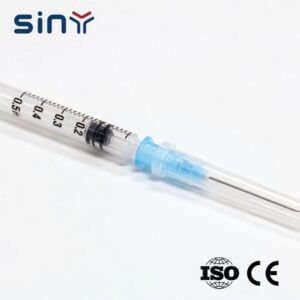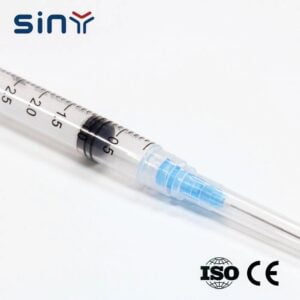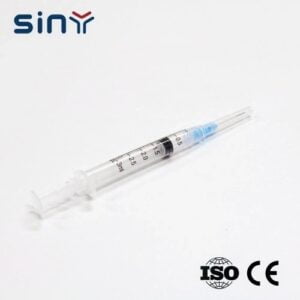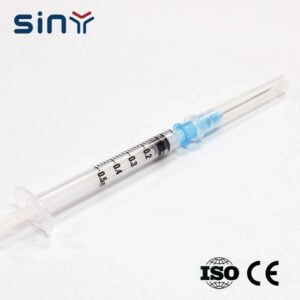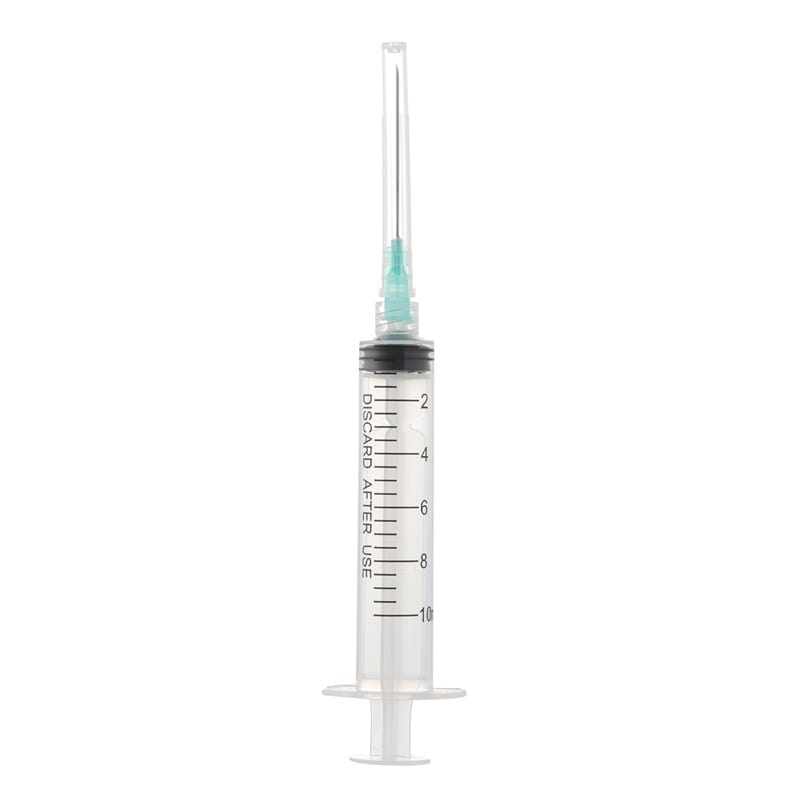
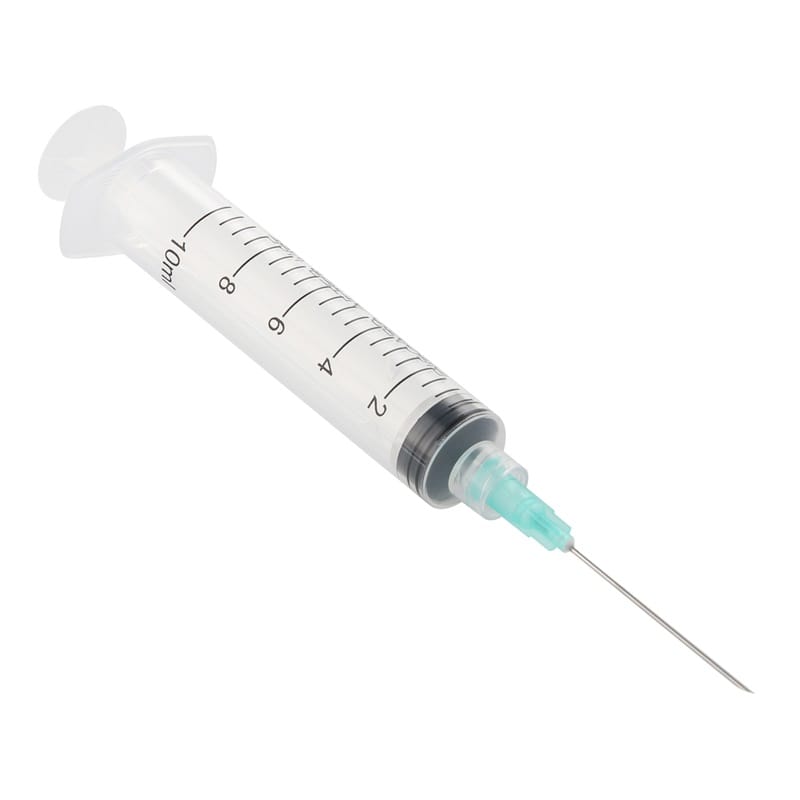
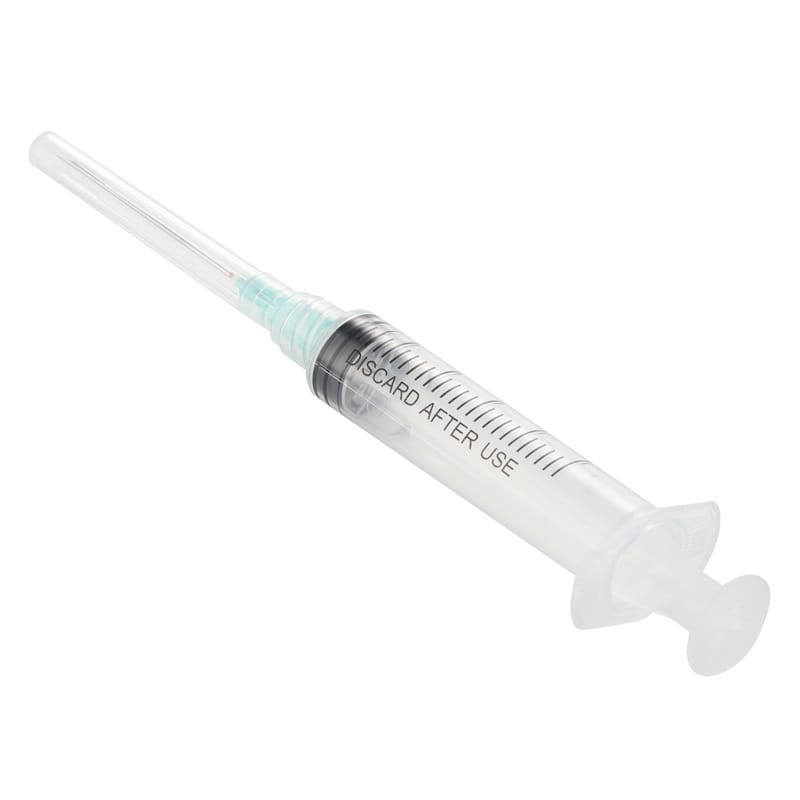
| Product Name | Self-Destructing Syringe |
| Material | PVC,PP |
| OEM/ODM | Yes |
| Certificate | CE,ISO |
| Usage | Hospital |
| Sterile | Ethylene Oxide Sterilization |
| Sample | Free |
| Service | In the groups we serve: distributors, import traders, government procurement, buying agents, and medical chain stores, we provide one-stop procurement for you to simplify your procurement process. |
Single-use syringe safety is not only about sterility before an injection. It also matters what happens after the syringe has completed its intended use. The 10ml Disposable Self-Destructing Syringe from Siny Medical combines a practical 10 mL capacity with a built-in anti-reuse design. After the syringe completes its intended single-use cycle, the self-destructing mechanism disables further normal reuse according to the product design.
This makes the syringe suitable for professional healthcare procurement where controlled single-use is an important requirement.
For hospitals, clinics, medical distributors, importers, government procurement programs, and OEM buyers, the product offers a clearly defined combination:
10 mL capacity + disposable syringe + self-destructing anti-reuse mechanism.
A standard disposable syringe depends on correct user behavior to prevent reuse.
A self-destructing syringe adds a mechanical anti-reuse feature.
The built-in mechanism is designed to disable normal syringe reuse after the intended injection cycle. This provides an additional physical control beyond the printed “single use” instruction.
For procurement teams, this distinction is important.
A conventional disposable syringe and a self-destructing syringe may look similar before use. However, their post-use functionality is different.
Therefore, buyers who specifically require an anti-reuse syringe should include that requirement in their purchasing specification.
For this product, the core specification is:
10 mL Disposable Self-Destructing Syringe
The self-destructing feature is integrated into the syringe mechanism.
During normal operation, the professional user draws or prepares the required fluid and completes the intended injection or fluid-delivery procedure.
After the designed use cycle, the internal mechanism disables normal reuse of the syringe.
Depending on the specific product structure, an auto-disable system can restrict further plunger operation or otherwise render the syringe unsuitable for another normal injection cycle.
This differs from relying only on a label that states “single use.”
The design provides a physical anti-reuse function.
However, professional users should still follow the instructions supplied with the final product configuration. They should not attempt to override, reset, or reuse the mechanism.
Syringe capacity should match the intended procedure.
A 10 mL syringe provides more fluid capacity than smaller 1 mL, 3 mL, or 5 mL formats. At the same time, it remains more compact than larger 20 mL or 50 mL syringes.
This makes 10 mL a useful specification for medical workflows that require a moderate fluid volume.
Potential professional applications can include compatible procedures involving:
The exact application depends on the medication, procedure, needle or connector configuration, and professional protocol.
Therefore, buyers should select the 10 mL format because it matches the required volume range, not simply because a larger syringe appears more versatile.
A syringe is both a delivery device and a measuring device.
Clear graduations help healthcare professionals observe the fluid volume during preparation and administration.
The 10 mL format provides enough barrel space for procedures that require a moderate quantity of fluid.
However, syringe size should always match the required dose or transfer volume.
Using a syringe that is unnecessarily large can make small-volume measurement less practical.
Likewise, using a syringe that is too small may require repeated filling.
For procurement teams, the goal is therefore not to choose the largest syringe available.
The better approach is to match syringe capacity to the intended workflow.
Both products are intended for single use.
The main difference is the anti-reuse mechanism.
A standard disposable syringe generally relies on correct handling and immediate disposal after use.
A self-destructing syringe adds a built-in mechanism designed to prevent normal reuse after activation.
This distinction can be useful in healthcare procurement programs that place additional emphasis on injection safety and control of syringe reuse.
However, a self-destructing mechanism does not remove the need for correct disposal.
After use, the syringe still needs to enter the appropriate medical waste or sharps disposal stream according to local procedures.
The anti-reuse mechanism and proper disposal work together. They do not replace each other.
These two terms should not be treated as synonyms.
A self-destructing or auto-disable syringe primarily focuses on preventing the syringe from being reused.
A retractable safety syringe focuses on controlling the exposed needle after use through a needle-retraction mechanism.
Some syringe designs may combine several safety functions. However, buyers should never assume that every self-destructing syringe automatically includes needle retraction.
This matters when writing procurement specifications.
If the requirement is primarily:
Prevent syringe reuse → specify a self-destructing or auto-disable syringe.
If the requirement is:
Retract or shield the needle after injection → specify the required retractable or needle-safety mechanism.
For this page, the primary product position is single-use anti-reuse control.
A safety needle and a self-destructing syringe also address different risks.
A safety needle may use a shield, cover, retraction feature, or another mechanism intended to reduce exposure to the needle after use.
A self-destructing syringe addresses repeated syringe use.
Therefore, the term “safety syringe” can be too broad when preparing a quotation.
Professional buyers should state the exact feature they require.
For example:
Clear specifications reduce confusion between products that may otherwise look similar in a catalog.
Disposable syringes are designed for one procedure and one patient according to their intended use.
Reuse can create serious contamination and infection-control concerns.
A self-destructing design adds a mechanical barrier that helps prevent another normal use after the syringe has completed its intended cycle.
This feature can support healthcare programs that want stronger control over single-use injection devices.
It is particularly relevant for institutional purchasing because safety requirements need to remain consistent across large quantities of devices.
However, no mechanical feature replaces professional infection-control procedures.
Healthcare workers should still follow applicable requirements for:
The syringe is one element within the full injection-safety workflow.
Hospitals and clinics use syringes in many different departments.
A 10 mL self-destructing syringe can fit workflows where both moderate fluid capacity and anti-reuse control are required.
Possible purchasing environments include:
The exact clinical use should always match the final syringe configuration and professional procedure.
For institutional buyers, consistent specifications are especially important.
A purchasing team should confirm the capacity, connection type, needle configuration, packaging, and self-destructing mechanism before placing a bulk order.
Auto-disable syringes are often associated with immunization programs because reuse prevention is an important injection-safety consideration.
However, syringe size must match the intended dose and program specification.
A 10 mL syringe is not automatically the appropriate choice for vaccination simply because it has a self-destructing mechanism.
Many vaccine doses use much smaller volumes.
Therefore, buyers should select the syringe capacity according to the vaccine, dosing requirements, and applicable immunization program specifications.
If a program specifically requires a smaller auto-disable syringe, buyers should select the corresponding size rather than substituting a 10 mL product.
This page focuses on the 10 mL configuration.
The current product belongs to a three-part syringe range.
A typical three-part syringe structure includes:
The barrel provides the fluid chamber and graduation scale.
The plunger moves within the barrel during fluid drawing and delivery.
The piston supports contact and movement between the plunger and barrel.
The final supplied configuration should always be confirmed before ordering, especially when buyers have requirements concerning piston material, needle supply, or connector type.
This is more reliable than assuming every 10 mL syringe has an identical component configuration.
The syringe barrel needs to provide clear volume visibility during professional use.
The plunger should also move according to the intended syringe design while allowing the user to control fluid movement.
For bulk buyers, component consistency is an important purchasing factor.
Small differences in barrel molding, graduation printing, plunger fit, and assembled components can affect the user experience.
Therefore, distributors should evaluate the complete syringe rather than focusing only on nominal capacity.
The self-destructing mechanism adds another important component to this system.
Its operation should remain consistent with the intended single-use design.
The old version of this product page grouped Luer Lock and Luer Slip configurations together.
However, the connection system should be treated as a separate purchasing specification.
A Luer Lock connection uses a twisting lock arrangement to secure a compatible needle or connector.
A Luer Slip connection uses a push-fit connection.
Neither option should be assumed from the 10 mL capacity alone.
Therefore, buyers should confirm the required connection before production.
A useful order description can include:
10 mL + Self-Destructing + Luer Lock
or
10 mL + Self-Destructing + Luer Slip
depending on the available product configuration and customer requirement.
This approach keeps the page focused on 10 mL self-destructing syringes while still allowing connection options to be discussed separately.
The current Siny Medical product information lists ethylene oxide sterilization.
The syringe is intended for single use.
Before use, healthcare professionals should inspect the individual package according to their normal procedure.
Do not use the product if the package is damaged or if package integrity is uncertain.
After the syringe has been used, it should not be reused.
The activated self-destructing mechanism also should not be modified or bypassed.
Professional users should dispose of the syringe according to applicable sharps and medical waste requirements.
It is important to separate two safety concepts.
A self-destructing syringe helps address reuse.
It does not automatically mean that the needle becomes covered or inaccessible after use.
Therefore, healthcare workers must still handle the needle carefully unless the supplied product configuration includes a separate needle-safety mechanism.
Used needles should enter an approved sharps disposal process according to local requirements.
This distinction makes product descriptions more accurate.
It also helps procurement teams choose the correct device when both reuse prevention and post-injection needle protection are required.
Start with the required fluid volume.
First, confirm that 10 mL matches the intended procedure.
Next, verify that the purchasing specification requires a self-destructing or auto-disable mechanism.
Then, confirm the connection type.
Buyers should also determine whether the syringe is required with or without a needle.
Before ordering, check:
This information allows the supplier to confirm the correct configuration.
It also prevents confusion with conventional disposable syringes or other safety syringe types.
The final syringe configuration should match the intended application and purchasing requirements.
Depending on the confirmed product configuration, available requirements can include syringe connection, needle configuration, labeling, individual packaging, carton marking, and other packaging details.
Specifications should be confirmed before production.
Contact Siny Medical with your required 10 mL self-destructing syringe configuration, quantity, packaging, and labeling requirements for more product information or a quotation.
A 10ml self-destructing syringe is a disposable syringe with a 10 mL capacity and a built-in mechanism designed to prevent normal reuse after its intended single-use cycle.
It refers to a syringe that incorporates an anti-reuse mechanism. After the intended use cycle, the mechanism disables further normal use according to the syringe design.
The terms are often used for syringe designs that prevent reuse. However, the exact mechanism can vary between products. Buyers should confirm the required design before ordering.
Yes. This product page specifically focuses on the 10ml Disposable Self-Destructing Syringe.
A 10 mL format can suit professional procedures that require a moderate fluid volume. The correct capacity should always match the medication, procedure, and professional protocol.
No. It is designed for single use and incorporates a mechanism intended to prevent normal reuse.
Not necessarily. Anti-reuse and needle retraction are different safety functions. Buyers who require needle retraction should confirm a retractable syringe configuration separately.
The self-destructing function primarily prevents reuse. It does not automatically eliminate exposure to an attached needle. Proper sharps handling and disposal remain necessary.
Needle configuration should be confirmed with Siny Medical before ordering. Buyers should state clearly whether they require the syringe with or without a needle.
Connection options should be confirmed according to the final product configuration. Buyers should include the required connection type in their inquiry.
The current product information places the 10 mL model within a three-part syringe range. Buyers should confirm the final product construction before placing an order.
The current Siny Medical product specification lists ethylene oxide sterilization.
Capacity should match the vaccine dose and program requirements. A self-destructing mechanism alone does not make a 10 mL syringe appropriate for every vaccination procedure.
After use, follow applicable healthcare-facility procedures and local requirements for sharps and medical waste disposal.
Yes. Medical distributors, hospitals, importers, institutional procurement programs, and other professional buyers can discuss bulk supply with Siny Medical.
OEM/ODM requirements can be discussed according to the confirmed syringe configuration, quantity, packaging, labeling, and destination market.
Selecting a self-destructing syringe requires more than choosing a disposable syringe and adding a safety label.
Buyers need to confirm the capacity, anti-reuse mechanism, connection type, needle configuration, packaging, and intended professional workflow.
The 10ml Disposable Self-Destructing Syringe from Siny Medical provides a capacity-specific option for buyers who require a moderate-volume syringe with built-in reuse control.
The purchasing specification can remain simple:
10 mL + Self-Destructing Mechanism + Required Connection + Required Needle Configuration
This makes quotations easier to compare and reduces confusion with standard syringes, retractable safety syringes, and other auto-disable products.
For wholesale, institutional procurement, OEM, or private-label requirements, contact Siny Medical with your required configuration, quantity, packaging, labeling, and destination market to request a quotation.
Copyright © 2026 | Ningbo Siny Medical Technology Co., Ltd