Modern laboratories depend on precision, reproducibility, and efficiency. Among the most widely used consumables in cell biology and microbiology labs are 96 Well Tissue Culture Plates. These plates allow researchers to culture, treat, and analyze cells in a standardized format that supports high-throughput workflows.
Whether you are performing drug screening, cytotoxicity assays, ELISA tests, or viral studies, 96 Well Tissue Culture Plate remain a foundational lab tool. Their uniform well structure, tissue-culture-treated surfaces, and compatibility with automated systems make them indispensable in clinical, academic, and pharmaceutical laboratories.
At Siny Medical, high-quality laboratory plasticware is designed to support reliable research outcomes. Understanding what 96 Well Tissue – Culture Plates are—and why they matter—helps labs select the right consumables for accurate and efficient experiments.
Table of Contents
- 0.1 What Are 96 Well Tissue Culture Plates?
- 0.2 Why Are 96 Well Tissue Culture Plates So Important?
- 0.3 Structure and Design of 96 Well Tissue Culture Plates
- 0.4 Applications of 96 Well Tissue Culture Plates
- 0.5 96 Well Tissue Culture Plates vs Other Culture Formats
- 0.6 Advantages of Using 96 Well Tissue Culture Plates
- 0.7 Manufacturing Standards and Sterility
- 0.8 Types and Variations of 96 Well Plates
- 0.9 Proper Handling and Usage Techniques
- 0.10 Choosing the Right Supplier
- 1 Summary
- 2 FAQs
What Are 96 Well Tissue Culture Plates?
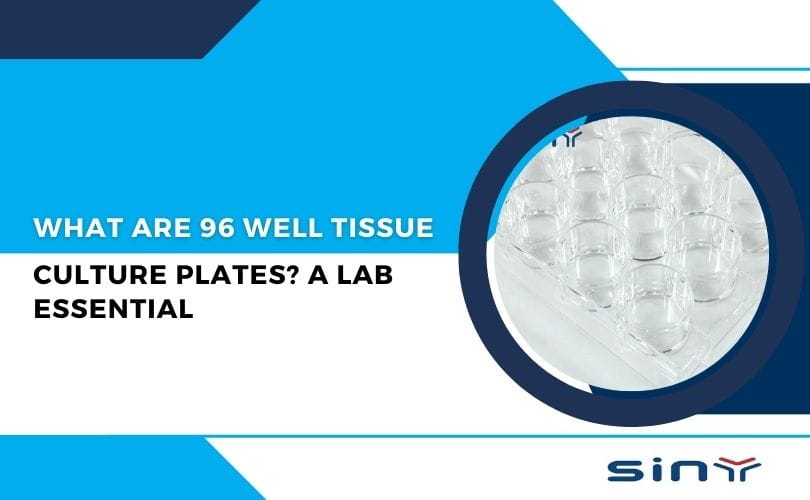
96 Well Tissue Culture Plates are rectangular laboratory plates made from medical-grade polystyrene. Each plate contains 96 individual wells arranged in an 8×12 grid. Researchers use these wells to grow and maintain cells under controlled laboratory conditions.

Unlike standard plates, tissue culture plates undergo surface treatment. This process modifies the plastic to promote cell attachment, spreading, and proliferation. As a result, adherent cell lines can grow efficiently on the treated surface.
These plates are typically:
- Sterile and individually packaged
- DNase/RNase free
- Pyrogen-free
- Designed for consistent optical clarity
The popular 96 Well Cell Culture Plate – Flat Bottom is widely used in research labs because flat-bottom wells allow uniform cell growth and accurate optical density readings.
Why Are 96 Well Tissue Culture Plates So Important?
High-throughput experiments demand consistency. Researchers often test dozens of variables in a single run. 96 Well Tissue Culture Plates allow scientists to perform multiple replicates, treatments, and controls within one plate.
According to data published by the National Institutes of Health (NIH), high-throughput screening platforms can test thousands of compounds per day. The 96-well format remains one of the most widely used microplate configurations because it balances throughput with manageable reagent volume.
Here is why these plates matter:
- Standardization: The 96-well format follows ANSI/SLAS microplate standards.
- Efficiency: Researchers use smaller reagent volumes, reducing costs.
- Compatibility: Most plate readers, incubators, and automation systems support 96-well plates.
- Scalability: Labs can scale experiments from 6-well or 12-well plates to 96-well plates seamlessly.
For laboratories exploring viral replication studies—including research related to a virus—the 96-well format provides controlled and reproducible environments.
Structure and Design of 96 Well Tissue Culture Plates
Understanding the design of 96 Well Tissue Culture Plates helps researchers choose the right configuration.
Plate Material
Most plates use optically clear polystyrene. This material allows easy microscopic observation and accurate spectrophotometric readings.
Surface Treatment
Tissue culture treatment enhances hydrophilicity. This chemical modification supports strong attachment of adherent cells such as fibroblasts and epithelial cells.
Bottom Shapes
Different experiments require different well bottoms:
| Bottom Type | Best Used For | Advantage |
|---|---|---|
| Flat Bottom | ELISA, cell viability assays | Uniform optical readings |
| U-Bottom | Suspension cultures | Easy pellet formation |
| V-Bottom | Centrifugation-based assays | Concentrated sample collection |
Flat-bottom 96 Well Tissue Culture Plates remain the most common choice for cell-based assays.
Applications of 96 Well Tissue Culture Plates
Cell Proliferation and Viability Assays
Researchers frequently use 96 Well Tissue Culture Plates for MTT, XTT, and WST assays. These colorimetric tests measure metabolic activity. Flat wells ensure even cell distribution, which improves data accuracy.
Drug Screening and Toxicity Testing
Pharmaceutical companies rely heavily on 96-well plates. Drug screening often involves testing multiple concentrations across replicates. The standardized format simplifies data comparison.
ELISA and Immunoassays
Although ELISA plates are often pre-coated, tissue culture plates can support certain immunological experiments. Uniform well geometry ensures reliable absorbance readings.
In virology labs, researchers infect cultured cells in 96 Well Tissue Culture Plate to study cytopathic effects. For bacterial culture comparisons, labs often complement microplate testing with traditional tools such as Petri dishes.
If you are new to microbiology, you may find it helpful to read What is a Petri Dish? or explore Why Use Petri Dishes? for a broader understanding of culture methods.
96 Well Tissue Culture Plates vs Other Culture Formats
Laboratories often choose between different well formats. Here is a comparison:
| Plate Type | Wells | Volume per Well | Typical Use |
|---|---|---|---|
| 6-Well Plate | 6 | 2–5 mL | Large-scale cell culture |
| 24-Well Plate | 24 | 0.5–2 mL | Medium-scale experiments |
| 48-Well Plate | 48 | 0.3–1 mL | Balanced throughput |
| 96 Well Tissue Culture Plates | 96 | 100–300 µL | High-throughput assays |
The 48 Well Cell Culture Series Tissue Plate offers a middle ground. However, when throughput matters most, 96 Well Tissue Culture – Plates provide superior efficiency.
For a broader overview of available options, visit the Cell Culture Plate category
Advantages of Using 96 Well Tissue Culture Plates
Reduced reagent consumption: Smaller well volumes lower costs.
Improved consistency: Standard well dimensions enhance reproducibility.
Automation compatibility: Robotic liquid handlers integrate easily.
Enhanced data collection: Microplate readers provide rapid, precise measurements.
Many labs also use complementary products like Tissue Culture Vessels for scaling experiments before transitioning to 96-well formats.
Manufacturing Standards and Sterility
Quality plays a crucial role in laboratory consumables. Poor-quality plates may cause inconsistent cell attachment or contamination.
High-grade 96 Well Tissue Culture_Plates should meet these standards:
- Manufactured in cleanroom environments
- Gamma sterilized
- Free from endotoxins
- Certified non-pyrogenic
Manufacturers such as Siny Medical maintain strict quality control systems to ensure product reliability. You can also explore international listings through platforms like https://sinymedical.en.made-in-china.com/ to review product specifications.
Types and Variations of 96 Well Plates
While all 96 well tissue culture-plates share the same basic configuration, variations exist to accommodate different experimental requirements. The most significant distinction lies in surface treatment—tissue culture treated (TC) plates feature modified surfaces that promote cell adhesion, making them ideal for adherent cell lines. In contrast, untreated plates work better for suspension cultures where cells should remain floating in the medium.
Color variations serve specific purposes as well. Clear plates allow for direct microscopic observation and are essential for assays requiring visual monitoring. White plates optimize luminescence and fluorescence detection by reflecting light, while black plates reduce well-to-well crosstalk in fluorescence assays by absorbing stray light.
Manufacturers also offer specialized plate formats with unique features. Some plates incorporate raised well rims to prevent cross-contamination, while others feature lids with condensation rings to maintain proper humidity. Advanced designs include barcoding for sample tracking and alphanumeric well labeling for easier identification.
For laboratories requiring different capacities, variations in well depth and volume exist. Deep well plates accommodate larger volumes and are useful for sample preparation, while shallow wells work better for optical measurements. Researchers can select from options like those available at Siny Medical’s product page to find the perfect match for their specific applications.
Proper Handling and Usage Techniques
Achieving reliable results with 96 well tissue culture-plates requires proper handling techniques. Begin by working in a clean environment, preferably under a laminar flow hood, to prevent contamination. Always use sterile pipette tips and change them between wells to avoid cross-contamination between samples.
When adding cells or reagents, aim for consistency in volume across all wells. Even small variations can significantly affect experimental outcomes, especially in quantitative assays. Many researchers use multichannel pipettes or automated dispensing systems to ensure uniformity across the plate.
Temperature control proves critical during plate handling. Before adding cells, allow plates to reach room temperature to prevent condensation formation that could affect well volumes. After seeding cells, minimize the time plates spend outside the incubator to maintain consistent growth conditions.
Proper sealing of plates prevents evaporation, particularly in edge wells which are more susceptible to volume changes. Options include adhesive seals, breathable membranes, or specialized lids. The choice depends on the specific assay requirements and incubation duration.
When working with 96 well tissue culture_plates, maintaining consistent conditions across all wells becomes paramount. Avoid placing plates directly on cold surfaces that could create temperature gradients. Similarly, ensure even distribution when incubating plates to prevent position effects that might influence results.
Choosing the Right Supplier
When sourcing 96 Well Tissue Culture Plate, laboratories should evaluate:
- Surface treatment quality
- Sterility assurance level
- Optical clarity
- Packaging integrity
- Certification documentation
Siny Medical provides reliable laboratory consumables backed by strict quality control. For product inquiries, laboratories can connect directly through the Contact Page.
You can also follow product updates and demonstrations via the official YouTube channel: www.youtube.com/@sinymedical.
Summary
96 Well Tissue Culture Plates serve as a cornerstone of modern laboratory research. Their standardized 8×12 format, tissue-culture-treated surfaces, and compatibility with automated systems make them ideal for high-throughput experiments. From drug discovery to viral research, these plates deliver efficiency, accuracy, and reproducibility.
Laboratories seeking dependable consumables should prioritize quality, sterility, and manufacturing standards. With proper use and sourcing, 96 Well Tissue Culture Plate will continue to support scientific innovation across biomedical and clinical research fields.
FAQs
1. What are 96 Well Tissue Culture Plates used for?
Researchers use 96 Well Tissue Culture Plates for cell culture, drug screening, cytotoxicity testing, ELISA, and viral assays. Their standardized format allows multiple experiments in one plate.
2. Why are 96 Well Tissue Culture Plates surface treated?
Manufacturers treat 96 Well Tissue Culture-Plates to improve cell adhesion. The hydrophilic surface supports the attachment and growth of adherent cell lines.
3. How much volume does each well hold in 96 Well Tissue Culture_Plates?
Most 96 Well Tissue Culture Plate hold approximately 100–300 µL per well, depending on the manufacturer and well design.
4. Can 96 Well Tissue Culture Plate be reused?
No. 96 Well Tissue Culture_Plate are designed for single use to maintain sterility and prevent cross-contamination.
5. How do 96 Well Tissue Culture Plate compare to 48-well plates?
96 Well Tissue Culture Plate allow higher throughput and use smaller reagent volumes compared to 48-well plates, making them more efficient for screening assays.